Showing posts with label Arnolfini. Show all posts

Sunday, 19 March 2017

Notes of Alignment. [3. veneration of the book]


The first book I remember seeing was the sacred book, at Mass; it had been placed in full view on the altar, and the priest turned the pages with great respect. My first book was therefore an object of worship. (Carriere, p.294)

An icon of Christ in an antique shop in Thessaloniki (Photograph: Patrick Comerford, 2011)


Ley lines mark alignments formed by sacred sites or sites of spiritual significance. Arnolfini Ley is a reading line, which runs between the Library of Trinity College in Dublin and the Library of Alexandria, connecting book related sites: special locations marked by the book - a very material object of spiritual veneration.
 
Book, indeed, is an ambiguous object, reliant on the reader to transform it from an object to an abject. Its existence is defined not solely by its physical presence, but also by its immaterial content: book can be a heavy volume of the Bible as well the sacred word of God it contains; it can be an intricately luxurious Sangorski binding and the ethereal rubaiyats of Omar Khayyám included into it. Holding the book allows us to admire it as an object. Reading, however, allows transmission of the intangible between the book and the person. 


Rubaiyat of Omar Khayyam. Fitzgerald, Edward; Illustrated by F. Sangorski and G. Sutcliffe.

Levantine Jews were the first to turn the act of reading into a ritual, the practice, which will later be picked up by Christians and make the base of Christian liturgy.
Babylonians and Assyrians had greatly respected magical texts. […] The respect had never entailed veneration of the written word itself, that is, the sanctification of writing and its physical material. The Levantine Jews introduced just such a sanctification, thereby adding a whole new dimension to reading. (Fischer, p 60)

In discussing ritualistic reading of Leviticus, Wesley J. Bergen suggests, that reading can even replace ritual sacrifice. Text, he says, is not a ritual. It is a text about ritual and it is a sign of absent ritual. It was written to be read and performed, to encourage participation.  Like in the contemporary Christian liturgy, “text becomes part of sacred space and time, the reading of the text becomes part of the ritual.”
Thus, the ritual “reading” Leviticus’ becomes a subsitute for the ritual animal sacrifice. […] Thus, the textualisation of the ritual is balanced by the ritualisation of the text. The command by God to Moses (to speak these words) is fulfilled even while no animals are killed. The movement from animal sacrifice to reading of texts involves some loss and some gain, as all change does. So there is no loss of ritual, only it’s transformation. (Bergen, p7)

Book as embodied word of God existed throughout the Middle Ages at the center of Christian ritual. Heavily adorned Bibles, often containing relicts of the saints, were seen as incarnations of Christ himself. Early parchment bindings must have made the “body of Christ” metaphor even more visual: the books were made of animal skins, with pores visible on the surface of the page along the words God. There is certainly something macabre yet sublime in having earthly flesh support the holy scripture.
The analogy between the body of Christ and the letter of scripture would become a Christian commonplace, leading to a long Christian tradition that attempted to apprehend the mystery of Christ as Word through visions of Christ as book. (Kearney, p. 14)
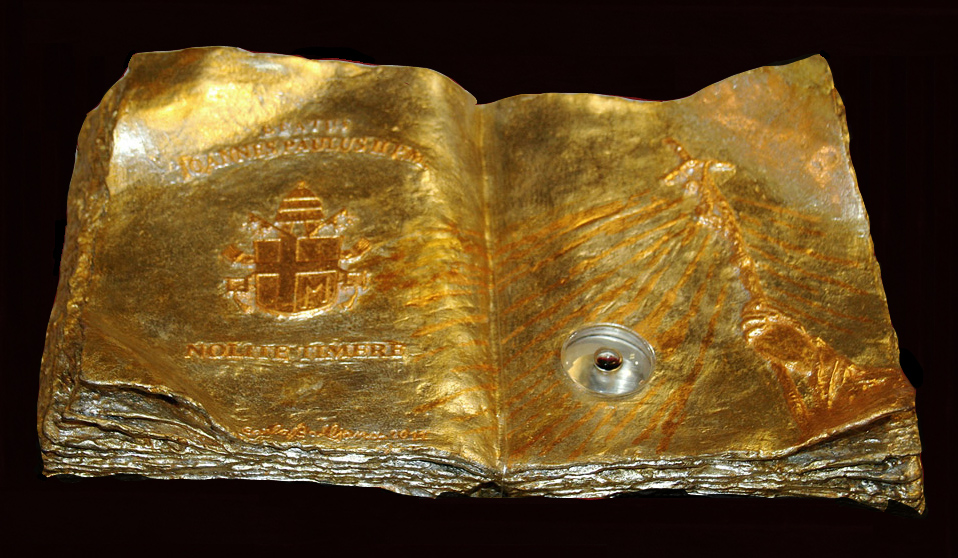
First class relic of Saint Pope John Paul II incased in a Golden Bible
Curiously, I found the idea of incarnate Word explicitly reinforced as as recently as 1965,  by Pope Paul VI in Dei Verbum ( the Second Vatican Council).
The Church has always venerated the divine Scriptures just as she venerates the body of the Lord, since, especially in the sacred liturgy, she unceasingly receives and offers to the faithful the bread of life from the table both of God's word and of Christ's body. She has always maintained them, and continues to do so, together with sacred tradition, as the supreme rule of faith, since, as inspired by God and committed once and for all to writing, they impart the word of God Himself without change, and make the voice of the Holy Spirit resound in the words of the prophets and Apostles. (Dei verbum

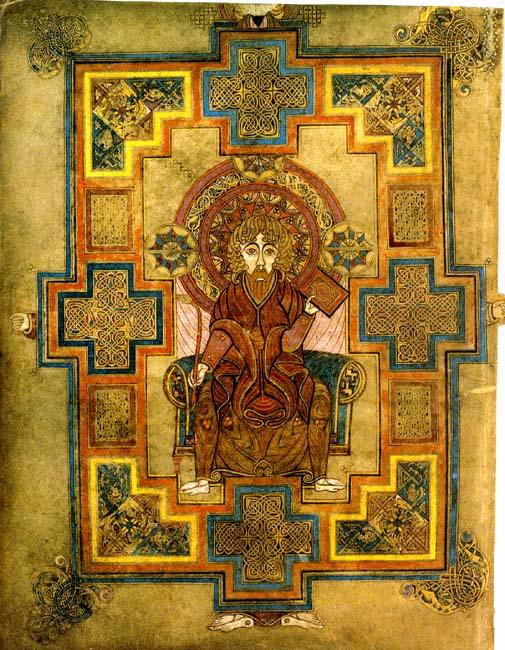
A good example of a ritual book is the Book of Kells, currently kept at the the Library of Trinity College in Dublin, our first point on Arnolfini Ley. This elaborately produced manuscript was produced with the purpose of it being displayed and worshiped. The book remained in Kells through Middle Ages, venerated as the gospel of St Colum Cille, a relic of the saint, brought to Kells together with another book (possibly Book of Durrow) (Library of Trinity College Dublin). The current binding of the Book of Kells exists as four  volumes. The original, however, was one heavy and substantial object. Not unlike religious architecture, such book was not meant to be carried around. It was also not designed to be used for study or even reading. Like churches and cathedrals, which housed such manuscripts, medieval altar Bibles were there to evoke awe and reverence, elated to an ineffable and noetic religious experience. They were mediators between the God and the man, in the same way that other icons, relicts, and the the church itself were.


The Book of Kells

It was Reformation that shook up the idea of book as a venerated gilded icon: a process that led Christianity from piety focused upon image to piety focused upon word (Kearney, p. 25) As Erasmus said - scripture and not picture should be at the center of religious experience. Reformation, of course, overlapped with the invention of printing press and a remarkably rapid growth of available printed texts across Europe as well as the spread of literacy.  While Kearney calls this period "the crisis of the book”, it was a period of crisis only in understanding of its the place in faith and liturgy.  Reading is a transformative act, powerful enough to convert reader to “true religion” (the reader can be easily corrupted, of course). Seemingly, it was in this period that veneration of the ineffable content of the book overtook veneration of book as an icon. It is not a viewer in the presence of the scripture that benefits from the book, it is the reader.
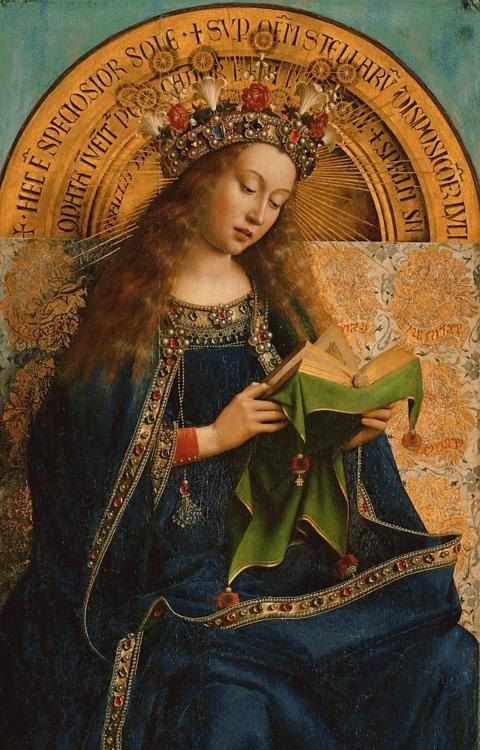
Veneration of the book needs an active reader, to transform it from an object to an abject. Adoration is not directed purely at the material qualities of the book, but at the noetic aspects of the experience. Like sacred sites, relics, cathedrals (or even, us, people)  books stand not only as solid structures, but also as embodiments of the metaphysical ideas and experiences.

[Egidija]

At a Book (c.1882). Marie Bashkirtseff (Ukrainian, 1858-1884). Oil on canvas. Kharkiv Art Museum.


PS
There is an interesting story which takes worship of the Word of God one step further, bridging it into veneration of any material text.
Ernst Curtius records an anecdote concerning Francis of Assisi in which “the saint picked up every written piece of parchment which he found on the ground, even if it were from a pagan book. Asked by a disciple why he did so, Francis answered: “Fifi me, litteme sum ex quibus componitur gloriosissimum Dei nomen. [My son, these are the letters out of which the glorious name of God is formed].” Here, the incarnation of the logos means that all language - fragments of text, scraps of parchment - has been glorified. Writing itself is sacred. (Kearney, p15)


SOURCES:
Bergen, Wesley (2005) Reading Ritual: Leviticus in Postmodern Culture.  New York: T & T Clark International
Carriere, Jean-Claude; Umberto Eco (2009) This is not the End of the Book. London: Harvill Secker
Dogmatic Constitution on Divine Revelation: Dei Verbum: Solemnly Promulgated by His Holiness Pope Paul V on November 18, 1965 [Online]. Available at http://www.vatican.va/archive/hist_councils/ii_vatican_council/documents/vat-ii_const_19651118_dei-verbum_en.html   (Accessed:  19 March 2017)
Fisher, Steven Rodger (2003) A History of Reading. London: Reaktion Books.
Kearney, James (2009) The Incarnate Text: Imagining the Book in Reformation England. Philadelphia: University of Pennsylvania Press.
The Book of Kells [Online]. Available at https://www.tcd.ie/library/manuscripts/book-of-kells.php     (Accessed:  19 March 2017)


Tuesday, 7 March 2017

Notes on the Ley - Arnolfini

The Arnolfini reading room is housed on the third floor of the Arnolfini gallery in Bristol. It is the second stop on the Arnolfini Ley. 

the Arnolfini reading room A

The Arnolfini was established in 1961 as a site ‘…where all the contemporary arts could coexist and interact in order to stimulate creativity, to provoke thought and to give pleasure to a wide range of people.’1

Bristol, Acraman's Quay B

A 1929 aerial photograph of Bush House B

It moved to its current site Bush House in 1975. Bush house was built in the early 1830s for Acraman Bush Castle & Co, for use as a tea warehouse which quickly failed. It was later used for iron and tin plate storage and expanded in the later 1830’s. By 1842 Acraman became bankrupt and in 1846 the building was occupied by George and James Bush, bonded warehouse keepers. Their company remained until the late 1960s and gave Bush house its name.2

Bush House in 1971 C

The Arnolfini gallery took its name from Jan van Eyck's fifteenth century painting The Arnolfini Portrait.1

The Arnolfini Portrait - Jan van Eyck, 1434 D

The Arnolfini Portrait is one of the earliest paintings to assert the presence of the artist within its depiction and links to Arnolfini's consistent concerns: to explore the role of artist as a witness and recorder of what is around them.3 This is an interesting side note that ties in to part of our project. The presence of the body and making you aware of it, is a part of the reason we are exploring reading spaces along the Ley. The act of reading and referencing that act, by drawing your attention to the body, through the hands, is an interesting part of the reading process and draws similarities with the Arnolfini Portrait. Where the Arnolfini Portrait references the artist as 'creator', our project references the hands as 'creator' and more importantly 'activator' of content. This process of the hands relationship through the book and the repeated actions of reading we have seen already at the Trinity College Library Dublin, through the devotional Book of Kells.  

the Arnolfini reading room A

We will take up residency in the reading room, which will become the focus of the Arnolfini Ley during BABE. The reading room is a space that houses a collection of contemporary art books, magazines and other resources that relate to the Arnolfini’s current programme. It is a space where ideas behind the exhibitions and events centre. Like a supplement to the visual art and events that appear throughout the gallery spaces, the reading room acts in the same was as an ‘orrery’. With an exhibition as a point at the centre, thoughts move around this point to add depth and understanding to the whole exhibit. 

A repeated action here is the action of acquiring knowledge, with a specific aim to be read. It is how, I think we came to be drawn to this part of the Ley. The centring of knowledge around a specific event such as BABE, gives the reading room an important role. Allowing us to explore and explain our thoughts around the alignment project. Using the space to build up a collection of ideas that act in the spirit of the reading room. 

the Arnolfini gallery E


References

3 Hedley, Gill (May 2007). "Rees, Jeremy Martin". Oxford Dictionary of National Biography.


Wednesday, 1 March 2017

Notes on the Ley - The Trinity College Library, Dublin

A series of posts are going to run alongside the 'Notes of Alingnment' called 'Notes on the Ley' that explore the points of interest that run along the Arnolfini Ley. The line itself connects various sites of reading and book veneration amongst other interesting places. There are some fascinating connections that make the line interesting from a reading and book perspective. The acts of reading at these points give the Arnolfini Ley a synergy of gesture that we can tap into and explore.

The Long Room, Trinity College Library A

The first stop is the Trinity College Library in Dublin. Which has the stunningly iconic library space that is the Long Room. 

The Library was founded in 1592 with the founding of the College. The famous long room (pictured above) was built between 1712 and 1732 and houses 200,000 of the Library's oldest books. The Long Room originally had a flat ceiling and shelving for books only on the lower level.1 But by the 1850s the room had to be expanded as the current shelves were full. The Library was endowed with a Legal Deposit privilege in 1801, which meant (and still does) it received a copy of materials published in the United Kingdom and Ireland, vastly expanding the collection.2 

The Long Room, Trinity College Library as it existed before the extension. B


Altogether the Library houses over 6 million printed volumes with the most famous one being the Book of Kells, which was donated in 1661 by Henry Jones the then Vice Chancellor of Trinity College.2 

Folio 2r of the Book of Kells C

Folio 291v contains a portrait of John the Evangelist. D

The Book of Kells is an illuminated manuscript of the four Gospels of the New Testament in latin and believed to have been created c. 800 AD. 

The manuscript takes its name from the Abbey of Kells in Kells, County Meath, where it was kept for centuries.3 The book is thought to have had a more sacramental rather than educational purpose. In this sense, it would have been used more as a venerated object and as the focus of sacred and devotional events within the abbey. It would have been placed on the high altar of the church and removed only for the reading of the Gospel during Mass.4

The book can be viewed online in full here: http://digitalcollections.tcd.ie/home/index.php?DRIS_ID=MS58_003v

Although this book no longer exists in a church it is interesting that it would appear on the Arnolfini Ley. The Arnolfini Ley came about from the reading and reverence of books and the repeated actions of reading that exist along it. Nothing typifies this reverence than a book made for ceremony. The intense focus upon the repeated act of reading has found its place on the Arnolfini Ley and brings the Trinity College Library in alignment with the other points. Even today the book is visited and read by people almost as a pilgrimage. It has become the focus and centre of the Long Room from which the Ley radiates out from. 


Roger Powell rebinding the Book of Kells E

A repeated act that is also to note and concerns the hands relationship to the book and the repeated actions that they produce, is in its binding. By its very nature the act of reading is destructive and to preserve the book it has had to be rebound. Sometimes for better and sometimes for worse. A destructive rebind in the 19th century saw the book drastically reduced in size and its edges trimmed and gilded.5 


Roger Powell talking about binding F

More recently in the 1950s the book of Kells was rebound from one into four volumes by bookbinder Roger Powell to stretch and preserve several pages that had developed bulges.3 This rebinding has changed the experience of the book. Its pace though reading and handling and through the movement of hands. Even now as it lies on display in the Trinity College Library only two copies are out at any one time. Though they can't be held, they can be read next to each other and the reading of it in this way has transformed its whole appreciation. 

[George]


References

1 "Book of Kells - The Old Library & the Book of Kells Exhibition : Trinity College Dublin, The University of Dublin, Ireland". Tcd.ie. 2014-12-04
2 http://www.tcd.ie/library/about/history.php
3 https://www.inyourpocket.com/dublin/Book-Of-Kells_34924v
4 Calkins, Robert G. (1983). Illuminated Books of the Middle Ages. Ithaca, NY: Cornell University Press. ISBN 0-8014-1506-3.
5 http://www.tcd.ie/library/manuscripts/book-of-kells.php

A https://en.wikipedia.org/wiki/File:Long_Room_Interior,_Trinity_College_Dublin,_Ireland_-_Diliff.jpg

B https://upload.wikimedia.org/wikipedia/commons/7/70/James_Malton_Trinity_College_Library_Dublin.jpg
C https://en.wikipedia.org/wiki/File:KellsFol005rCanonTable.jpg
D https://en.wikipedia.org/wiki/File:KellsFol291vPortJohn.jpg
E http://www.irishtimes.com/culture/heritage/from-the-archive-handled-with-care-and-great-dedication-1.2908763
F http://www3.hants.gov.uk/wfsa/sound/craft-recordings/bookbinder.htm


http://www.libraryireland.com/IrishPictures/I-2.php

https://www.flickr.com/photos/nlireland/6713554905

http://www3.slv.vic.gov.au/latrobejournal/issue/latrobe-46/fig-latrobe-46-052a.html


Wednesday, 15 April 2015

BABE 2015 - from behind the table


Our table in BABE 2015

Firstly I would like to say how impressed I was with #BABE2015 at the Arnolfini. The amount of visitors and variety of stalls was outstanding.

I would like to talk a bit about being behind the table and the chance of interacting with the public, also more importantly for them to interact with our books. I think it ties in quite nicely to the talk that we also gave at BABE entitled: 'codex: between one hand and another. A video and talk on the relationship between the reader, the book and the hand.'


We showed a video which we have been working on, where people where asked to close their eyes and talk about how the book feels. The book as an object. A still of which is above. Listening to people talk about their experiences was fascinating, as people filled the lack of sight with memories.

What is important for me as a book artist and sitting behind the table at BABE was watching people interact with the books. Experiencing and learning about them through touch. One of my books has interleaved pages which get turned over one by one. (See the images below). Watching how people approach it, pick it up and how it reveals itself to them though movement was for me really interesting. I know it sounds a bit cliche to say it, but it made me see the work in a new way. It is so easy to get caught up in the making of it, you get lost sometimes in the simplicity of things. I often wonder if people interact with the work in a way that I intended, as often my books rely on movement to convey their meaning. If people move them differently does it still convey the same thing?

'connected space' - George Cullen


The book structure is a familiar thing but when it is presented in a slightly different way, as in my book above, or in another example in some of my colleagues Egidija's work. It is an intriguing new experience that is fun to watch and be a part of. Some of Egidija's work on the table at the weekend (see below) were beautifully fragile and light. They came as unbound, folded loose sheets. The very nature of the super thin printed Japanese papers to float and catch in the wind, transformed these pieces when picked up, into a performance. There was a lightness in them that brought out a poetic romantic quality from the book, which spoke of the femininity of the paper coupled with the strength of the book structure. Something which, only as I watched people read them did I notice. 


'those frivolous readers' -  Egidija Čiricaitė

So if you are a book artists and have never been to a fair, I strongly recommend it. Having a table at BABE was a great way to critique your own work. For me at least it has sparked some thoughts in where I would like my work to progress. We make books to be read, so let people read them!

[George]