Showing posts with label Book Arts. Show all posts

Wednesday, 21 September 2016

Liberature : Literature in the Form of the Book (Sally-Shakti Willow)


a4285e0b-thumb 

Based in Krakow, Poland, Katarzyna Bazarnik and Zenon Fajfer are creating, curating, documenting and theorising a literary revolution : Liberature.  Since Fajfer coined the term in 1999 – which could be used not only to describe the kinds of works that he and Bazarnik were creating together but could also be applied retrospectively to works by writers such as James Joyce, Stephane Mallarme, William Blake and Laurence Sterne and equally applied to a range of more recent and contemporary works by writers such as B.S. Johnson and Jonathan Safran Foer – the couple have been prolific in producing, publishing and researching around this previously undocumented area of literary activity.
Katarzyna has published widely in academic contexts on Liberature, including the 2014 Incarnations of Material Textuality, and has a book forthcoming this year.  Zenon’s collected essays from 1999-2009 can be found here.  Together they edit and run the Liberature imprint at Krakow-based small publisher Korporacja Ha!art, which has published several notable works including the first publication in Poland of Raymond Queneau’s One Hundred Thousand Billion Poems, a specially-formatted version of Mallarme’s Un Coup de Des following the writer’s original directions for the text, and the first foreign translation of Nobel Prize winner Herta Muller’s Der Wächter nimmt seinen Kamm.  The Liberature imprint has also published works by B.S. Johnson, and publishes a range of liberatic works by Bazarnik and Fajfer themselves.

Liberature takes its name by replacing the Latin ‘liter’ (letter) with the Latin word for book, ‘liber’, which also means ‘free’.  

What distinguishes Liberature from literature is the focus on the form of the book as an integral element of communication within the structure of the whole.  Where generally the bound codex is rendered invisible – and in the digital age, almost obsolete – as simply the carrier of the message of the printed word, Liberature recognises and foregrounds the book’s physical materiality as a vital component of the literary work printed onto its pages.
What distinguishes Liberature from the Artist Book is that the primary focus is on the literary text in its relationship with the book object – the marriage of material form and literary content – where the Artist Book in general explores the possibilities of the book form without requiring specific literary content.
On 12th August, Joe and I met Katarzyna and Zenon at the Liberature Reading Room in Krakow where they showed us their collection and spoke about their work.  The Liberature Reading Room is a research resource housing books from their own personal collection, theoretical and scholarly publications, promotional material and press clippings, all related to contemporary and historical works that are considered to be works of liberature, or ‘liberatic’.

Liberature Reading Room, KrakowLiberature Reading Room, Krakow


The book for which the term was coined, Oka-leczenie (2000), is formed of three interlinked codices bound together – a deliberate decision to present a physical experience of the book’s content in material form.  Spanning the stories of a death, a birth and an intermediary period between the two, the book can opened at the beginning of any of the three codices which never end but open onto one another in an intentionally endless cycle. Thus the book is no longer an invisible component, subordinate to the text in the communication of meaning, or at least intention.  In a work of Liberature, the material structure of the book is employed as an integral dimension of communication in the design of the text as a whole.  This, for those who have attempted it, is a radical act that questions some deeply held assumptions.
The focus of Western literary production and its critical reception has overwhelmingly been on the words of the text, rather than the design of the book as an object.  This echoes the cultural prejudice that has traditionally valued the intellectual over the physical.  The physicality of the book remains invisible and unquestioned, as it has largely been the intellectual work of the writer in creating the text that has been most valued.  In this way, it’s become easy to ‘lose yourself’ in a good story – the physical act of turning the pages becomes no interruption to the mental and intellectual act of reading the words and reconstructing an imaginary narrative.  But this kind of reading can neglect, or at worst negate, the body: the physical processes at work not only in the act of reading, but in the experience of being human.  To me, this replicates the age-old theological dichotomy between the body and the soul, which again demonises the former in favour of the latter.  Liberature aims at bringing the material form back into play, to foreground its relationship with the immaterial and raise questions about its role.

The codex form itself, far from being an innocuous and insignificant vehicle for the written word, developed at a culturally and spiritually significant point in time.  The first codices were Coptic – designed to encode the biblical narrative.  In the structure of the codex form, with its linear temporality and teleological focus, we can see the structure of the biblical narrative embodied in material form.  Every novel ever written and produced within this set of structures is to a greater or lesser degree reproducing the structure and story of the Bible.  Its structures and codes have dominated our narratives for so long that they are now an unconscious and unquestioned part of our lives, shaping the ways that we think, interpret and experience the world.

For these reasons and others, I believe it is the vital work of writers and artists to draw attention to and question our unconscious assumptions about the material form of the book.

In his ’emanational texts’ – the literary texts that become the content for the liberatic material forms – Fajfer goes further still in probing the relationship between the physical and the spiritual.  Each book contains both a visible text and an invisible text: the invisible text emanates from a close reading of the first letters of each word of the visible text, until only a single seed word remains.  The seed word becomes both the origin and the end point, or the birth and the death, of the visible text on the page.  In this way, both the visible and the invisible carry equal significance and weight, as each gives rise to the other.


8d4dcede-thumb
Oka-leczenie, Katarzyna Bazarnik and Zenon Fajfer (2000)
An exploration of the relationship between the physical form of the book and the physical form of the body, and the energising of silent spaces in relationship with the word, are integral elements in the work of our book The Unfinished Dream, which we donated to Katarzyna and Zenon for the Liberature Reading Room while we were there.  It was exciting to discuss our work in the context of Liberature: particularly being told that The Unfinished Dream is a liberatic project in their opinion.  Overspilling the boundaries of the codex, The Unfinished Dream is also a performance and a film with each element of the project designed to foreground the relationship between the physical forms of the book and the body and the interrelationship between word and silence in speech and on the page.

The physical object of the book is a central concern of The Unfinished Dream.  The project explores the ways that the materiality of the book is ignored and made invisible at the expense of the words and ideas it contains, in a similar way to the relationship between the physical human body and the concepts and ideas that are generated by the mind.  The Unfinished Dream explores writing, drawing and creative practice as embodied, physical processes – processes that take place in, of and through the body, and which may be experienced physically, viscerally and emotionally by those who come into contact with them.  The foregrounded interrelationship between word and silence is intended to raise questions about the relationships between self and other, subject and object, writer and reader: creating a non-linear multiplicity that requires the collaboration of the reader to engender meaning.

It was incredibly inspiring and energising to meet with Katarzyna and Zenon to discuss Liberature, and we’re grateful to them for their generosity and their genuine interest in our work as well as the vibrant and animated conversations we had that sparked so many ideas.  We hope to continue the conversation for many years to come.
 
  Sally-Shakti Willow


Wednesday, 13 July 2016

Fantasy as Truth as Book


Truth is fundamental to fairy tales and fantasy fiction. If you look beyond the otherworldly settings these stories teach us something about our lives, they ask questions and throw light into the dark places of the world, holding up a mirror to the things we hide from, bury or ignore. Coming packaged in fantasy makes these truths easier to accept and to learn from. Fantasy fiction is not the sole property of literature. The visual arts have the same power to create and tell fantastical stories; stories that ask questions and pierce through our perceptions of the world and ourselves. 


My newest work, The Ellentree, is a short fantasy story through text, photography and the book form. The narrative follows Evelyn and his encounters with unnamed character You. Evelyn slips between our world and another following a path of leaves left by the mystical Ellentree. Central to both the story and the greater questions behind it is the saying ‘Seeing is Believing’. This idea is threaded throughout the book, particularly in my use of photography and text. 


I could not photograph the imagined other world in which Evelyn finds himself. Instead I chose to construct a surreal reality, making, installing and photographing hundreds of origami birds in various natural landscapes across the country. It is through the contrast between image and text, the space between what we are seeing and what the text is describing, that the fantasy world is constructed and the story told. The text brings to the photographs new readings not contained within the image, these readings are fantastical ones that state categorically that what we are seeing: origami cranes and copper piping are actually a fantasy tree in another world. The surrealism of the photographs aims to make this fantasy easier to believe. When aided by the text the origami becomes a symbol for something other. Rather than paper birds they become the impossible leaves described as belonging to an impossible tree. This reading is steadily built upon as the origami is used repeatedly throughout the book. Appearing each time in a new location or season this symbol of the other world is able to drive the narrative journey forward. The birds anchor the reader in the imaginary, allowing me to use real world landscapes as a springboard for the reader’s imagination. 


Telling this story requires the audience’s active participation: our assumptions, expectations and most importantly, our projections. We complete the narrative almost instinctively, filling in the blanks from image to image, connecting the dots from text to photograph. This process needs a space to be enacted, the story needs a space in which to be told, contained and encountered. The artists’ book is the perfect space. The book can encompass the meeting of mediums, ideas, stories and questions. As a form the book is an intimate thing, one we are at once familiar with and yet still willing and able to be surprised by. It is also a structured space, and one that can act as a foundation upon which these different elements can be built. The Ellentree is a book of duality and contrasts: between the real and the fantasy, third and second person, photography and text. It is through the design and structure of the book that this duality becomes harmonious. As we turn the pages of The Ellentree we encounter and re-encounter photographs, page layouts and font colours, discovering a rhythm and pattern intended to that acts as signposts through the story and the questions it asks us. The relationship between the text and photographs depends upon the white space of the page to link them together. Our eye travels across the page, reading across both forms and so blending them together, reading them as one. They become part of the same thread, one that we are able to access through the quiet intimacy of the space of the book. This intimacy is important for the questions and emotional story; it is why The Ellentree was always intended as a book. The story of The Ellentree is at once uplifting and thought provoking, sad and happy, real and not real. Whatever truth, whatever mirror might be found within this fantasy story is made possible by the contemplative, intimate, contained yet limitless space of the book.


Rosie Sherwood is an artist, scholar and independent publisher. At the heart of Sherwood’s interdisciplinary practice is a fascination with time and a desire to tell stories. In 2012 Rosie Sherwood founded As Yet Untitled and Elbow Room, successfully crowd funding to expand the publishing company in 2015. Sherwood graduated from Camberwell College of Art with an MA in Book Arts in 2013. She has delivered conference papers and University lectures across the country. Sherwood has taken part in both group and solo exhibitions as well as artist book and small publishers fairs. Sherwood’s works can be found in special collections including The Poetry Library, Tate Library and Archive and the National Libraries of both Victoria and Queensland, Australia.

www.asyetuntitled.org

@ayupublishing

@rosie__sherwood


Wednesday, 8 June 2016

GUEST POST: The Book as Utopian Object (Sally-Shakti Willow)


For my practice-based PhD in utopian poetics and experimental writing at the University of Westminster, I’m researching the utopian philosophy of Ernst Bloch and the artist books of Theresa Hak Kyung Cha.  I’m coming towards the end of my first year, and the first fruit of creative practice is the project called The Unfinished Dream, a collaborative work with illustrator and animator Joe Evans.

The Unfinished Dream began as an experiment in applying Ernst Bloch’s utopian theory to creative writing practice, inspired by the text works of Theresa Hak Kyung Cha.  Both Bloch and Cha explore the relationship between subject and object (self and other).  Bloch suggests that the experience of non-alienation, where the subject (the individual) experiences itself as not-separate from the object (the world/the other) is the essence of the utopian.  Cha embodied this desire to create an experience of non-alienation between the subject and the object in all of her major text, film, and performance works.  The Unfinished Dream experiments with these ideas and has developed into a collaborative project that keeps growing and shifting – an unfinished and unfolding creative process.

For Bloch, the utopian function of art and literature is to facilitate the ‘self-encounter’ (100), the recognition of oneself in and through an encounter with the other.  For Cha, as for Bloch, the art object becomes a space of encounter between the artist and the audience where each fulfils the roles of both subject and object in their interrelationship with one another through the work.  One of the forms used by Cha for realising this connection was the artist book.  The book is an object of intimacy, a space in which the reader and writer are drawn together through the page.  The book, as an object, is designed to be held and engaged with in a one-to-one relationship between the writer/maker and the reader.  Cha uses scriptovisual techniques to create a relationship between text and space, words and silence, self and other in her artist books.

I’m interested in exploring this strange relational space between artist and audience, writer and reader, self and other as an experiment in the kind of non-alienation that Bloch ascribes to the utopian function of art and literature.  I’m interested in the ways that the book form can facilitate this kind of an encounter between subject and object, self and other.  What kinds of spaces need to be opened up within the text for the reader to project herself into?  How might the relationships between text and space / word and silence / text and image / image and space engender a performative experience of non-alienation for a reader encountering the book object? 

To experience something, we often need to encounter it physically, via our sense organs.  In this sense, and in others, the physical relationship between the book and the body is integral to the project.  I’m also deeply interested in the physicality of the book form, its materiality and its function.  Below, I describe some of the processes and ideas behind the creation of The Unfinished Dream, the first part of my creative practice for this three-year PhD.

The Unfinished Dream illustration details

 ‘May I write words more naked than flesh, stronger than bone, more resilient than sinew, sensitive than nerve’. Theresa Hak Kyung Cha, Dictee
  
The Artist Book:
The physical object of the book is a central concern of The Unfinished Dream.  The experimental writing collection explores the ways that the materiality of the book is often ignored and made invisible at the expense of the words and ideas it contains, in a similar way perhaps to the relationship between the physical human body and the concepts and ideas that are generated by the mind.  The Unfinished Dream explores writing, drawing and creative practice as embodied, physical processes – processes that take place in, of and through the body, and which may be experienced physically, viscerally and emotionally by those who come into contact with them.

Similarly, the general invisibility of the book form means that culturally we take for granted the codex structure which has become synonymous with what a ‘book’ is.  Historically though, and across geographical and cultural spaces, different forms such as scrolls, wrapped papers, and now digital platforms have provided alternative ‘book’ forms with different relationships to structure, linearity and temporality.  The codex form developed with Coptic Christianity and encodes the linear, teleological (end-focused) structure of the biblical narrative.  What happens when we question these invisible assumptions that structure the stories we tell ourselves, and the stories we tell of ourselves, so implicitly?  The Unfinished Dream explores the human relationship to the codex form and the teleological narrative it encodes and embodies.

Ernst Bloch describes utopia as ‘in the process of being’ (15).  For Bloch, utopia is a process rather than a destination and as such it is non-teleological.  Cha’s major artist book Dictee embodies a non-teleological structure in that there is no temporal narrative development throughout the book, and her use of repetition to return to key thematic images and ideas gives the book a cyclical or circular structure, despite its codex binding.  The Unfinished Dream embodies a similar structural rhythm in an attempt to disrupt the teleological structure of the codex form via its content. 
The book also explores the relationship between words and silence as represented by the spaces between words and phrases on the page; the relationship between words and images; and the relationship between parts of words through the non-standard use of the square bracket.  Each of these relationships has the potential to generate multiple possibilities through the gaps in between two elements and/or the dissonance generated between two or more contradictory parts placed together.  This is intended to have a twofold utopian function in that it disrupts teleological structural development by offering a profusion of possible pathways through the book as well as situating the reader as a co-creator of meaning, as each person encounters and experiences the book differently.  In this way the boundaries between writer and reader become more permeable.  The  co-creative relationship between the reader and the writer/artist is at the heart of The Unfinished Dream, as the reader must complete and interpret the work of the writer and illustrator from the multiple possibilities that are offered both within and beyond the text.

When making The Unfinished Dream we also wanted to question some of the invisible assumptions which suggest that artist books must be artisan products, requiring specialist skills, materials and equipment to produce and displaying the skills of fine craftsmanship.  We love those kinds of artist books of course.  But we were interested in a kind of democratic creative process that didn’t fetishize the book as an object, that embraced real life physical processes and that aesthetically embodied the ideas contained within the book.

 
 A4 school exercise books, hand illustrated, cut and pasted
Binding with Sally’s hair
The Unfinished Dream – artist book
The Unfinished Dream – interior pages
The final poem is left unfinished, with space for the reader to complete the work


In addition to the artist book, The Unfinished Dream is also a short film and a performance.  Click here to watch the film (90 seconds; contains nudity).
To find out more about the project, including the film and the performance, please click here.
A still from the film, projected as part of the performance


The Unfinished Dream is a project by [Sub]Atomic Books: Sally-Shakti Willow & Joe Evans


Bibliography:
Bloch, Ernst (1988). The Utopian Function of Art and Literature: Selected essays, trans. Jack Zipes and Frank Mecklenberg.  Cambridge Massachusetts and London: The MIT Press
Cha, Theresa Hak Kyung (2001 [1982]).  Dictee.  Berkeley, California: University of California Press

Wednesday, 27 April 2016

→ intimate and cathartic is the constellation of cancer


Speaking in Tongues: Speaking Digitally / Digitally Speaking (2015) by David Paton


"Intimate and cathartic" refers to both: the process of making a book and the process of reading. Book as an object encourages intimate interaction between the maker and the object, the object and the reader. Art as an activity veers towards the cathartic experiences between the artist and the object; the object and the viewer. Adding to that a medical context, results in Medical Humanities and an approach to art, which considers artist’s books as a tool to aid healing and facilitate communication between doctors and patients.


Test Day II (1999) by Martha A. Hall


I was honoured to co-organise with Dr Stella Bolaki Prescriptions exhibition, which is now open until August 14 at The Beaney House of Art and Knowledge, Canterbury. The exhibition is part of Artists’ Books and the Medical Humanities project by the University of Kent’s School of English. It was originally structured around a set of Martha A Hall’s books, which she created from 1998 until her death in 2003 to document her experiences with breast cancer and interactions with the medical community. To extend Prescriptions further, I initiated an open-call, which resulted in over 200 artists worldwide submitting nearly 250 works, of which 88 bookworks were selected as a curated Medical Humanities artist's books collection, reflecting on the themes of illness, grieving, disability, mental health, surgery, birth, aging, recovery, history of medicine, treatments and wellbeing. Once the exhibition is over, the collection will be housed at University of Kent’s Library's Special Collection.


View of Prescriptions at The Beaney, Canterbury.


Illness, healing, grief are intimate processes. Like Martha A Hall, a number of Prescriptions artists have responded to their conditions by making books: some dealt with  their own diagnosis, others dealt with the grief at the illness of a friend. Like Martha A Hall, 25 of the participants have cancers, of which 11 are breast cancer patients and further 4 are friends or family of a breast cancer patient. 


→ 


Cancer is one of the twelve constellations of the zodiac. Its name is Latin for crab and it is commonly represented as one. Its astrological symbol is ♋. Cancer is a medium-size constellation with an area of 506 square degrees and its stars are rather faint. Cancer is the dimmest of the zodiacal constellations, having only two stars above the fourth magnitude.


Cancer is frequently represented as a combination of five stars. 


1. Lizzie Brewer
The first star in my Cancer constellation is Lizzie Brewer. Lizzie's work Prescriptions is a set of embossed prints, which reflect on the amount of pills taken during the five years of her breast cancer treatment. Each tablet is one little step towards healing: her work shows a long journey. Repetition is what stands out in Lizzie’s work: tablets look the same, pages look the same. There is meditative quality to an ongoing expanse of sheet after sheet after sheet. Other then details of her surgical report there are no other texts and there are no images. The person behind this data is very much absent - repetition hides her like a smokescreen.


 2. Carole Cluer
Carol Cluer was diagnosed with breast cancer in 2004. Unknown is another seemingly detached work, which hides individual well behind volume, number and data. Carole considers the number of people diagnosed with breast cancer in the same year as her. Based on the measurement grids and tattoos used when you have radiotherapy, she had drawn a grid by dragging a fine gold wire across paper, so each dot represents one person - anonymous person - like herself. The books consist of pages and pages and pages of identical looking hand drawn grids: simple to look at, but exquisitely executed. If Lizzie’s work zooms into individual’s experience, Carol’s work zooms out to globalize it, by re-contextualising herself into the worldwide stream of data. 


3. Carol Pairaudeau
 
If individual is hiding behind the data in two previous two works, Carole Pairaudeau puts herself right into the center of her book. Not only is the work presented in a hospital sample bag with Carole's name printed on it, her book is a concertina, showing her scar and bruising on one side and words (about healing of the scar) on the other. The photo images of bruised skin are otherworldly in their blues, greens and purples. Their beautiful and painterly quality contrasts with their painful origin. The text complements images: it transports reader through stitch to fade of the scar in three concertina folds, producing six steps. Like in Lizzie’s work, Carol’s work is about time and healing. The steps might be bigger and may take more time of complete, but the work feels cathartic and emotionally true.

4. Ruchika Wason Singh
 
Ruchika Wason Singh builds her book as a journey of acceptance at the loss of her breast. Physical and emotional healing is replicated in her creative process. Ruchika paints breasts and tears them into pieces, which she then restores by painting onto them. She resurrects the breast visually as she completes her inner transformation into an honest acknowledgment of her situation. Ruchika then pastes images onto sheets of paper to form a book, which further contributes to the idea of archiving the experience. Her set of collages is loosely held together by fabric, resembling bandages. The cover image is a stitched scar. The book is wholesome, bold and honest. Ruchika’s work elicits anguish and grief that feel resolved as the book is closed.


5. Mara Acoma
A photo book by Mara Acoma documents her own experience of having her mother diagnosed with breast cancer. The work, Mara says, allowed her to demystify her own emotional journey. She is using the visual language of near death experiences and folklore surrounding ghosts. The images are dark, produced to the backdrop of gothic sets of crumbling castles, gloomy forests, abandoned hospitals and misted up windows. A lone ghost of a heroine is moving from one location to the next across sprawling spreads of large size monochromatic photographs. Those imaginary locations represent her mental states, which - like Lizzie’s tablet’s or Carole’s bruises - are steps towards emotional healing. 


→
 

Intimate and cathartic is a diary for the writer, as it is for the reader. The books above are diaries in the most generic sense of the word. They are non-verbal diaries. Their authors reach beyond language to say the unsayable. The (almost) lack of language evokes universal readability of the artwork, which in turn, resonates with universal concerns of understanding illness and understanding healing as a process.


[Egidija]


Wednesday, 2 December 2015

Exhibition: Anselm Kiefer, 'L’alchimie du livre / The Alchemy of Books' at La Bibliothèque nationale de France

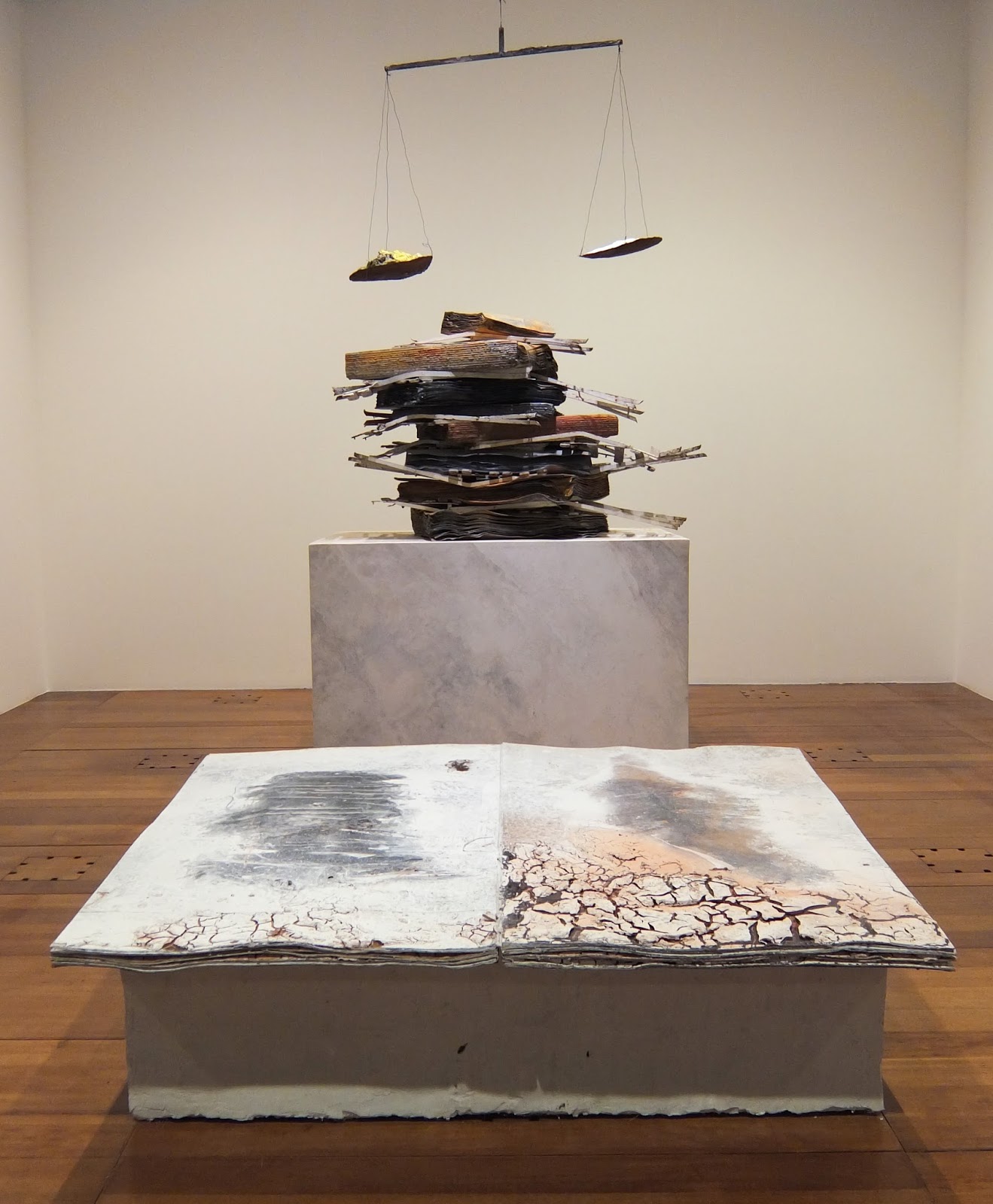
Installation view of 'Ton âge et mon âge et l'âge du monde', 2005 and 'Nigredo', 1998.

Recently I got chance to see a retrospective of Anselm Kiefer's book works at the megalithic Bibliothèque  Nationale François-Mitterand in Paris; a building that I love for its sheer audacity (how many other libraries have a wood planted right in the middle of them?).

Library Exterior.
During the course of my studies I'd heard a lot about Kiefer's books, particularly in relation to their earthy, organic qualities. And because books are often such small, intimate objects, I was keen to see the scale of the works.

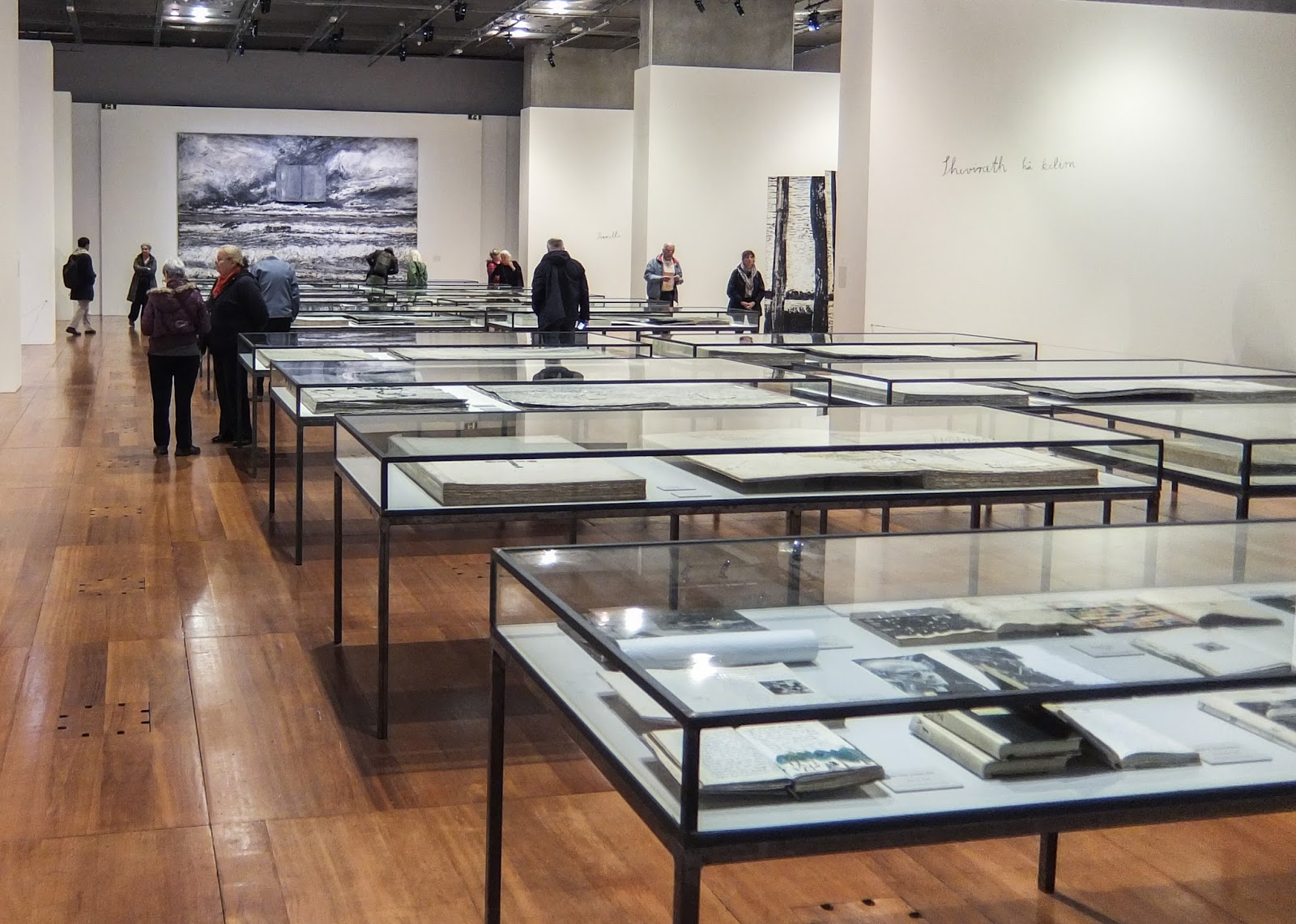
I have never seen an exhibition at the Bibliotheque National before, but the gallery was bigger than I expected. The room is made up of an open central space with vitrines of more traditional books and three alcoves on each side, housing the bigger, more physical books.


The first alcove on each side is called 'A Library Of Artists' Books' and have been made to look like archives with their utilitarian grey metal shelving. The shelves hold large (around 1m square) seemingly perfect-bound books. The thick pages have a quality of children's board books, but the content and construction is more akin to a sketch book or a journal. It is easy to imagine that each book is preparation for an artwork. Filed among these are boxes (presumably of books or loose-leaves), sculptural objects and vitrines. The effect is like a behind-the-scenes view of the artist's studio. The huge tomes have a real sense of gravity and even though they can't be read, these reading rooms are still immersive and contemplative spaces.

A Library of Artists Books, 2015

Subsequent alcoves feature large sculptural works - a particular favourite was the installation featuring 'Ton âge et mon âge et l'âge du monde' (2005) and 'Nigredo' (1998) (shown at the top of the page) as the balance between the organic and the bookish in the works seemed just right. Kiefer's work is confident and complex, but the familiar form and the earthy colours lend a warmth to it. This may also on part explain the artist's appeal to those on the Book Arts course I was on.

Le Livre, 2007 (detail)
 'Lichtung (Clairière)', 2015 (detail)
The front and back walls are flanked by large-scale, heavily layered paintings each of which incorporated a book form. I like the symbolic use of the book form within the composition, and although such a deep layering can make paintings very dense for me they certainly had a lot of energy and they enclosed the space very well.

In the vitrines down the middle of the room are a broad range of the artist's books. Many are open and although they can't be touched, the viewer is given a hint as to their contents. In an exhibition like this is not necessary to be able to handle these works, particularly as many are much closer to sculpture than an actual book.

'Les Reines de France', 1996 (detail)

Leaving the exhibition I was impressed with how prolific Kiefer is and how consistent his work is. I feel lucky to have had the chance to see the work and particularly in such a relevant context.

'The Alchemy of Books' continues until 7th February 2016.

[Chris]

Wednesday, 28 October 2015

/ / / / ECHO


Currently we have a piece of art on display in Cambridge. The work is part of an art fair called Art Language Location which sees works by various artists dotted around Cambridge. The piece is called MIRROR ECHO. 

We have chosen three double sided notice boards outside a lecture theatre in Cambridge University’s Sidgwick Site. 


The piece is a play on perception and reflections. We want you to look at what is reflected on the boards instead of what is in them. Underneath a glass surface are a white sheet, black sheet and sheets with gradients from black to white and vice versa. 


The outer boards have the gradients so reflect the rest of the campus in a slightly distorted way. A black surface reflecting much clearer than a white one. The gradient boards act like a lens flare in a photograph masking out parts of the image. It is something that has to be seen to really experience it,  as the photographs have a kind ‘photoshopped’ quality, where the boards look false or artificial. It is something that you have to walk alongside, in doing so you see your reflection disappear and reemerge.


On the reverse of these gradient boards are printed two words: MIRROR and ECHO. These words reflect on the centre board. As you walk though the space you get caught in the reflection. You may notice the words printed backwards or you may notice the reflection of the word, but to see one board is to see the other. Situated outside the doors to lecture theatres that see multiple lectures a day there is a lot of passing traffic. I hope at least a few stop and contemplate on the space. 


MIRROR ECHO is located on the Noticeboards outside Lecture Block A, Cambridge University, Sidgwick Site, Sidgwick Avenue, CB3 9DA. They will be there from 15 October – 1 November 2015


What became really interesting for us in this piece are the gradient boards. I'm wondering if it will lead to more uses of gradients and the change in perception that they provoke.

I came across this book, that will act as a colourful contrast to our black and white boards.


The RGB Colourspace Atlas by Tauba Auerbach

It is interesting how the gradient defines the passage of time and space. The movement in colour signifying a movement in page and a movement on the page signifying the volume of the book. There is a lot in the simplicity of it. In the fact that it can only exist as a book, a 3D visualisation of a form of colour. 


\