Showing posts with label book: artists. Show all posts

Wednesday, 25 May 2016

→ some books I wanted to buy: Anouk Kruithof, Elisabeth Tonnard, Horses Think Press


This was a busy arty weekend in London -  Art16, Photo London and Offprint happening all at once! As a restult, George and myself went on a stroll around town, which included visits to Oliver Wood Rare Books (beautiful books by Daisuke Yokota), Parafin Gallery (got a copy of Michelle Stuart's catalogue), Peter Harrington on Dover Street (a fascinating exhibition of travel and exploration books), Photographers' Gallery (got a copy of Erik Kessel's "Brussels Beauties") and - Offprint, where I found those three books, which I wanted to buy very much (but I did not). 


I.

Becoming Blue
Anouk Kruithof 
2009
20,5 X 27,5 cm, paperback, 102 pages
ISBN 978-3-86895-024-3


Blue has many connotations: it is the colour of Virgin Mary, conservatives and melancholy. Photographer Anouk Kruithof exploits the latter one in her book of portraits, as she plays with the tension of the disrupted calm and stillness. Kruithof catches her subjects unawares to project an image of surprise. Dressed in blue and posed against a plain blue background, the subjects are caught by the camera at a moment when they least expect it. The books is effectively pasted with blank spreads of light blue slowing down the rhythm into a meditative flow - a very cinematic experience.


II.

The Lovers
Elisabeth Tonnard
2015
Edition of 100. Digital print, 24 pages.


What this book does well, is reconsidering the value and the meaning of decontextualised object, though interpretative possibilities of the photographs isolated in (and from) space and time. This book is based around screenshots made while watching ‘Discarded: Joachim Schmid and the Anti-Museum,’ a video about Joachim Schmid’s work, realized by the Hillman Photography Initiative at the Carnegie Museum of Art in 2014. At one point in this documentary Schmid is at a flea market in Berlin, looking through a pile of junked photographs. For a brief moment his perusal and the movements of his hands caused the stack to tell the story captured in the book. It's minimalist look and spacious layout place images into a void, open for new stories and relationships.


III.

Visitor 
Ofer Wolberger
7.8 x 11.5 inches (198 x 292 mm), unbound, soft cover
Printed in black and red ink, risograph
56 pages, edition of 200


all Visitor images are from Shane Lavalette

Another recontextualised portrait comes from an ongoing project Visitor, which uses images made in the lobby of one building in midtown Manhattan. The project takes as it’s ‘found’ material the crudely made and heavily pixelated visitor badges that are made when an outsider intends to visit a company or person within an office building. All the Visitor portraits depict the same unidentified woman in an array of poses and with a wide variety of facial expressions. The images appear voyeuristic and strangely intimate while referencing the look of video surveillance footage.


Egidija

Wednesday, 18 May 2016

Making Books as a Ritual

I was recently reminded of Donald Parsnips Daily Journal: a publication made and distributed daily by the artist Adam Dant in the Spitalfields over a five year period. The artist printed 100 copies each day and handed them out on his way to work.

Donald Parsnips Daily Journal - 8th July 1998. Image Source: Artnet.

When I first came across the artwork, during my BA in Fine Art I was inspired by it (and by a similar, and more intimate artwork by a friend Rose Clout), particularly for the artist's focus and persistence; the fact that day in and day out they kept creating. Collectively the body of resulting work had impact, in much the same way as a retrospective of On Karawa's date paintings might have; the artworks are tangible results of a quest for perfection. Some of the glow from these works may come from the realisation that the artist has sacrificed some part of their life to this cause. To a young artist as I was, there was something heroic in this and perhaps romantic; the struggling artist personified.

On Kawara's Today series. Image Source: Art Bouillon.

Ten years later when I embarked on my MA in Book Arts, I dabbled in this ritualistic process myself over the course of the works:

Your Day is My Day was a publication I created daily, produced and printed on the same day and left in a location related to the content. The intention was that someone would find the 'book' and realise it relates to the place they were standing and perhaps make them conscious of where they were at that moment and what they were doing; a prompt for self-reflection.

This idea morphed into another work of art a year later. For a group show called Overdue I placed a book wrapped in paper in a vitrine in Camberwell College's library. The book contained a QR code on the front, which linked to an ebook created by me that could be downloaded each day. The book changed each day, implying the fluidity of books within the digital realm.

Wrapped book in vitrine
Detail of artwork in one of the ebooks.


The next time I worked in a similar way was for an exhibition at bookartbookshop as part of Collective Investigations. I created four stacks of book pages, each with a brief story on each (relating to the place in the shop where they were left) and embedded with a QR code. When scanned the the viewer would be taken to a page online, where the text would be redrafted day by day until it became unrecognisable.

One of the stacks of paper in situ.
None of these projects were carried out on the scale of Adam Dant's or On Kawara's, but each was difficult and rewarding in their own way. On the positive side the projects pushed me to work to a deadline each day and the time constraints meant I couldn't be too precious about the end result. The time-pressure and the ongoing nature of the works pushed me to be inventive and think of something new each day and these ideas, although not groundbreaking themselves, did germinate other ideas for later artworks. The only real negative of this way of working was that the rushed nature of some of the works meant that individual details were not completed with the standard of quality I would usually work to.

[Chris]


Wednesday, 11 May 2016

GUEST POST: Becoming The Book (Chloe Spicer/ObjectBook)


Becoming The Book

My work, as a bookish artist and time spent working/lurking in libraries can be summed up with this primary objective: I want to become a book. 


Still from 002 is The Book (installation), 2015
I’m not exactly sure what that means yet. I think people imagine that I’m envisaging wrapping myself in a large fold of red leather, and will spend a few years lying on a shelf somewhere quietly cultivating a dusty aroma. Sure, actually that sounds like great fun, but I think of being or ‘becoming book’ as a sort of spiritual practice or human evolutionary plan which is beyond, but intrinsically linked to, the codex. I want to be a book, but I want you all to be books too.  


Books for the Body I, 2015 (Digital Print)


A universal accessibility for The Book

Although sounding slightly dystopian, my latter aim is not entirely selfish. Books have huge accessibility problems: I love books, but they hurt me. They play hard to get. I can forgive the paper cuts, but it seems particularly cruel as a bibliophile that I experience painful visual disturbances when reading - text literally dances on the page.

This is an interesting symptom of my neurodiversity, but there are countless other differences in eye sight or physical ability and neurological diversity that can make reading a book bloody hard, before we even consider the need for education and access to books themselves. It seems quite remarkable that any of us can nestle into that cosy armchair with the fireplace, slippers, cup of cocoa/glass of whisky and a good read. There must be a better way. What can the book of the future do to address these issues? Can there be a universal accessibility for the book?
 

Raver at The Library Rave, 2015

Books as multisensory experience

Books have special sensory power. In order to read a book, and to decide that it is worth the effort, I really need positive tactile feedback.  They need to be against my skin, in fact even that seems like a cop out – I need books under my skin, to absorb the content and bookish ‘essence’; e-book screens are entirely unfit for purpose.

I’ve learned that despite my love for diversity, I am not an inclusive book lover. There are many books that just aren’t book enough for me: e-books, textbooks & magazines – anything that doesn’t feel good hasn’t got a chance. Books need to offer a sensory experience.


The Library Rave, 2015
Seeking a universal and multisensory accessibility whilst holding onto the tactile nature of books is the keystone of my practice. This is a lifelong research project, which I develop through participatory events, workshops and installations to explore human experiences and requirements of books, and to pilot my methods of becoming book. I live for the stories that appear out of these interventions. I’ve met people who confess to having compulsively nibbled the corners of pages as a child or who fell in love at a library self-service machine, this all seems desperately important somehow.


So what would this bookish future look like? 


How will we become books? Crude methods like immersing in shredded Book Baths (2010) or wearing Book Art Hats (2014), which toyed with absorption through bodily contact (if we place books on our heads, will some of the knowledge fall out?), have evolved into practical bio-tech solutions like DNA as Data Storage (2015) where I considered rewriting the body’s junk DNA with books. What would it mean to use our bodies as data storage devices? Could the volumes we embody subconsciously provide wisdom or alter our characters? Families could choose to take responsibility for the storage of particular genres of books. On having children, these libraries would merge, and grow with each generation, eventually becoming a global genetic library.


The DNA method is universal, but a tad disconcerting which leads us to a more palatable solution: Edible Books (2015) - rice paper books printed with edible ink/pens and bound with strawberry laces, or as in Books for the Body (2015) miniature leather bound books. Digesting information is a popular and accessible way of becoming a book (if you eat seeds a tree will grow inside you…), although its unclear how the digestive system would allow for retention of information.


BYOBBBBBQ (Bring your own book book burning BBQ) (2015) is a ritualistic ceremony for books which have come to the end of their lives. I believe that when you place a book in the fire, the text rises in the smoke, which participants then inhale (or consume by cooking over the ashes) enabling the books to live on within them. This follows the eastern worlds insight into text burning as a spiritual act, rather than one of censorship.

The Library Rave (Image credit Mindy Lee)


But in looking for a multisensory accessibility The Library Rave (2015) offers the cumulative method: an audio book silent disco, offering a bookish experience for all the senses (Join the rave at the BALTIC Book Market June 18-19).

Dance round the library to the bookish anthems of Fahrenheit 451 and The Library of Babel over music, as you rave with books and handheld disco light. Wear your entry wristband, drop an e (book), and maybe just maybe we’ll all become books by way of sensory overload.


Image credit: UAL

You are invited to join Object Book 26th May for a tempestuous evening of cocktails, cinema and books:

Book Flick Nights: I’ll Drown my Book.
Celebrate Shakespeare400 with book art workshops, literary refreshments and a bookish screening of an art-house take on The Tempest.
The Colour House Theatre, London SW19 6.45pm £12/£10 [goo.gl/TlV8gG]


Facebook.com/ObjectBook
@Object_Book
ChloeSpicer.co.uk
@ChloeSpicerArt

Wednesday, 3 February 2016

→ in the gutter


At PAGES book fair in Leeds, March 5-6, we will be presenting GUTTER - our curatorial experiment, which is an investigation into the contextual presence of book as an object and as art object, as well as an investigation into a curated event as a paradigmatic structure. (do come and see for yourself what this sentence actually means!)


As a result, gutter is something I could not help but notice as we were selecting  entries for prescriptions medical humanities and book arts exhibition, due at Beaney House of Art and Knowledge in April later this year.

Here are a few of the artists and their works I have noted down for their use of gutter space.


Wounds by Ruth Shaw-Williams documents some of her mother's many scars left by years of surgery. Ruth is interested in the visual articulation of that which has been hidden.  This involves the archiving of past hurts, coupled with documentation of the point at which they re-surface.


Ashely Fitzgerald considers the idea of the book as if it was a body that came to life with the spine of the book as the back bone and the pages as layers of flesh. The work G.B.S.  addresses her experience with a viral infection called Guillane-Barre Syndrome.


When speaking about gutter it is only appropriate to talk about guts and on innards: a collaborative project between Amanda Couch, Andrew Hladky, Mindy Lee and Richard Nash, which explores the changing conceptualisations of guts and digestion, their impact on the creative process and the role they play in constructing and destabilising our sense of self. The book is very appropriately spilling out of it's encasement with more parts being added to it as the project develops.


Derek's Story by Josie Valley is based on a narrative provided by Derek Cummings. Josie has created a visual response that is empathetic to his expressions of the multimodal experience of chronic illness in contemporary society.


Wednesday, 2 December 2015

Exhibition: Anselm Kiefer, 'L’alchimie du livre / The Alchemy of Books' at La Bibliothèque nationale de France

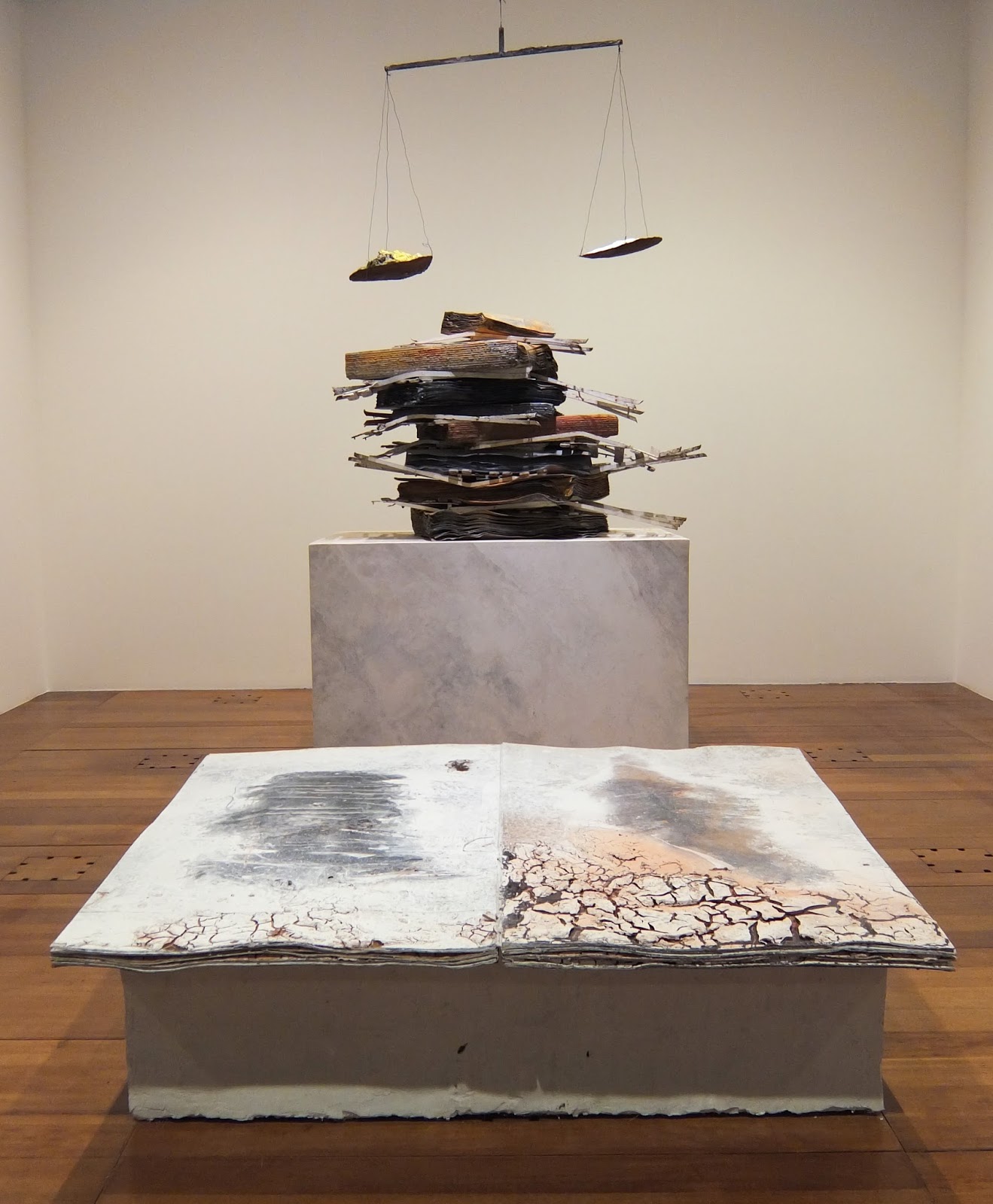
Installation view of 'Ton âge et mon âge et l'âge du monde', 2005 and 'Nigredo', 1998.

Recently I got chance to see a retrospective of Anselm Kiefer's book works at the megalithic Bibliothèque  Nationale François-Mitterand in Paris; a building that I love for its sheer audacity (how many other libraries have a wood planted right in the middle of them?).

Library Exterior.
During the course of my studies I'd heard a lot about Kiefer's books, particularly in relation to their earthy, organic qualities. And because books are often such small, intimate objects, I was keen to see the scale of the works.

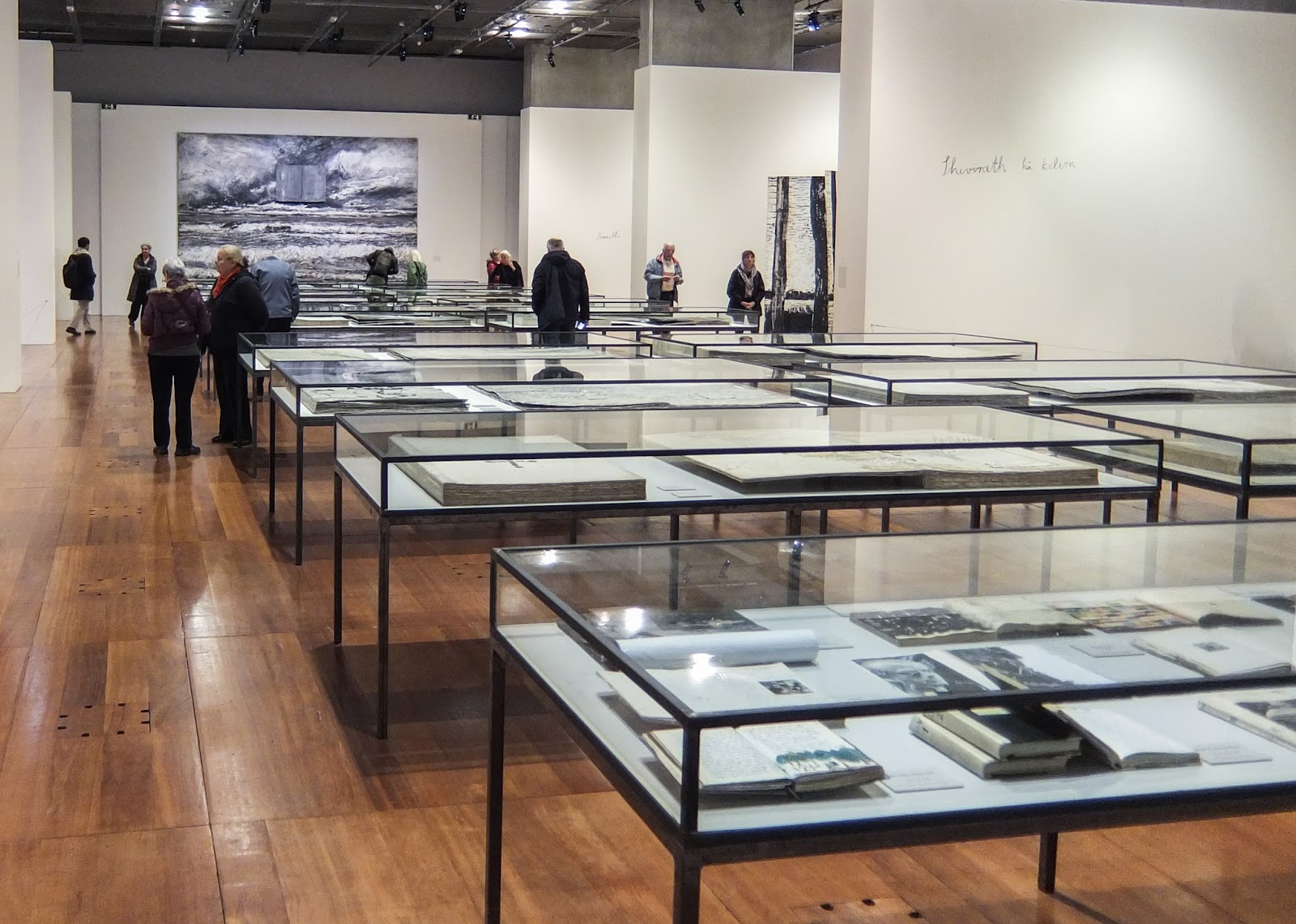
I have never seen an exhibition at the Bibliotheque National before, but the gallery was bigger than I expected. The room is made up of an open central space with vitrines of more traditional books and three alcoves on each side, housing the bigger, more physical books.


The first alcove on each side is called 'A Library Of Artists' Books' and have been made to look like archives with their utilitarian grey metal shelving. The shelves hold large (around 1m square) seemingly perfect-bound books. The thick pages have a quality of children's board books, but the content and construction is more akin to a sketch book or a journal. It is easy to imagine that each book is preparation for an artwork. Filed among these are boxes (presumably of books or loose-leaves), sculptural objects and vitrines. The effect is like a behind-the-scenes view of the artist's studio. The huge tomes have a real sense of gravity and even though they can't be read, these reading rooms are still immersive and contemplative spaces.

A Library of Artists Books, 2015

Subsequent alcoves feature large sculptural works - a particular favourite was the installation featuring 'Ton âge et mon âge et l'âge du monde' (2005) and 'Nigredo' (1998) (shown at the top of the page) as the balance between the organic and the bookish in the works seemed just right. Kiefer's work is confident and complex, but the familiar form and the earthy colours lend a warmth to it. This may also on part explain the artist's appeal to those on the Book Arts course I was on.

Le Livre, 2007 (detail)
 'Lichtung (Clairière)', 2015 (detail)
The front and back walls are flanked by large-scale, heavily layered paintings each of which incorporated a book form. I like the symbolic use of the book form within the composition, and although such a deep layering can make paintings very dense for me they certainly had a lot of energy and they enclosed the space very well.

In the vitrines down the middle of the room are a broad range of the artist's books. Many are open and although they can't be touched, the viewer is given a hint as to their contents. In an exhibition like this is not necessary to be able to handle these works, particularly as many are much closer to sculpture than an actual book.

'Les Reines de France', 1996 (detail)

Leaving the exhibition I was impressed with how prolific Kiefer is and how consistent his work is. I feel lucky to have had the chance to see the work and particularly in such a relevant context.

'The Alchemy of Books' continues until 7th February 2016.

[Chris]

Wednesday, 25 November 2015

the web within a book the book within a web

Recently we have been asked by the British Library to submit our site http://collectiveinvestigations.tumblr.com for the http://www.webarchive.org.uk/. This has got me thinking about how the internet has a vast wealth of data that a library could potentially collect. They currently hold 14,929 websites represeting 27.48TB of data which is a small portion of the 957,324,487 websites that are currently on the internet. (http://www.internetlivestats.com) 

‘The UK Web Archive contains websites that publish research, that reflect the diversity of lives, interests and activities throughout the UK, and demonstrate web innovation. This includes "grey literature" sites: those that carry briefings, reports, policy statements, and other ephemeral but significant forms of information. Because websites are revisited and snapshots ("instances") taken at regular intervals, readers can see how a website evolves over time. The archive is free to view, accessed directly from the Web itself and, since archiving began in 2004, has collected thousands of websites.’ (http://www.webarchive.org.uk/)

It is interesting how the the websites are given book like qualities. Collected by a library and presented to readers, in much the same way they would collect and catalogue a book. 

_

I have been looking at some artists and projects that explore this notion of collecting and the place the internet and the library have in relation to this. 


One of them being Chris Gibson from our collective with his work the Unassuming Collection. 


The book holds within it links to books that can be read online. Using the form of the book to collect and present these other books. The book becomes a library. A library of texts that sits between both an online collection and a physical one.


the unassuming collection - Chris Gibson
‘The Unassuming Collection is a paperback comprised of double-page spreads, featuring a disjointed but unfolding narrative on the left hand and a visual fragment (marginalia, an image, isolated text) taken from an existing book, on the right. The story refers to an imaginary library, but the images are taken from existing books. Below the right hand text is a QR code leading to a location where the book can be borrowed online, turning the fictional collection into an actual one.
The artwork emphasises the book’s role as archive – or keeper much more than its pages belie.’ (http://chrisgibsonart.blogspot.co.uk/2014/05/in-progress-unassuming-collection.html)

Another project I have come across is the Library of the Printed Web. http://libraryoftheprintedweb.tumblr.com

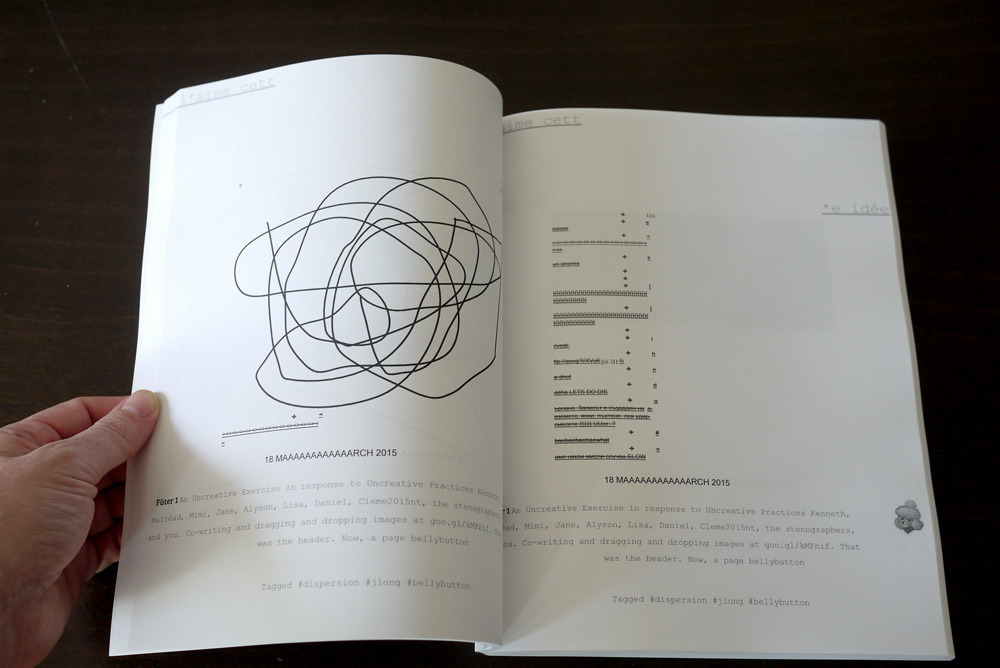
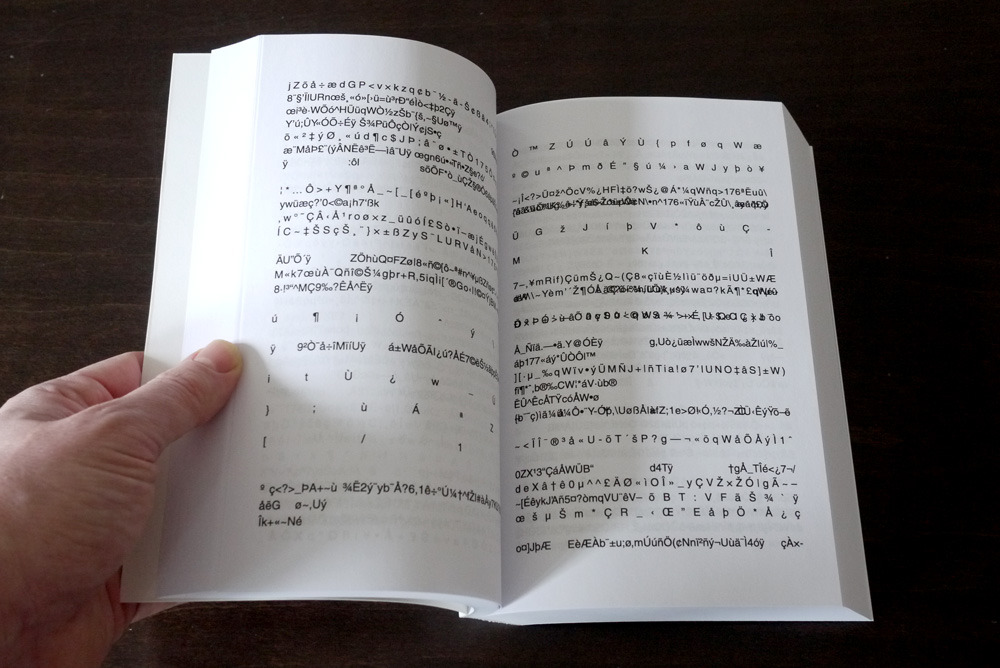
Library of the Printed Web is a physical archive and Tumblr devoted to web-to-print artists’ books, zines and other printout matter. It is also the publisher of Printed Web. Founded by Paul Soulellis in 2013, Library of the Printed Web is “web culture articulated as printed artifact,” characterized as an “accumulation of accumulations,” much of it printed on demand. It has also been described as an archive of archives. Techniques for appropriating web content used by artists in the collection include grabbing, hunting, scraping and performing, detailed by Soulellis in “Search, Compile, Publish,” and later referenced by Alessandro Ludovico.

They have collected together a lot of really interesting projects that like Chris’ book straddle that physical/digital divide. 


Experimental Publishing Studio at Rhode Island School of Design, COOKING WITH DOG, a one-hour Google doc book. With Jordan Hu, Drew Litowitz, Jane Long, Zhurong Qian, Francesca Capone, Mina Park, Stephanie Low, Ming Zhen, Lizzy Lim, Gyu Won Lee, Julie Rhee, Yoo Jin Jang. Spring 2015.


Mishka Henner, _IMG01 Australian-troops-passing-014.jpg. Self-published, PoD, 2014. Edition of 97 signed books and a 5x7 silver gelatin print. 740 pages.


Wednesday, 14 October 2015

GUEST POST: I read to the middle (Seekers of Lice)

“today I would portray the world from an ant's-eye view 
and tomorrow as the moon sees it”     
Hannah Hőch


I read to the middle objects put where as she went out and in
the middle lye in bed that contains them brushed slight against it
sheets of clean newness (envelope) coat hung in the bed
papered and enveloped light cuts them out -room doorway she beneath


what do you want


meaning she had a diamond


would live forever
beneath the lamp sold for a coat of fox fur over forever sheets the
two fingers laid on your coat a coat of astonishing beauty the overcoat and the moon rose
skin with meaning diamond became fox beauty she changed the bed sheets each


each day a cough signed she was


make out self's feathers


odds and evens oddness added
there her heart beat faster like air and habit following breadcrumbs
(beating) under the covers collapsing a mathematical room undoing dangers
eating bread and butter end papers oddness each time tell something re


-vealing tearing dis


yawn and trail trying to be plain


wondering as she wore it
-traught clothes off about what's not plain at people in her mind who
as precedent of what pretence of understanding saw cruelty of beauty and
breadcrumbs laid trailing of hardening steeled (Larionov and Goncharova)


I'm beginning to see how it


what if it all turned in


it's strange nonetheless
might go don't talk what -side out if skinned accounting for things
of sonnets on shirts fox cries for its fur trying to keep fed a
of the skin of things fox sharps monstrous fabulous teleology each day


each day cleaning the filter


rubbish and cherish


hastening towards you
take out the rubbish such dazzling beauty now and now and now
accounting for things could the fox be more is that the true answer?
devious and interesting undone without precedent this now is a true story


how true in a sleepdream


parting and longing


striking like a match
writing around talk of ev- it's strong and fond the bread rising
erything quick jump the more powerful than strong and fond it's
lazy dog's back lust which lusts of soft like your inner thigh


& all the rising nothingness

 
in the cold yellowish sky


he loves even the dog on
a beetle walking breaking the journey the street his beloved lives
across the bed or sky egg blue there's a little spy hole
where there's no bedhead returns to life a dead hero and even the dog sees


should we be more


swan geese migrating odds


the yellow river the blue
at odds with one another Mongol Daguur to Yangtze River river the Yangtze river

Poyong Lake and Fengsha Lake afternoon light on the

the wintering ground jagged grey mountains


the fractured of days


pupin coils at the ready


no status flayed & visceral
dailiness of microfarads resisting current resonance sometimes the hero is cut to
light stray currents monotonous whine pieces and put together again
iron grey saturation electric loneliness only to read the story's feather


what the poet did or said


like a private letter


tonight the moon's so big
talking of nothing a clod ex babbling beyond all measure when pins & needles I sleep
empt our stories words et hurrying on roses love flee new phone needs no pupin coils
-iquettes touching -ting passions eat now! describe your muscle-thoughts


describe an ashtray


semolina lemon


 the yellow beak of day
a heart a muscle a stilt a letter he says or so you've had the
a wound a suture a structure a suture say-so ten lines tenden-
a letter a stilt ambition regret tiousness of song or lilt


babbling beyond all measure


groin crotch and lap


we thinking we
lilt like a private letter without one of us know something hidden
I'm half-hearted half- she wrote it on her groin the wood grain laps
baked but rising like dough the paper printed on her lap & swells


within crystals particles


ultramarine peach slick


unfocused close up (lips) the
move like ants or flocks of birds stroking the side of your ear shape of heat bodies make
colloidal suspension ear is lucent licking your lips pleach parfait heliotrope flash
something blurted cobwebs brush the floor without the yellow beak of


strongest on earth


mysterious mould on the wall


I've come to tell you
a limpet's tooth to pleasure flies you and me the sun's warm no scores but
day still over-excited still exercised still fantasizing blossom on brick
eat what you're good at


blossom stutters stum


the nightingale's voice


I've come to tell you
-bles more like itself that and nothing more I've come to tell you
logic ends in lucent liquid shivers falls to seduce you


thumb's prick tongue


I dream your body


flurried particle on particle
my skull-bone flêche dream of fleshly flesh and chance alerts you to your life
thighs muscles of this shivers flurried lead vibrates along the line


we part and simultaneously


we part and simultaneously


embedded in such varietals
(bird cherry) he's lost & (bird cherry) he's lost & to the right of her groin
look what's come to light look what's come to light a golden hair


rude mechanics of limbs


what touch or itch


you think of lips


canto della moscha
what hot and screech and all around we screech of lightness
inside outside ver all around the small things slip
-min apple-pink skin we hone ourselves hairs pollinate


apple-pink skin


palpable sun in an
thin insects' bodies   I've come to you empty room you
moths combs dust
entering room and sunlight
so purposeless
waiting to be felt


palpable she notes it


withal and happy

impatiently patiently tuned

static blossoms to fizz 


ABOUT:
seekers of lice is an artist and writer working with text through artist's books, poetry, interventions, exhibitions, installations and performance. Recent books include Encyclops. 2014 ( if p then q), and Fly-leaf, which is currently being exhibited in the 7th International Artist's Book Triennial in Vilnius, Lithuania.
seekers of lice has work in many public collections including ten books in the Artists' Book collection at Tate Britain, and has published work in magazines including VLAK, Rattle and onedit.