Showing posts with label Exhibitions. Show all posts

Wednesday, 3 December 2014

scrolling gadgets {moving panoramas}

http://www.frieze.com/issue/review/tomas_saraceno/
Tomas Saraceno, Cumulus at Barbican


↓↓↓

Some time ago I wrote a post digitised scrolls: from the Pond at Deuchar to the Trip to London, at the bottom of which I mentioned a charming Georgian device Trip to London that had been digitised by Princeton University. Trip to London is a box containing a twelve plate scroll that displays a humorous story of a honeymoon trip. It is a close development of the very popular moving panoramas, which came to Europe in late 17th century and by early 19th century they were so common, that there were even ladies' fans with miniature scrolled pictures incorporated into the designs. 


Trip to London

↓↓↓


Moving panorama - to put it simply - is a long panorama in a scroll, which has ends of it attached to two rods. The handles on the rods are then turned to allow the panorama to move across the screen, very much like a basic animation film. Moving panoramas were available in handheld scrolling devices as well as a form of large screen/stage entertainment. They were hugely popular: successful shows drew crowds and boasted years of performances. For example, Albert Smith's Ascent of Mont Blanc was performed for seven years at the Egyptian Hall in London, while Hugo d'Alesi's Mareorama allowed seven hundred spectators per viewing of this show, that offered a multisensory sea voyage illusion, complete with thunder, wind and local dancers.


a card promoting Hugo d'Alesi's Mareorama


Moving panoramas were extraordinary pieces of engineering. They often featured special enhanced sets and effects, merging of medias and mediums into one immersive spectacle. For example, touring panoramas of the late nineteen century England frequently included such novelties as mechanical puppets and slide projections. The most impressive ones, of course, were present at Exposition Universelle in Paris, 1900. The above mentioned Hugo d'Alesi's Mareorama incorporated two screens, each 2,500 feet long and forty feet in height, which were scrolled for the viewers present on board of the full size boat. The boat required hydraulic piston engines and pumps driven by electric motors to stimulate motion. 


Hugo d'Alesi's Mareorama


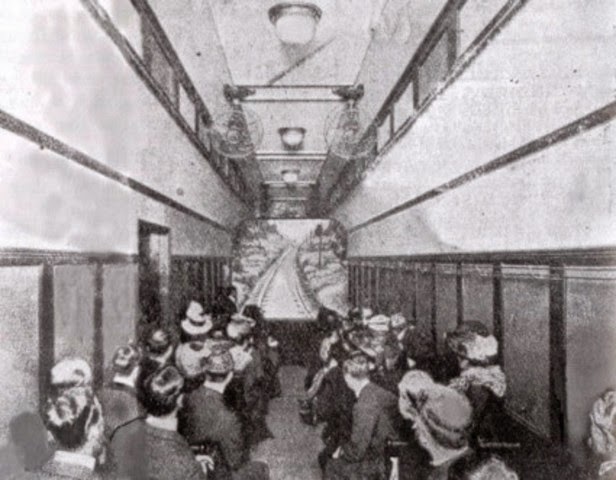
Another immersive panorama at Exposition Universelle in Paris was Pavel Yakovlevich Pyasetsky's Great Siberian Railway Panorama in the Russian pavilion. It offered a 45 minute experience of Trans Siberian rail journey complete with stuffed polar bears on papier-mache icebergs, a dinner of caviar and sturgeon in a luxury imitation train with a library, gymnasium, marble bath, smoking and music salons.


This 45-minute experience was an essay in detail. It offered a chance to experience the 14-day journey by rail from Moscow to Peking, a 6300-mile journey over tracks not yet completed at the time of the Paris Fair of 1900.
There were three realistic railway cars, each 70 feet long, with saloons, dining rooms, bars, bedrooms, and other elements of a luxury train. Totally detailed and lavishly equipped, the cars were elevated a little above a place for spectators in conventional rows of seats. The gallery faced a stage-like arena where the simulated views along the train trip were presented by an inventive contraption.
The immediate reality of a vehicular trip is that nearby objects seem to pass by more rapidly than distant ones. So, nearest to the participants was a horizontal belt covered with sand, rocks, and boulders, driven at a speed of 1000 feet per minute! Behind that was a low vertical screen painted with shrubs and brush, travelling at 400 feet per minute. A second, slightly higher screen, painted to show more distant scenery, scrolled along at 130 feet per minute. The most distant one, 25 feet tall and 350 feet long painted with mountains, forests, clouds and cities, moved at 16 feet per minute.
Real geographical features along the way were depicted on this screen: Moscow, Omsk, Irkutsk, the shores of great lakes and rivers, the Great Wall of China, and Peking. The screens, moving in one direction only, were implemented as a belt system. Due to the inexact speeds of the scenery,the 'journey' never repeated itself exactly, providing an ever-changing combination of scenes and a reason to pay to see the attraction again.  (from The Past Was No Illusion  by Walt Bransford)


Pavel Yakovlevich Pyasetsky's Great Siberian Railway Panorama

↓↓↓


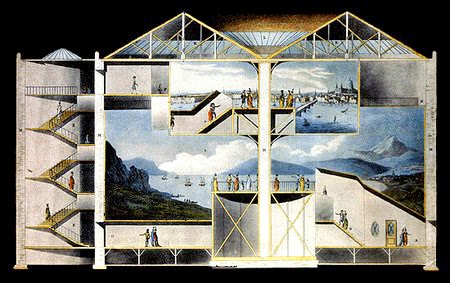
Apart from the great spectacles at Exposition Universelle, 1900, there was a range of other - more common and more humble - weird and wonderful panorama devices. There existed pleoramas, dioramas, padoramas, myrioramas, phantom rides for public viewing as well as personal hand panorama reels, magic lanterns and peep-shows.


http://dip9.aaschool.ac.uk/references/
The Kaiserpanorama, 1900
http://motherboard.vice.com/en_uk/blog/remembering-the-human-gopros-that-gave-the-world
Phantom Ride
https://ore.exeter.ac.uk/repository/handle/10472/2843
Rotunda, Leicester Square
https://ore.exeter.ac.uk/repository/handle/10472/212
Coronation Procession of King George IV
https://ore.exeter.ac.uk/repository/handle/10472/4717
Tableau of the procession at the Queen's coronation June 28, 1838
http://writhingsociety.blogspot.co.uk/2010/02/myriorama.html
Myriorama or tableau polyoptique by Jean-Pierre Brès
(a set of cards that can be arranged in any order)


↓↓↓


Here are a few of the contemporary moving panoramas that range between overwhelming digital installations of Tomas Saraceno to painted paper scrolls of Adam Cvijanovic.

http://helendouglas.onlineculture.co.uk/ttp/ttp.html
Helen Douglas, The Pond at Deuchar
http://www.frieze.com/issue/review/tomas_saraceno/
Tomas Saraceno, Cumulus at Barbican
https://erindziedzic.files.wordpress.com/2013/09/rolling-panaorama-1_cvijanovic.jpg
Adam Cvijanovic, Rolling Panorama Number 1
http://upload.wikimedia.org/wikipedia/commons/8/8d/Panoramic_View_of_Old_City_lane_%28Pole%29_Ahmedabad.jpg
Panorama of Achmedabad


 ↓↓↓


The Trip to London scroll box is a story telling gadget that bridged book and upcoming cinema. It's situation is not dissimilar to the hybrid publishing projects emerging today as a result of media arts niche-ing themselves into the book market, such as FakePress and HybridBook. Moving panoramas were defeated by the cinema, of course. Which of the contemporary story telling gadgets are going to stay?


↓↓↓


Printed book sources:
- Schwartz, Vanessa. Spectacular Realities: Early Mass Culture in Fin-de-siecle Paris . Berkeley: University of California Press, 1998.


[Egidija]


Wednesday, 17 September 2014

the false azure in the windowpane


I went to the V&A to see 'Double Space' this week that forms part of the London Design Festival. I went with the specific aim to see this installation, as we have been talking a lot together about reflections for a piece of work we are putting together for Art Language Location in Cambridge that is coming up in Ocotber. We have been having conversations about what is seen, what is experienced and what is real. Focusing in on a quote from Vladimir Nabokov's 'Pale Fire': 

'I was the shadow of the waxwing slain
By the false azure in the windowpane;' (1)

A bird tricked by the seemingly lifelike reflection of the sky in the window flies straight into it and dies. 

We will be installing work on the widow of the philosophy library, that draws on the dual nature of a widows ability to reflect the world around it and also at the same time to be seen through. It is then our point of perception that interprets this layered reflection and transparency. Pulling apart the different spaces and trying to make sense of them. What is outside the window can appear inside, through its reflection and vice versa. What we are working on has become an exploration in destinguishing the truth of spaces and how we know a reflection as a reflection and the room beyond the window as the room. Nabokov goes on to say: 

'And from inside, too, I'd duplicate
Myself, my lamp, an apple on a plate:
Uncurtaining the night, I'd let dark glass
Hang all the furniture above the grass,
And how delightful when a fall of snow
Covered my glimpse of lawn and reached up so 
As to make chair and bed exactly stand
Upon that snow, out in that crystal land!' (2)

Peter Jones - 'that crystal land' (3)

It suggests that the reflection can construct a parrelel space identical to the one that you are in, confusing the genuineness of the reflection and merging it with what is beyond the glass. 


This brings me nicely to the installation at the V&A. Two large aeroplane wing shapped mirrored pannels are suspended from a structure in the gallery. They are positioned high up in the eaves in the Raphael galleries and rotate in a choreographed pattern. The work has been created by Edward Barber and Jay Osgerby, it reflects everything in the room, the ceiling, the paintings and the people moving about below them. Of the work they say this: “It will amaze the visitor and enable them to appreciate the space in a totally new way, the visitor becomes part of the room for a fleeting moment. Through movement and reflections, the static display of the paintings are brought to life while inviting the viewer and the gallery to be part of the performance.’’ (4)


It is an amazing experience, a mirror that moves like a boat on the sea bobs back and forth reflecting a distorted room. It highlights parts that you may never have noticed before. The ceiling gets pulled down into the room, the floor gets pulled up into the ceiling. Its a strange phenomenon. The room all of a sudden has doubled in size but no extra space has been created. But this doubled space is not a true lifelike representation. The fact that it moves for one, but also the fact that the mirror is curved. the reflection is a distortion. It puts me in mind of the Nabokov quote. The way a window can project a reflection of the room you are in outside, these mirrors rather than project out project into themselves whats below them. Everything is absorbed but unlike the bird in Norbokov's pale fire you are not tricked into the illusion, you can see the room and the reflection in one glance. A double space that is more about the experience rather than the ilusion. Edward Barber says: "We wanted people to come in and take something away that was an experience rather than an analysis of an object." (5) 


You are experiencing the room in a new way and seeing parts you may never have seen before. The artwork that is already in the space almost becomes irrelevant. It is the room that is important and reinterpreting it on that scale is something you have to experience yourself. The reflection brings attention to yourself in relation to this space and you become central to everything. With your interpretation the room stretches out from you in and then again in the reflection 

Through this work and through the Nabokov texts I have learnt that the body is essential to the construction of this experience. It is your perception of the reflection that creates it as a space.

I strongly advise you to go and experience this work for yourself, as there is little you can gain from seeing the images. The design festival runs from 13th to 22nd September. For more information visit: http://www.londondesignfestival.com/ You can see our work in Cambridge from 15th October to 2nd November for more information visit http://artlanguagelocation.wordpress.com/

[George]

1. & 2. NABOKOV, V. Pale Fire. 1962
3. JONES, P. the crystal land. 2012 http://instagram.com/p/QczUo9q-7J/?modal=true