Showing posts with label Galleries&Museums. Show all posts

Wednesday, 24 June 2015

→ the photo book (part II): between documentation and memory (@ Photographers' gallery, London)


Georges Didi-Huberman has recently been awarded Theodor-W.-Adorno-Preis 2015, which is given for outstanding achievement in philosophy, music, theater or film. Some years ago he wrote Images In Spine of All, in which he discussed four explicit photographs of mass extermination in Nazi camps. Huberman put the voyeur, the history and the art into one line of questioning. Photography, he said, rested between documentation and memory.
A simple piece of film - so small that it can be hidden in a tube of toothpaste - is capable of engendering an unlimited number of prints, of generations and enlargements in every format. Photography works hand in glove with image and memory and therefore possesses their notable epidemic power. (Huberman, p24)
↓↓↓
As a Lithuanian, I must start this blog with Moshe Vorobeichic. In 1931 he published Paris (as Moi Ver), one of the very first photo artists' books ever produced. At about the same time, however, he published another photo book Ein Getto im Osten - Wilna (1931), documenting the Jewish quarter in Vilnius, where he himself grew up. Like Paris, Wilna book is equally avant-garde in it's collages and layouts. Yet, it is also a very intimate book: the viewer is brought very close to the faces, the puddles, the baskets of Vilnius Jews. The reader is led though the back streets and the markets; the reader looks at the rooftops and the pavement; the reader meets residents of the Jewish quarter. This book is not a record of a historical point in time, rather it is a personal reference point to somewhere in his childhood, soaked in black-and-white nostalgia.


↓↓↓
Photographers' Gallery at the moment is hosting a Chinese photo book exhibition curated by Martin Parr and WassinkLundgren. The exhibition space is tight, but there are large double-page-spread photos, videos of books, books to handle (albeit chained) and books to look at under the glass.


The exhibition does not solely focus on the artists publications, but brings together the whole range of photographic books, pamphlets, promotional material under one umbrella. There is no line between photo books as artists' publications and institutional albums, produced to document an aspect of research, such as tongue conditions or bridges. Does a distinction between photo book as a document and photo book as a creative practice, rest on the maker's intentions only, rather then certain qualities of the outcome? Ed Ruscha recorded gasoline stations, while Chinese government recorded bridges. Both resulted in photo books.


The Hairy People of China


Basics of soccer - a series of techniques

This merging of intentions is what I found so pleasing about the exhibition: there were instructions on the correct ways to play sports and then there were artists' publications, such as the beautifully cinematic  This Face portrait book by Xu Yong.


 Zi U's face was photographed during various times of the day: with make-up and without, tired and refreshed. She is a sex worker. She sees clients from very close and she is used to be seen from close. The sequence of photographs forms an intimate portrait similar to that produced by a film: the trace of the real Zi U is captured in-between the page spreads and the viewer, in-between proximity and truth, in-between memory and document.

Photographers' Gallery also contained an exhibition of Deutsche Börse Photography Prize 2015 (now closed). Mikhael Subotzky and Patrick Waterhouse - the winners - had the work in the first room for their mammoth long term project documenting the fate of Johannesburg's Ponte City. The prize was awarded "for their ambitious publication Ponte City (Steidl, 2014), charting the social and political history of a 54-floor apartment block in Johannesburg", which was built under apartheid rule in 1976 and was originally conceived as a center of aspirational living for a white elite.  A sequence of books follows the temporal line of events, with an introductory pamphlet - containing newspaper headlines - placed at the front. The narrative is built one step at a time by thoughtful sequencing of images and texts. The work balances between the space of historical documentation and artistic interpretation, merging the boundary between the the objective fact and subjective elucidation. 


↓↓↓
As a young teenager I collected photo books of my city. They were published once every few years. I did not own a camera - I documented my space and time in another way. Like those Chinese photo books - which show the correct way to play soccer - Kaunas photo books reflected the correct Soviet way to see my town. They are not voyeuristic (like Xu Yong's book), they are not nostalgic (like Moshe Vorobeichic book) and they only have the intimacy of a travel agent's photography. Yet, they stand as a document and they stand in for memory. Because they contain photographs.
Photographed images do not seem to be statements about the world so much as pieces of it, miniatures of reality that anyone can make or acquire. (Sontag, On Photography)


↓↓↓


1. Susan Sontag also argues against photo books, because they determine the order in which photographs are to be viewed. Like cinema, photo books sequence images as determined by artist's intentions. It is in the nature of the photo book to be sequenced. Yet, it is also in the nature of the book as such to accommodate a random access option for the viewer should one desire to exercise such.


References:

images Egidija's own, except for M. Vorobeichic (Moï Ver), Ein Ghetto im Osten – Wilna, 1931, which were taken from achtung.photgraphy website.


Didi-Huberman, G (2008), Images in Spite of All: Four Photographs from Auschwitz, Chicago: University of Chicago Press.
Sontag, Susan, On Photography http://www.susansontag.com/SusanSontag/books/onPhotographyExerpt.shtml, June 21, 2015.


[Egidija]

Wednesday, 10 June 2015

GUEST POST: Annotated treasures at the Library of Amgueddfa Cymru – National Museum Wales

This months guest post is from Jennifer Evans the Assistant Librarian at the Amgueddfa Cymru – National Museum Wales. She also keeps a beautiful blog of gems from their collection which is definitely worth looking at: http://www.museumwales.ac.uk/blog/?cat=1784


The Library at Amgueddfa Cymru - National Museum Wales


The Library at Amgueddfa Cymru – National Museum Wales primarily holds collections that reflect the museum’s curatorial departments; Art, Archaeology & Numismatics, Industry and the Natural Sciences. However, over the years we have been the welcome recipient of several generous loans and donations and have built up a collection of some very unusual and eclectic early books.  

Special Collections in the Library at Amgueddfa Cymru - National Museum Wales


However, today I’d like to share a selection of items we hold that are absolutely unique. These are annotated books, and whereas normally this would fill any decent Librarian with dread, these items were annotated long ago and one always hopes, by the owner. 


Instructions for collecting and preserving insects; particularly moths and butterflies by William Curtis [1771]

This 1771 edition of Instructions for collecting and preserving insects; particularly moths and butterflies by William Curtis [1771] has been annotated with the most exquisite watercolour insects. We do not know who added these drawings but we think we know why; another edition we hold, has a plate of illustrations but this one does not and therefore someone has copied the illustrations [plus many others] into the margins. 

We have a strong collection of early natural history books greatly enhanced by the Willoughby Gardner Donation bequeathed to the museum in 1953. Included in this collection are our only two incunabula [pre-1501 books], as well as writings by Conrad Gesner and other 16th and 17th century writers. Gardner’s interests were varied, but he had a most particular penchant for bees, wasps and butterflies, evident in the exceptional insect and Aurelian works by, among others, Moses Harris, Benjamin Wilkes and Thomas Moffet. 


Cambria Depicta by William Pugh [1816] is an observant and amusing account of a walking tour of North Wales


We also have a strong collection of Welsh topographical books; these late 18th and early 19th century tours of Wales are mostly accounts written by well-to-do early tourists, mainly from England, and together with some very interesting illustrations, they provide an invaluable picture of the country at this time. And within this collection is a copy of Cambria Depicta [1816] by Edward Pugh.

This is an observant and amusing account of a walking tour of North Wales; the book contains 68 various engravings, and gives very detailed descriptions of a journey that took the author almost 10 years to complete. It offers a unique insight to the history and poetry of the time, and is therefore considered to be a true representation of North Wales two hundred years ago.

Before this book ever came to us, someone had written extensive notes and sketched exquisite drawings in the margins. These are no random doodles, all drawings and written notes relate specifically to the text itself.


This two volumed work, Memoirs of Lord Bolingbroke  by George Wingrove Cooke [1836]  is an example of fore-edge painting


This last example of annotated books concerns fore-edge paintings; images painted onto either of the three fore-edges of a book.

This two volume work, Memoirs of Lord Bolingbroke, by George Wingrove Cooke, [1836] is an example of “single disappearing fore-edge painting”. Single, because the painting appears only on one edge of the book. Disappearing, because the painting was done when the pages of the books were slightly bent over, thereby allowing the image to be painted along the very edge of the pages. When the image dries the book is allowed back into its original state and the image effectively disappears.

Memoirs of Lord Bolingbroke  by George Wingrove Cooke [1836] Volume I showing fore-edge painting of Caernarfon Castle

Memoirs of Lord Bolingbroke  by George Wingrove Cooke [1836] Volume II showing fore-edge painting of Conwy Castle


The earliest fore-edge paintings date as far back as the 10th century and were mostly symbolic designs. Early English examples, believed to date from the 14th century, presented heraldic designs in gold and other colors. The first known example of a disappearing fore-edge painting like these, where the painting is not visible when the book is closed, dates from around 1649. The earliest signed and dated example is from 1653. These books were purchased specifically because of their fore-edge paintings, the two volumes have watercolour images depicting Caernarfon Castle and Conwy Castle

To conclude, and still on the subject of unique books, the following photographs show some surprising items we have found nestled between the pages: 

Hayward's Botanist's pocket book by W.R. Hayward [this edition 1930]

Insectorum sive minimorum animalium theatrum [Theatre of Insects] by Thomas Moffet [this edition 1634]

The Fern Paradise by Francis George Heath [1876]


We are resigned to the fact that we will probably never know who painted the marginalia and fore-edge images and most certainly will never know who placed the butterfly wings, scorpion sketch and ferns between the pages of these books. But, this very fact makes these mysterious and wonderful additions to our special collections.


We love to Blog and Tweet about our Library Collections! 
Please follow us here:

Jennifer Evans
Assitant Librarian
Amgueddfa Cymru – National Museum Wales

All photographs taken by the author
Copyright Amgueddfa Cymru – National Museum Wales


Wednesday, 4 March 2015

marbled pages


Vintage 19th c. marbled paper, Gloster pattern. A


Continuing my theme on printing techniques and methods of production I'm going to write about marbling. While being beautiful it is also really interesting and most of us I imagine are familiar with seeing it as endpapers in books. 


Marblers at work and illustrations of marbling equipment. B


The basics of marbling is to float coloured inks on water and then manipulate them into a pattern. Paper is then applied to the surface of the water and a print is taken.


Two pages of waka poems by Ōshikōchi Mitsune (859?-925?) C


One of the oldest examples of marbled paper is from this manuscript. Here are two pages of waka poems by Ōshikōchi Mitsune (859?-925?). 20cm height, 32cm wide. Silver, Gold, Color, and ink on suminagashi paper. From a copy of the Sanjurokunin Kashu or "Thirty-Six Immortal Poets" kept in the Hongan-ji Temple, Kyoto. It was presented to the Emperor Shirakawa on his sixtieth birthday in 1118 C.E. 1.

An early possible reference to marbling is found in a compilation completed in 986 CE called: 文房四 Wen Fang Si Pu or "Four Treasures of the Scholar's Study" edited by the 10th century scholar-official 蘇易簡 Su Yijian (957-995 CE). 
This compilation contains information on inkstick, inkstone, ink brush, and paper in China, which are collectively called the four treasures of the study. The text mentions a kind of decorative paper called 流沙箋 liu sha jian meaning “drifting-sand” or “flowing-sand notepaper" that was made in what is now the region of Sichuan. 2.

Sheets of silhouette and marbled papers from an Album Amicorum, Prague 1600. D


Fast forward to the 17th century and marbled paper comes to Europe through travelers from the middle east who collected marbled papers in books called 'Album Amicorum'. These albums acted like scrapbooks or travel journals and contain a wide variety of Turkish of Persian marbled papers. 3.


Album Amicorum of Marcus Conrad von Rehlingen E


The art of marbling became increasing popular by the 19th century and books were published exploring this art form like: Charles Woolnough's: The Art of Marbling (1853).


The Whole Art of Marbling as Applied to Paper, Book Edges, etc. Charles W. Woolnough, 1881 F


As well as its purely decorative use marbled paper has some interesting and creative outlets in book arts and in literature. One most famous one is Laurence Stere's 'The Life and Opinions of Tristram Shandy, Gentleman'. One marble page appears in the book. This mysterious page at the time must have been sensational. In 1759 peoples contact, especially in Britain to marbled papers would have been very limited,  'commercial production in England did not begin until the 1770s' 3.


The marbled page from the first edition of Tristram Shandy. G


But the marbled page has significance to the book, in the page opposite sterne tells the reader that the next marbled page is the 'motly emblem of my work'—the page communicating visually that his work is endlessly variable, endlessly open to chance." 4.


Various editions of Tristram Shandy, showing the variety of the marbled page. G


In each edition of the book the marbled page is different. "Each marbling is unique, as is each reading of Tristram Shandy. It is fitting that your copy of Tristram Shandy is different from mine, since your subjective experience of the book is different." 5.

For more information on the variety of marbled papers visit: http://content.lib.washington.edu/dpweb/patterns.html who hold a great digital resource of marbled paper types. 


[George]


References:

1. Chambers, Ann (1991). Suminagashi: The Japanese Art of Marbling. Thames & Hudson
2. Su, Yijian. (2008). Wen Fang Si Pu. Shi dai wen yi chu ban she
3. Wolfe, R. (1990). Marbled Paper: It's History, Techniques, and Patterns: with Special Reference to the relationship of Marbling to Bookbinding in Europe and the Western World.
4. Sterne, L (1759) The Life and Opinions of Tristram Shandy, Gentleman
5. De Voogd, P. Laurence Sterne, the marbled page, and ‘the use of accidents’,” in A Journal of Verbal/Visual Enquiry

Illustrations:

A. http://digitalcollections.lib.washington.edu/cdm/singleitem/collection/dp/id/71/rec/10
B.  l'Encyclopedie of Denis Diderot and Jean le Rond d'Alembert. Vol. IV p. 275-6 (1768).
C. http://en.wikipedia.org/wiki/Paper_marbling#mediaviewer/File:36poets_collection_MITSUNE1.JPG
D. http://goran.baarnhielm.net/Islam/stambok.jpg
E. http://www.rarebooksdigest.com/wp-content/uploads/2012/10/marble-Album-Amicorum2.jpg
F. http://www.metmuseum.org/collection/the-collection-online/search/591856
G. http://www.laurencesternetrust.org.uk/exhibition.php?id=100

Wednesday, 3 December 2014

scrolling gadgets {moving panoramas}

http://www.frieze.com/issue/review/tomas_saraceno/
Tomas Saraceno, Cumulus at Barbican


↓↓↓

Some time ago I wrote a post digitised scrolls: from the Pond at Deuchar to the Trip to London, at the bottom of which I mentioned a charming Georgian device Trip to London that had been digitised by Princeton University. Trip to London is a box containing a twelve plate scroll that displays a humorous story of a honeymoon trip. It is a close development of the very popular moving panoramas, which came to Europe in late 17th century and by early 19th century they were so common, that there were even ladies' fans with miniature scrolled pictures incorporated into the designs. 


Trip to London

↓↓↓


Moving panorama - to put it simply - is a long panorama in a scroll, which has ends of it attached to two rods. The handles on the rods are then turned to allow the panorama to move across the screen, very much like a basic animation film. Moving panoramas were available in handheld scrolling devices as well as a form of large screen/stage entertainment. They were hugely popular: successful shows drew crowds and boasted years of performances. For example, Albert Smith's Ascent of Mont Blanc was performed for seven years at the Egyptian Hall in London, while Hugo d'Alesi's Mareorama allowed seven hundred spectators per viewing of this show, that offered a multisensory sea voyage illusion, complete with thunder, wind and local dancers.


a card promoting Hugo d'Alesi's Mareorama


Moving panoramas were extraordinary pieces of engineering. They often featured special enhanced sets and effects, merging of medias and mediums into one immersive spectacle. For example, touring panoramas of the late nineteen century England frequently included such novelties as mechanical puppets and slide projections. The most impressive ones, of course, were present at Exposition Universelle in Paris, 1900. The above mentioned Hugo d'Alesi's Mareorama incorporated two screens, each 2,500 feet long and forty feet in height, which were scrolled for the viewers present on board of the full size boat. The boat required hydraulic piston engines and pumps driven by electric motors to stimulate motion. 


Hugo d'Alesi's Mareorama


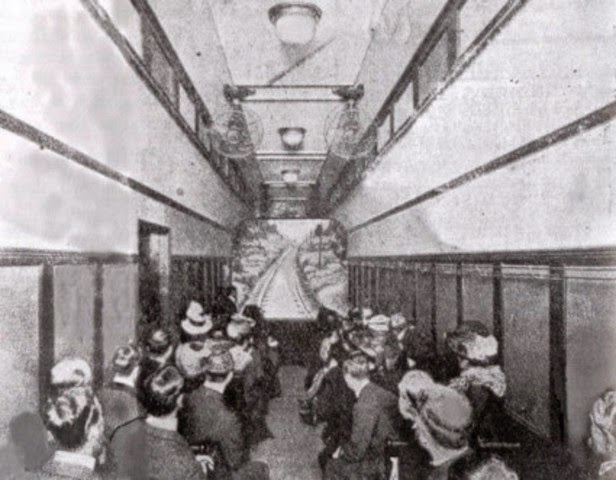
Another immersive panorama at Exposition Universelle in Paris was Pavel Yakovlevich Pyasetsky's Great Siberian Railway Panorama in the Russian pavilion. It offered a 45 minute experience of Trans Siberian rail journey complete with stuffed polar bears on papier-mache icebergs, a dinner of caviar and sturgeon in a luxury imitation train with a library, gymnasium, marble bath, smoking and music salons.


This 45-minute experience was an essay in detail. It offered a chance to experience the 14-day journey by rail from Moscow to Peking, a 6300-mile journey over tracks not yet completed at the time of the Paris Fair of 1900.
There were three realistic railway cars, each 70 feet long, with saloons, dining rooms, bars, bedrooms, and other elements of a luxury train. Totally detailed and lavishly equipped, the cars were elevated a little above a place for spectators in conventional rows of seats. The gallery faced a stage-like arena where the simulated views along the train trip were presented by an inventive contraption.
The immediate reality of a vehicular trip is that nearby objects seem to pass by more rapidly than distant ones. So, nearest to the participants was a horizontal belt covered with sand, rocks, and boulders, driven at a speed of 1000 feet per minute! Behind that was a low vertical screen painted with shrubs and brush, travelling at 400 feet per minute. A second, slightly higher screen, painted to show more distant scenery, scrolled along at 130 feet per minute. The most distant one, 25 feet tall and 350 feet long painted with mountains, forests, clouds and cities, moved at 16 feet per minute.
Real geographical features along the way were depicted on this screen: Moscow, Omsk, Irkutsk, the shores of great lakes and rivers, the Great Wall of China, and Peking. The screens, moving in one direction only, were implemented as a belt system. Due to the inexact speeds of the scenery,the 'journey' never repeated itself exactly, providing an ever-changing combination of scenes and a reason to pay to see the attraction again.  (from The Past Was No Illusion  by Walt Bransford)


Pavel Yakovlevich Pyasetsky's Great Siberian Railway Panorama

↓↓↓


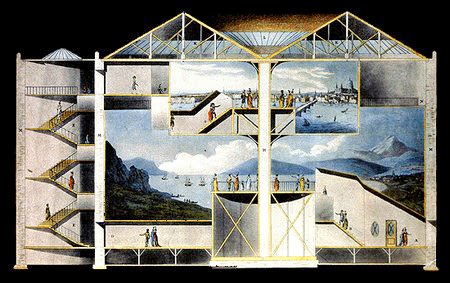
Apart from the great spectacles at Exposition Universelle, 1900, there was a range of other - more common and more humble - weird and wonderful panorama devices. There existed pleoramas, dioramas, padoramas, myrioramas, phantom rides for public viewing as well as personal hand panorama reels, magic lanterns and peep-shows.


http://dip9.aaschool.ac.uk/references/
The Kaiserpanorama, 1900
http://motherboard.vice.com/en_uk/blog/remembering-the-human-gopros-that-gave-the-world
Phantom Ride
https://ore.exeter.ac.uk/repository/handle/10472/2843
Rotunda, Leicester Square
https://ore.exeter.ac.uk/repository/handle/10472/212
Coronation Procession of King George IV
https://ore.exeter.ac.uk/repository/handle/10472/4717
Tableau of the procession at the Queen's coronation June 28, 1838
http://writhingsociety.blogspot.co.uk/2010/02/myriorama.html
Myriorama or tableau polyoptique by Jean-Pierre Brès
(a set of cards that can be arranged in any order)


↓↓


Here are a few of the contemporary moving panoramas that range between overwhelming digital installations of Tomas Saraceno to painted paper scrolls of Adam Cvijanovic.

http://helendouglas.onlineculture.co.uk/ttp/ttp.html
Helen Douglas, The Pond at Deuchar
http://www.frieze.com/issue/review/tomas_saraceno/
Tomas Saraceno, Cumulus at Barbican
https://erindziedzic.files.wordpress.com/2013/09/rolling-panaorama-1_cvijanovic.jpg
Adam Cvijanovic, Rolling Panorama Number 1
http://upload.wikimedia.org/wikipedia/commons/8/8d/Panoramic_View_of_Old_City_lane_%28Pole%29_Ahmedabad.jpg
Panorama of Achmedabad


 ↓↓↓


The Trip to London scroll box is a story telling gadget that bridged book and upcoming cinema. It's situation is not dissimilar to the hybrid publishing projects emerging today as a result of media arts niche-ing themselves into the book market, such as FakePress and HybridBook. Moving panoramas were defeated by the cinema, of course. Which of the contemporary story telling gadgets are going to stay?


↓↓↓


Printed book sources:
- Schwartz, Vanessa. Spectacular Realities: Early Mass Culture in Fin-de-siecle Paris . Berkeley: University of California Press, 1998.


[Egidija]