Showing posts with label photography. Show all posts

Wednesday, 22 February 2017

Notes of Alignment. [2. on The Old Straight Track]


This post is about Alfred Watkins’  The Old Straight Track, some ideas and legends behind it, its rebirth in 1960s and some of the influences.


Alfred Watkins published The Old Straight Track in 1925 on the back of his lecture to the Woolhope Naturalists’ Field Club in Hereford, where he presented his idea of leys - lines of straight alignments (of stones, mounts, churches, etc) in the landscape, which are visible to this day as a record of the ancient trade routes used by our ancestors to travel across Britain.  Alfred Watkins had spent years photographing his native Hereforshire and mapping the walking routes (Daniels). Then, in 1920, as he was sitting in his car at a Blackwardine crossroads, he came up with the theory of leys.


(Watkins was no walker along ley-lines, at least for any distance; he favoured motor cars of various kinds, both steam and petrol powered vehicles, to get close to the key sites, to carry his camera and his assistant Mr McKaig, and to establish the scope of the system. (Daniels))


The book is an impressive, extensively researched effort to make sense of the landscape Watkins clearly loved. The Old Straight Track is as elegant, as it is methodical. When reading it, it is easy to get fascinated by his systematic account of mounts, stones, wells, ponds, histories and customs that surround them, links with the Bible narratives as well as straight lines in other countries, attempts at etymological explanations of toponyms and hydronyms. Then, there is a poetic quote at the start of each chapter and the book completes with a four-liner from Ruyard Kipling.  The Old Straight Track can appear romantic and far-fetched in places (some etymologies are incorrect, some alignments are rather imaginative), however Watkins constructed a vision of olde England, which defines the relationship of many English ramblers with their walking tracks today.


The Old Straight Track got forgotten soon after Watkins’ death. Then, psychedelic 60s came. In 1961 Tony Weld - a former RAF pilot - suggested that there was a link between the leylines and UFO sightings, twisting the idea of ancient trackways into energy lines, thus giving birth to the subject of  “earth mysteries”. (
Pennick, p.27)  Nothing illustrates better the leap from Watkins original archeology-based ideas to ancient astronauts and psychic channelling, than rewriting of the event at Blackwardine crossroads (see the first paragtaph above). The "updated" version says, that 

Alfred Watkins was riding around the Herefordshire hills in the early 1920s, when he pulled up his horse to gaze across the landscape, and he had a sudden revelation. In his vision, every landmark, whether natural or man-made, was linked by a network of straight lines, which he saw as glowing wires laid out over the surface of the land.  The lines passed through hill summits and cairns, linking church spires, prehistoric settlements and burial sites, old encampments and sacred monuments.   Following the route that they took were trackways, straight roads that had been ancient and well trodden long before the coming of the Romans, along which the first settlers of this country would have travelled by day and night, their eyes keenly aware of waymarkers. (Woolf)

New Age mystics highjacking the The Old Straight Track brought it to the forefront of discourse and visibility. As Timpson says, 
The attraction of cranks to leylines is naturally no encouragement to take them seriously: but neither it is a reason for the subject to be rejected (Timpson, p.8)
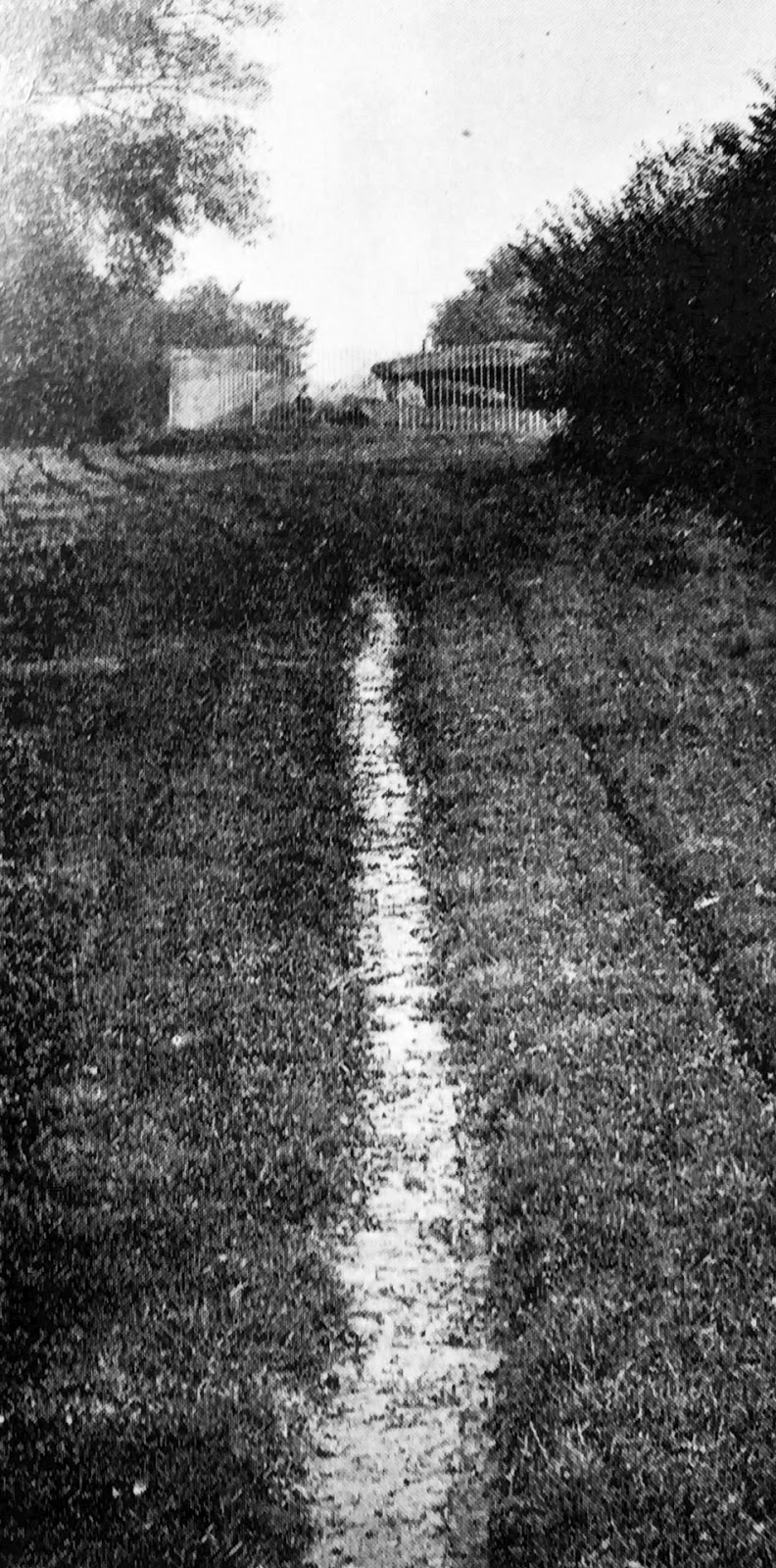


I found few direct references on how Watkins’ book influenced art. It is inevitable that it did so to some extent, considering that arrival of New Age magic coincided with the beginnings of “land art” movement. Looking at the land works of Richard Long and photography of Alfred Watkins it is easy to see visual similarities. However, those similarities lie not in the mystical and the magical energies, but in the real and physical human presence on the land, such as human marks on the land made though walking. 


Richard Long


Richard Long first found out about about ley-lines at the time of his solo exhibition at The Whitechapel Gallery in 1971:
"Someone came up; he saw my lines of walking across Exmoor, the line made by walking and said, have you heard of this man, an eccentric geographer who had a strange theory about invisible lines that connected prehistoric sites across England. That was the first time I had heard of these ley-lines." (Daniels)


Hamish Fulton


Hamish Fulton, on the other hand, was not only affected by the concept of leys, but also by the designs of Alfred Watkins’ books. 
His Straight Line Walk, 1969, relates to the artist’s fascination with the prehistoric ‘ley’ system of walking paths. Around the same time, Fulton made a special visit to the Hertford [sic] Public Library to see Watkins’s original books. Fulton acknowledges this as a very important visit, not only because of his interest in the concept of a walked line for navigational purposes, but also because of the artist’s admiration for the sheer visual and physical beauty of Watkins’s books. Fulton remains fascinated by the clarity and elegance of 1930s and 1940s book layouts, with clear geometric blocks of text, augmented by delicately tinted, tipped in photographs. (Daniels).


Watkins was indeed a competent photographer and his books offer not only skilled pictures, but accomplished and clever layouts and compositions: some pages contain sweeping landscapes with mistied background hills, while others sit as combined images, united as a journey sequence of a common alignment. Simple and clear, parts of The Old Straight Track are tremendously enjoyable as a photo book.


Like Hamish Fulton, we too are fascinated by Watkins' books and their aesthetics - not just The Old Straight Track, but also Early British Trackways with its collaged and overlapping images and simple clear lettering. Alignment project might be borrowing some of those designs. 
There are some conceptual aspects which we will be taking further. In particular, we like the idea that major sacred landmarks can be aligned into a straight track: regardless of what mystic or mundane causes for the alignment might be. If either for sheer randomness or divine intention some sites fall into one line, could we find alignments of our own?


REFERENCES:

Daniels, Stephen (2006) Lines of Sight: Alfred Watkins, Photography and Topography in Early Twentieth-Century Britain.  Tate Papers Autumn. [Online]. Available at http://www.tate.org.uk/download/file/fid/7394  (Accessed:  21 Ferbruary 2017)

Knight, Adam (2013) Ley-lines lead writer to wrong place in history. Hereford Times. 10 June.  [Online]. Available at http://www.herefordtimes.com/news/10465680.Ley_lines_lead_writer_to_wrong_place_in_history/?ref=rss  (Accessed:  21 Ferbruary 2017)

Neil, Alan (2015) Ley Lines of the South West. Launceston: Bossiney Books.

Mills, Billy (2015) The Old Straight Track by Alfred Watkins – walking through the past.  The Guardian. 8 August, [Online]. Available at  https://www.theguardian.com/books/booksblog/2015/aug/20/the-old-straight-track-by-alfred-watkins-walking-through-the-past. (Accessed:  21 Ferbruary 2017)

Pennick, Nigel (1997) Leylines. Mysteries of the Ancient World. London: Weidenfeld & Nicolson.

Timpson, John (2002) Timpson’s Leylines. A Layman Tracking the Leys. London: Cassell Paperbacks

Watkins, Alfred (1974) The Straight Old Track. Its Mounds, Beacons, Moats, Sites and Mark Stones. London: Abacus.


Woolf, Jo Book review: ‘The Old Straight Track’ by Alfred Watkins. The Hazel Tree.  14 July, 2014. [Online]. Available at https://the-hazel-tree.com/2014/07/14/book-review-the-old-straight-track-by-alfred-watkins/ (Accessed:  21 Ferbruary 2017)


Unless otherwise stated, all images are rephotographed from:
Watkins, Alfred (1974) The Straight Old Track. Its Mounds, Beacons, Moats, Sites and Mark Stones. London: Abacus.

Wednesday, 18 November 2015

→ books in cyanotype


BOOK No1

Some weeks ago - just in time for the World Photobook Day - I discovered Anna Atkins' 1841 cyanotypes for the Manual of British Algae: the first book to be photographically printed and illustrated. A copy of this book is kept at Horniman Museum in South London.

(both images from Horniman Museum)
Anna Atkins' prints were "photogenic drawings"(1), as she called them. Cyanotype process offered her an image reproduction technique, which escaped the need for accurate drawings. Blue background suggestive of the sea lent poetic beauty to her images of sea plants. While Atkins famously failed on scientific accuracy, she succeeded in producing an very elegant photo book.


BOOK No2


Last year's MA Visual Arts (Book Arts) show at Camberwell College of Arts featured works by Ziyan Lu -  Unfolding Shaddow. Lu printed by setting up paper in various public locations; then impressing poetics of the flowing time into her books: abstract images were produced by the passing shadows from the objects around.


 BOOK No3

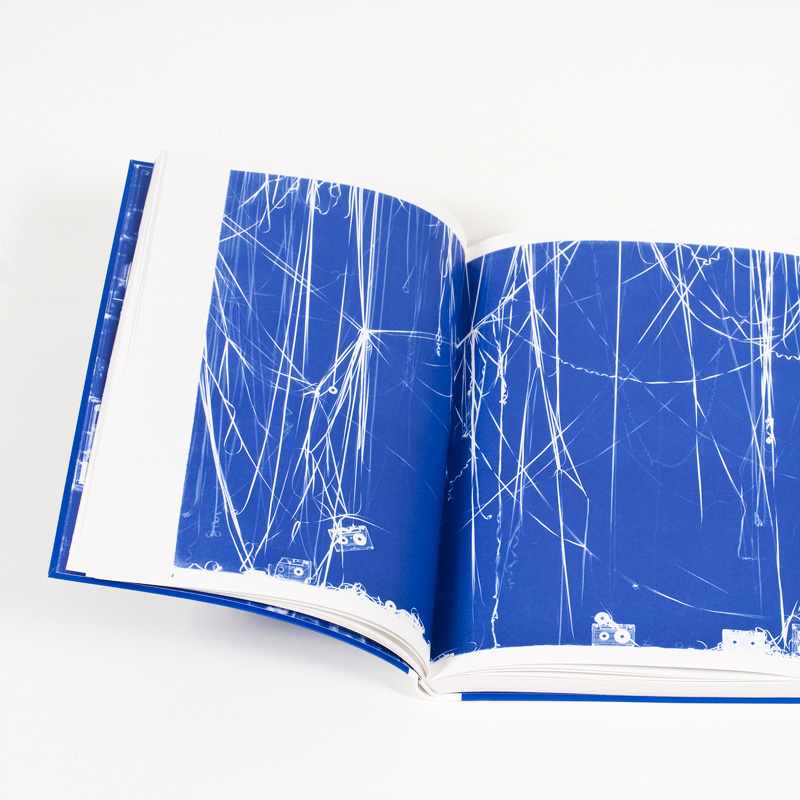
Christian Marclay is a New York based visual artist and composer whose innovative work explores the juxtaposition between sound recording, photography, video and film. In 2011, he published Cyanotypes, for which he used drawings of unwound the spools of old cassette tapes. Often using multiple exposures, Marclay created a labyrinth of lines, all tracing a distinct musical history that becomes abstracted, or at least estranged, on paper.


(images from GRAPHICSTUDIO)


 BOOK No4

In 2011 Ellen Ziegler produced an  artists' book, as she was grieving a sudden loss of her boyfriend. "Imbue” is a sheaf of abstract chemically-altered cyanotype prints inscribed with a crow-quill pen, the words chemically bleached out of the deep blue background. The poems by Patti Smith & Frances McCue reach the sorrowing depths of beautiful and ferocious grief.


(images from Ellen Ziegler website)

AND A BLOG

Vedos Project at Satakunta University of Applied Sciences / School of Fine Art Kankaanpää in Finland unites artists and teachers interested in studying and practising alternative printing processes in photography and printmaking. Their very informative webpage gives a fascinating insight into the processes, including paper and tinting tests.

(images from Vedos Project)


(1) Henisch, Heinz (1994) The Photographic Experience, 1839-1914: Images and Attitudes, University Park, Pa. : Pennsylvania State University Press. p317.


Wednesday, 24 June 2015

→ the photo book (part II): between documentation and memory (@ Photographers' gallery, London)


Georges Didi-Huberman has recently been awarded Theodor-W.-Adorno-Preis 2015, which is given for outstanding achievement in philosophy, music, theater or film. Some years ago he wrote Images In Spine of All, in which he discussed four explicit photographs of mass extermination in Nazi camps. Huberman put the voyeur, the history and the art into one line of questioning. Photography, he said, rested between documentation and memory.
A simple piece of film - so small that it can be hidden in a tube of toothpaste - is capable of engendering an unlimited number of prints, of generations and enlargements in every format. Photography works hand in glove with image and memory and therefore possesses their notable epidemic power. (Huberman, p24)
↓↓↓
As a Lithuanian, I must start this blog with Moshe Vorobeichic. In 1931 he published Paris (as Moi Ver), one of the very first photo artists' books ever produced. At about the same time, however, he published another photo book Ein Getto im Osten - Wilna (1931), documenting the Jewish quarter in Vilnius, where he himself grew up. Like Paris, Wilna book is equally avant-garde in it's collages and layouts. Yet, it is also a very intimate book: the viewer is brought very close to the faces, the puddles, the baskets of Vilnius Jews. The reader is led though the back streets and the markets; the reader looks at the rooftops and the pavement; the reader meets residents of the Jewish quarter. This book is not a record of a historical point in time, rather it is a personal reference point to somewhere in his childhood, soaked in black-and-white nostalgia.


↓↓↓
Photographers' Gallery at the moment is hosting a Chinese photo book exhibition curated by Martin Parr and WassinkLundgren. The exhibition space is tight, but there are large double-page-spread photos, videos of books, books to handle (albeit chained) and books to look at under the glass.


The exhibition does not solely focus on the artists publications, but brings together the whole range of photographic books, pamphlets, promotional material under one umbrella. There is no line between photo books as artists' publications and institutional albums, produced to document an aspect of research, such as tongue conditions or bridges. Does a distinction between photo book as a document and photo book as a creative practice, rest on the maker's intentions only, rather then certain qualities of the outcome? Ed Ruscha recorded gasoline stations, while Chinese government recorded bridges. Both resulted in photo books.


The Hairy People of China


Basics of soccer - a series of techniques

This merging of intentions is what I found so pleasing about the exhibition: there were instructions on the correct ways to play sports and then there were artists' publications, such as the beautifully cinematic  This Face portrait book by Xu Yong.


 Zi U's face was photographed during various times of the day: with make-up and without, tired and refreshed. She is a sex worker. She sees clients from very close and she is used to be seen from close. The sequence of photographs forms an intimate portrait similar to that produced by a film: the trace of the real Zi U is captured in-between the page spreads and the viewer, in-between proximity and truth, in-between memory and document.

Photographers' Gallery also contained an exhibition of Deutsche Börse Photography Prize 2015 (now closed). Mikhael Subotzky and Patrick Waterhouse - the winners - had the work in the first room for their mammoth long term project documenting the fate of Johannesburg's Ponte City. The prize was awarded "for their ambitious publication Ponte City (Steidl, 2014), charting the social and political history of a 54-floor apartment block in Johannesburg", which was built under apartheid rule in 1976 and was originally conceived as a center of aspirational living for a white elite.  A sequence of books follows the temporal line of events, with an introductory pamphlet - containing newspaper headlines - placed at the front. The narrative is built one step at a time by thoughtful sequencing of images and texts. The work balances between the space of historical documentation and artistic interpretation, merging the boundary between the the objective fact and subjective elucidation. 


↓↓↓
As a young teenager I collected photo books of my city. They were published once every few years. I did not own a camera - I documented my space and time in another way. Like those Chinese photo books - which show the correct way to play soccer - Kaunas photo books reflected the correct Soviet way to see my town. They are not voyeuristic (like Xu Yong's book), they are not nostalgic (like Moshe Vorobeichic book) and they only have the intimacy of a travel agent's photography. Yet, they stand as a document and they stand in for memory. Because they contain photographs.
Photographed images do not seem to be statements about the world so much as pieces of it, miniatures of reality that anyone can make or acquire. (Sontag, On Photography)


↓↓↓


1. Susan Sontag also argues against photo books, because they determine the order in which photographs are to be viewed. Like cinema, photo books sequence images as determined by artist's intentions. It is in the nature of the photo book to be sequenced. Yet, it is also in the nature of the book as such to accommodate a random access option for the viewer should one desire to exercise such.


References:

images Egidija's own, except for M. Vorobeichic (Moï Ver), Ein Ghetto im Osten – Wilna, 1931, which were taken from achtung.photgraphy website.


Didi-Huberman, G (2008), Images in Spite of All: Four Photographs from Auschwitz, Chicago: University of Chicago Press.
Sontag, Susan, On Photography http://www.susansontag.com/SusanSontag/books/onPhotographyExerpt.shtml, June 21, 2015.


[Egidija]

Wednesday, 4 February 2015

→ reading imagining picturing procrastinating


New Focus arrived today. While Bible might be delivering good news for some parts of population, in our house - it's Focus. Today's issue alone is going to take a few bubble-baths of reading. So what's the good news of today? 


  reading

First of all, Einstein's collected papers are available online through Princeton university - a very clearly structured interface for accessing some of the most extraordinary pieces of writing of the 20th century. For example, one can now dip into a delightfully lyrical world of Einsteinian letter-writing, such as this one he sent to Mrs Curie in 1913.


http://einsteinpapers.press.princeton.edu/vol5-trans/354


"A few days have passed since the wonderful profusion of things rushed past me. The fibrils of my brain must still be in terrible disarray from all of that....
If science can be poetic - Einstein has certainly nailed it - of course, among a few other facts that he had nailed rather well too. Such a pleasure to read! I only wish the texts were complemented by the scans of the originals.


↓  imagining

The second bit of great news is that...  everything is in the head. Apparently, carrying out five sessions of imaginary exercise per week had positive effects on developing grip-strength in volunteers at Ohio University. No sweaty armpits, no chlorine soaked hair, no shin splints - only five imaginary sessions which, I could perform from a hammock under linden trees.


  picturing

Third - not entirely everything is in the head, as page 81 suggests. Why do we get a mental picture when reading? Or - why don't we? 
Visual and auditory areas of your brain are at work when you read, as you subvocalise the words when one of the characters is speaking... All of this contributes to what we think of as pictures in our head - yet in reality our brains probably contain no such thing. Indeed, recent theories treat vision more like an activity or interaction with the world rather than a picture-making process. Oddly enough, more detailed written descriptions may not result in richer or more satisfying mental imagery. Sometimes, the simplest descriptions allow you to create your own imagined world with far more detail and emotional involvement. 
 Less is more, they suggest. It is more emotionally satisfying to be involved in creating a personalised mental imagery. This satisfaction is probably what explains the allure of haiku poems and artists such as Hiroshi Sugimoto and Indrė Šerpytytė

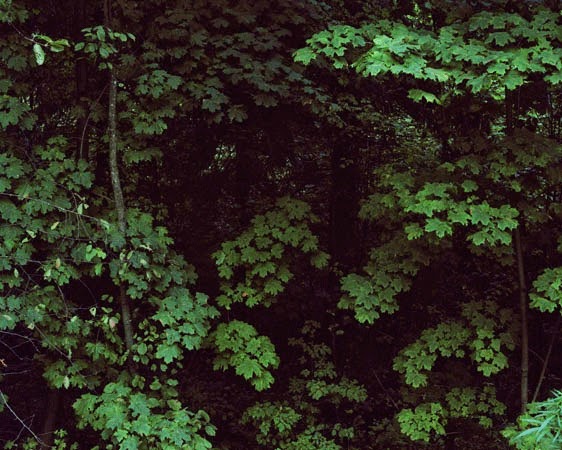
Indrė Šerpytytė is one of the artists currently showing as part of Conflict Time Photography exhibition at Tate Modern. In one of the rooms (towards the end) she is showing wooden carvings of KGB interrogation houses and their studio "portraits". Refreshingly, her take on Lithuanian history is a non-judgemental, non-sentimental commentary with plenty of gaps and empty spaces for the viewer to fill in. My favorite works, however, are those from Forest Brothers series: dense treescapes, suspended between the world of Hansel-and-Gretel-fairy-tale fear of the dark forest and an honest link with factual landscape of the post-war Lithuanian resistance fighters. Less is more.


↓  procrastinating

The final good news is called WIKIGALAXY. Computer science MA(!) student Owen Cornec put together this galaxy-style visualisation of tens of thousands of Wikipaedia pages to help you get lost down even more rabbit holes of useless but fascinating information. While drifting aimlessly among his 3D paths linking various concepts, I did wonder if this could be called a binding. If the metaphor of book can extend into the digital reading media, could we not extend the notion of binding too, to denote the ways that keep separate pages of digital information together? 


[Egidija]