Welcome back after our summer break, we hope you had a nice few weeks!
To ease us back, I thought I'd start with a gentle post about one of my all-time favourite websites - OpenLibrary.org. For the uninitiated the goal of OpenLibrary is to be "an open, editable library catalog, building towards a web page for every book ever published".
As well as being a catalogue, OpenLibrary also contains millions of scanned copies of books that can either be downloaded, borrowed or read online completely for free. Below is a selection of the the books to read and books to borrow.
This library is a huge resource - according to the stats for the past month they had over 7m unique visitors, who borrowed over 95,000 books!
Open library is a resource I have used in three art projects (twice as integral parts of the work and once in the background):
For The Good Reader: Between the Lines, I created a narrative about Paris comparing my own recollections to the stifled descriptions from travel guides. Using a QR code reader readers can borrow electronic copies of each of the guidebooks referred to.
For The Unassuming Collection I created a fictional narrative about a library, illustrated by images from existing books. A QR code on each page linked to the full book behind each of the illustrations. The intention was to create a real library that sat behind the fictional one.
The third way I have used Open Library is to catalogue a small collection of books that was part of an exhibition called Folles de leur Corps at Cafe Gallery Projects, by Sharon Kivland. This was a great way to group the books so a more permanent record could be kept.
I hope this post has given a suggestion of the artistic possibilities of OpenLibrary - the potential of it seems immense to me.
[Chris]
Showing posts with label digital books. Show all posts
Wednesday, 9 September 2015
Wednesday, 18 March 2015
→ from book to film to book in a fanny dance
.
→ FROM
When the moving image was first invented there was a tremendous excitement about the possibilities of the new medium. It was a spectacle on par with the magic shows. Georges Méliès produced The Haunted Castle and A Trip to the Moon. Lumière Brothers produced Le Squelette joyeux and Spanish Bullfight. Watching those films it is easy to see what the joy and the fascination were all about. It was "the cinema of attractions", as Tom Gunning called it, full of "visual delights…surprises…displays of exotic, beautiful or grotesque…or other sorts of sensational thrills “ (Abel, 2005)
Those early short films - each only about 4 minutes long - certainly used and explored the moving image with imagination and dedication of Caractacus Potts. The idea of film as a non-narratative medium (or where story-telling takes a secondary role) resembles a form of an artist's book, which excites the reader with form and content, rather then the verbal story on its pages (symmetry Nr1): a short blast of unfolding enjoyment.
→
The parallel between book and film goes beyond a direct book adaptation. Like film, codex is inherently sequential by it's structure: there are pages (film frames) and pages (film frames) and pages (film frames) that require time to ingest in a linear order from 1 to X hundred. (symmetry Nr2). McFarlane, in contrast, compares book to a literary narrative, distinguishing word as the smallest unit in the sequence. He rightly points out, that we do not watch film frame by frame as we read novel word by word. The comment would still stand even if comparing film/frame structure to the book/page structure. However, the principle of linear time-based sequenciality remains.
→ BOOK TO FILM TO BOOK
Film editing process requires patience, stamina and precision of a typesetter, as I realised when editing between one hand and another. It was an illuminating experience, that had me appreciate links between book and film production and possible transitions that I had not yet considered.
When looking for more specific bridges between the two areas, I found that most conversions between the mediums happen in reference to their inherent sequentiality (symmetry Nr2). Flip books are the ones that came to my mind first. (Is it a film? Is it a book? Is it a toy?) Flip Books ! Un livre, un pouce, un film is probably the most remarkable project of them all. The film (which was screened at this years Pages book fair), includes an anthology of 300 activated flipbooks from Pascal FOUCHÉ’s collection (France - 2007). It traces the history from the XIXth century to today and it is subdivided into categories, such as dance, animals, artist's books, publicity, etc. Remarkably, there is "no dialog, no music, only the characteristic "flip" sound, in Stereo Dolby , wow !"
PS. → IN A FANNY DANCE
Visual books use even more cinematic features: such as panning, flashbacks, eye-line matching, etc. I was also going to include video poetry (I did, in fact, and I deleted), photobooks and animation (flipbook linked), and then I realised that I was digging too deep and this whole blog post was getting out of my hands. So I stopped. Leaving some great subjects and artists to tackle next time.
Sources:
Abel, Richard (2005) "Cinema of Attractions." Encyclopedia of Early Cinema . New York. p. 124.
[Egidija]
(…) as we begin to read, a temporal process commences, which in addition to the two dimensions of surface and to the dimension of space—we think of the body of the book!—brings the fourth dimension of time. One of the essential characteristics of time is that the direction in which it moves is irreversible. (Hoculli, 1996)
→ FROM
When the moving image was first invented there was a tremendous excitement about the possibilities of the new medium. It was a spectacle on par with the magic shows. Georges Méliès produced The Haunted Castle and A Trip to the Moon. Lumière Brothers produced Le Squelette joyeux and Spanish Bullfight. Watching those films it is easy to see what the joy and the fascination were all about. It was "the cinema of attractions", as Tom Gunning called it, full of "visual delights…surprises…displays of exotic, beautiful or grotesque…or other sorts of sensational thrills “ (Abel, 2005)
Those early short films - each only about 4 minutes long - certainly used and explored the moving image with imagination and dedication of Caractacus Potts. The idea of film as a non-narratative medium (or where story-telling takes a secondary role) resembles a form of an artist's book, which excites the reader with form and content, rather then the verbal story on its pages (symmetry Nr1): a short blast of unfolding enjoyment.
→
As soon as producers realised that longer films meant bigger profits, narrative cinema was born: Cinderella (Georges Méliès) and Alice in the Wonderland (by Cecil Hepworth and Percy Stow) were among the first to be made.The adjective “well-thumbed” tends to suggest a certain monomania regarding a text (Farry, 2015)
The parallel between book and film goes beyond a direct book adaptation. Like film, codex is inherently sequential by it's structure: there are pages (film frames) and pages (film frames) and pages (film frames) that require time to ingest in a linear order from 1 to X hundred. (symmetry Nr2). McFarlane, in contrast, compares book to a literary narrative, distinguishing word as the smallest unit in the sequence. He rightly points out, that we do not watch film frame by frame as we read novel word by word. The comment would still stand even if comparing film/frame structure to the book/page structure. However, the principle of linear time-based sequenciality remains.
Like oral or cinematic narrative, it (literary narrative) can only be "consumed", and therefore actualised, in time that is obviously reading time, and even if the sequentiality of its components can be undermined by a capricious, repetitive, or selective reading. (Genette, 1980)
→ BOOK TO FILM TO BOOK
Film editing process requires patience, stamina and precision of a typesetter, as I realised when editing between one hand and another. It was an illuminating experience, that had me appreciate links between book and film production and possible transitions that I had not yet considered.
When looking for more specific bridges between the two areas, I found that most conversions between the mediums happen in reference to their inherent sequentiality (symmetry Nr2). Flip books are the ones that came to my mind first. (Is it a film? Is it a book? Is it a toy?) Flip Books ! Un livre, un pouce, un film is probably the most remarkable project of them all. The film (which was screened at this years Pages book fair), includes an anthology of 300 activated flipbooks from Pascal FOUCHÉ’s collection (France - 2007). It traces the history from the XIXth century to today and it is subdivided into categories, such as dance, animals, artist's books, publicity, etc. Remarkably, there is "no dialog, no music, only the characteristic "flip" sound, in Stereo Dolby , wow !"
The film certainly sounds fascinating - just like the whole business of flip-books. I will be coming back to the subject very soon.
The video below does not come from Flip Books ! Un livre, un pouce, un film - I found no quality images of the project online. This video is a credit to the amazing Flipbook Collector on YouTube - great channel!
→
Flip Books ! Un livre, un pouce, un film is a professional documentation of 300 books. But there are also documentation works of individual artists: artist's who work with all kinds of books (not just flipbooks) often resort to video to record their work. Because it is time-based. Personally, I like how our George documents his works. His videos and their presentation maintain the character of his books: they are a good step above a tipod+flipbook set-up. Below is an illustration from to every action there is a reaction. Take time to look at his other book videos. Immaculate.
→
And here is the most obvious work of them all. DOT (DOT: The book as a video and DOT: The book) The video is a sequence of digitally reproduced letterpress prints, produced in the typography workshop of the University of Arts in Braunschweig, Germany. The pages were collected and bound to three (almost) identical books. The project’s subheading refers to this coexistence of print and digital video.
It is an interesting project which requires spotless skills of a typesetter and a video editor. I loved the experimental idea of it, however - as for the rest - it was somewhat underwhelming. I wonder what Romano Hänni could have done with the video!
→Flip Books ! Un livre, un pouce, un film is a professional documentation of 300 books. But there are also documentation works of individual artists: artist's who work with all kinds of books (not just flipbooks) often resort to video to record their work. Because it is time-based. Personally, I like how our George documents his works. His videos and their presentation maintain the character of his books: they are a good step above a tipod+flipbook set-up. Below is an illustration from to every action there is a reaction. Take time to look at his other book videos. Immaculate.
→
And here is the most obvious work of them all. DOT (DOT: The book as a video and DOT: The book) The video is a sequence of digitally reproduced letterpress prints, produced in the typography workshop of the University of Arts in Braunschweig, Germany. The pages were collected and bound to three (almost) identical books. The project’s subheading refers to this coexistence of print and digital video.
It is an interesting project which requires spotless skills of a typesetter and a video editor. I loved the experimental idea of it, however - as for the rest - it was somewhat underwhelming. I wonder what Romano Hänni could have done with the video!
(…) as we begin to read, a temporal process commences, which in addition to the two dimensions of surface and to the dimension of space—we think of the body of the book!—brings the fourth dimension of time. One of the essential characteristics of time is that the direction in which it moves is irreversible. (Hoculli, 1996)
PS. → IN A FANNY DANCE
Visual books use even more cinematic features: such as panning, flashbacks, eye-line matching, etc. I was also going to include video poetry (I did, in fact, and I deleted), photobooks and animation (flipbook linked), and then I realised that I was digging too deep and this whole blog post was getting out of my hands. So I stopped. Leaving some great subjects and artists to tackle next time.
Sources:
Abel, Richard (2005) "Cinema of Attractions." Encyclopedia of Early Cinema . New York. p. 124.
Buchan, Suzanne (2013) Pervasive Animation. Routledge p. 63
Chilyan, Tagui (2011) The Development of Narrative Film. Hitrecord: http://www.hitrecord.org/records/402381
Genette, Gerard (1980) Narrative Discourse. New York: Cornell University Press. p. 34.
Hochuli, Jost & Kinross, Robin. Designing books: practice and theory. Hyphen Press. London,1996. p.12
Farry, Oliver (2015) "The crack of the spine: why do we find wear and tear in books so comforting?". New Statesman: Feb 19, 2015 http://www.newstatesman.com/culture/2015/02/crack-spine-why-do-we-find-wear-and-tear-books-so-comforting
McFarlane, Brian (1996) Novel to Film: An Introduction to the Theory of Adaptation. Oxford: Clarendon Press.
[Egidija]
Wednesday, 14 January 2015
#cybertext
↓↓↓
Generally, I prefer reading straightforward linear texts in straightforward linear books page by page in a non-confusing arrangement of thoughts where one idea follows another. Unfortunately, as I look around myself at this very moment I can see two open books to the left, a small pile of photocopied pages to the right, an iPad, a laptop and my notes all annotated, cross-referenced and collated to accompany my re-reading of Katherine’s Hayle’s Writing Machines (Mediaworks Pamphlet)
How cybertextual!
The term cybertext was coined by Espen Aarseth in Cybertext: Perspectives on Ergodic Literature
"The concept of cybertext focuses on the mechanical organization of the text, by positing the intricacies of the medium as an integral part of the literary exchange. However, it also centers attention on the consumer, or user, of the text, as a more integrated figure than even reader-response theorists would claim.
...cybertext is used here to describe a broad textual media category. It is not in itself a literary genre of any kind. Cybertexts share a principle of calculated production, but beyond that there is no obvious unity of aesthetics, thematics, literary history, or even material technology. Cybertext is a perspective I use to describe and explore the communicational strategies of dynamic texts.(Espen Aarseth, Cybertext: Perspectives on Ergodic Literature)
↓↓↓
Here is one of the online i-Ching reading sites → 易經.
↓↓↓
Vladimir Nabokov's Pale Fire
↓↓↓
↓↓↓
Here is one more beautifully produced piece of digital art! Hollowbound Book by Erik Loyer is an interactive response to N. Katherine Hayles’ book Writing Machines, in which a newly liberated book binding testifies to its liberation at the hands of Hayles’ theories. It is not a cybertext in it's own right (for what I understood about cybertexts). However, it can be considered part of cybertext that N. Katherine Hayles’ Writing Machines (Mediaworks Pamphlet)
↓↓↓
Children's books - like artist's books - often allow themselves the sort of ingenuity that adult books do not. A few blogposts behind I mentioned Myriorama or tableau polyoptique - a form of cards entertainment that became especially popular in the 19th century: a child was able to arrange and re-arrange the cards into any order to build visual narratives. Similarly, my own children in their own time could not have enough of Mixed Up Fairy Tales (Mixed Up Series)
↓↓↓
Aarseth's cybertext is an idea of a multicursal text, which allows readers to biuld their own path though the labyrinth of reading - for example, through a possibility of physical rearrangement of narrative modules. Some of those objects mentioned above are books, while others are games or "whatever they are" (my very very favorite quote by Johanna Drucker in relation to digital book models). As cybertexts, they are a form of text - a text, which is a big metaphorical leap away from it's definition in linguistics. As reader-led narratives, they are a form of story-telling tradition.
PS. The idea of cybertext is confusing in many ways - as I have mentioned above. I would be happy to hear from anyone with useful links on the subject.
A curious note that had no space in the text above:
At the start of the book Aarseth cites Penelope Reed Doobs discussion on physical and metaphorical labyrinths of classical antiqity and Middle Ages. She distinguishes two types of labyrinth paths: "unicursal, where there is only one path, winding and turning, usually toward a center; and the multicursal, where the maze wanderer faces a series of critical choices". The two ideas of labyrinth have co-existed until Renaissance, until the concept was "reduced to the multicursal paradigm that we recognise today". As a result we have since grown to regard linear and labyrinth and incompatible ideas.
[Egidija]
Wednesday, 12 November 2014
#metadata #narrative #archive
↓↓↓
The images on this page are generated by "visually similar" Google image search for brass pull cord bayonet type lightbulb lamp holder traditional earthed. An algorithm pulled them out from the vast archive of Google images for me.
Somebody said that digital database defines the 21st century.
↓↓↓
A couple of weeks ago Books in Browsers 2014 took place in San Francisco. Most of their talks are now available on YouTube, including the one from Johanna Drucker Database Narratives in Book and Online. She gives a neat introduction into what she believes to count as a book*. She then admits homicidal feelings towards those who think otherwise, and continues with her fascinating talk on the structuring of a narrative as an online database and a consecutive print output.
At the core of Johanna Drucker’s talk is her personal project, where she attempts to reign in the archive of her unpublished works, the records of which span about 40 years of writing. In the process of this experiment she scans her unpublished works to create an online representation of the library and to explore it’s relationship to the potential printed book as well as the original manuscript. She works in xml format and her archive is heavy with metadata. Metadata fields, she says, allow to structure multiple kinds of chronological and temporal organisational filters: they allow to redistribute literal temporality built into most of the narratives.
Johanna Drucker talks about the relationship between the networked resource and a printed output. What would the role of the printed book be in relation to the database? Is it a catalogue of the archive? Is it a guidebook? Is it an interface providing an augmented experience of the web environment?
Those questions, of course, can be asked about any book published from a database. Wolfgang Ernst in his essay The Archive as Metaphor** observes that archive as such does not contain narratives: it is a purely technical practice of data storage.
The archive does not tell stories; only secondary narratives give meaningful coherence to its discontinuous elements. In its very discreteness the archive mirrors the operative level of the present, calculating rather than telling. In the archive, nothing and nobody ‘speaks’ to us – neither the dead not anything else. The archive is a storage agency in spatial architecture. Let us not confuse public discourse (which turns data into narratives) with the silence of discrete archival files.When traditional paper archives migrate into digital forms, their contents get reduced to a binary code. As a result, computer stops separating stored file information and processing rules (as in traditional archives).
When both data and procedures are located in one and the same operative field, the classical documentary difference between data and meta-data (as in libraries, where books and signatures are considered as two different data sets) implodes.
Digitalised memory undoes the traditional supremacy of letters in paper-based archives; instead, sound and images enter as well which can be addressed in their own medium: melodies can be retrieved by similar melodies, images by images, patterns by patterns.
Metadata allows to break the syntagmatic relationship between the items in the traditional database, in favour of highlighting paradigmatic links. While a collection of data in its own right has no narrative, it is how we travel through the archive: how we connect its fragments and how we fill in the gaps, that gives linearity to the experience.
Is clever manipulation of metadata enough to function as a guide for the reader? Or would database benefit from a printed interface providing an augmented experience of the web environment?
↓↓↓
An expansive volume of writing and artwork is available on the subject of archives, database generated narratives, collaborative authorship, etc. Below I have chosen a couple of works and texts that I had found fascinating:
art:
Pockets Full of Memories by George Legrad
Postcards From Google Earth by Clement Valla
I’m Google by Dina Kelberman. (I did not get to the end of it. If you do, can you let us know what’s there at the bottom?)
Girls on White by Rebecca Lieberman
I’m Google by Dina Kelberman. (I did not get to the end of it. If you do, can you let us know what’s there at the bottom?)
Girls on White by Rebecca Lieberman
Lev Manovich : Database as a Genre of New Media
Wolfgang Ernst : Digital Memory and the Archive
Wolfgang Ernst : The archive as metaphor **
Brooke Belisle : Total Archive: Picturing History from the Stereographic Library to the Digital Database
D|N|A: Seven Interactive Essays on Nonlinear Storytelling
UK Web Archive
-
oScope visual search
TinEye multicolour search
retrievr search by sketch
Musipedia melody search
-
oScope visual search
TinEye multicolour search
retrievr search by sketch
Musipedia melody search
* Book is a a structured sequence of intertextual components that have a structural relationship to each other, each of which is coded in order to participate in the semantic field of the book as a whole.
↓↓↓
Wednesday, 8 October 2014
this blog post is about you
I have been doing some research in where to place the reader, or more what is the space in which the reader is. If the book (or piece of book arts) is a space where the author/artist puts their work what is the space in which the reader puts themselves.
But it is literature that I am most interested in. As this singular experience you are having with the book suddenly becomes plural one. Where a conversation has been started. For example, In Miguel de Cervantes - Don Quixote: 'Idle reader: thou mayest believe me without any oath that I would this book, as it is the child of my brain...' and Charlotte Bronte's Jayne Eyre: 'Reader, I married him....'. You are placed somewhere by the book because it addresses you. The book is in front of you looking out. You form part of the story and part of the space in which it exists. Not only is the book about containing the story it is about you reading it. It is important that you are there.
________________________
I will bring together two parts of my research one in the form of a short piece of text and the other a short visual essay.
When creating a book I think it is easy to overlook the reader. To think of it merely as a receptacle in which you place your thoughts. But without the reader the book itself would not be activated, it would not be read. It would simply lie like sculpture observed but not entered. To pick up a book and hold it you enter a space, you are immediately placed in front of the book. You are there behind it as you hold the book in front of you. What happens then when you are made aware of this space through your interaction with the book?
I have been reading about the 'Fourth Wall'. Originating in theatre where the imaginary forth wall was the wall facing out to the audience. The first, second and third walls being the sides and back of the walls on stage. This forth wall is used in some plays to its advantage. Not only as a point for what is off the stage (the audience) to look in, but what is on stage to look out and acknowledge. Actors on stage speak directly to and acknowledge the audience in a technique called 'breaking the fourth wall'. This breaking of the fourth wall is a way of acknowledging the space that the audience in is a vital part of the play. Of course this also happens in cinema:
But it is literature that I am most interested in. As this singular experience you are having with the book suddenly becomes plural one. Where a conversation has been started. For example, In Miguel de Cervantes - Don Quixote: 'Idle reader: thou mayest believe me without any oath that I would this book, as it is the child of my brain...' and Charlotte Bronte's Jayne Eyre: 'Reader, I married him....'. You are placed somewhere by the book because it addresses you. The book is in front of you looking out. You form part of the story and part of the space in which it exists. Not only is the book about containing the story it is about you reading it. It is important that you are there.
________________________
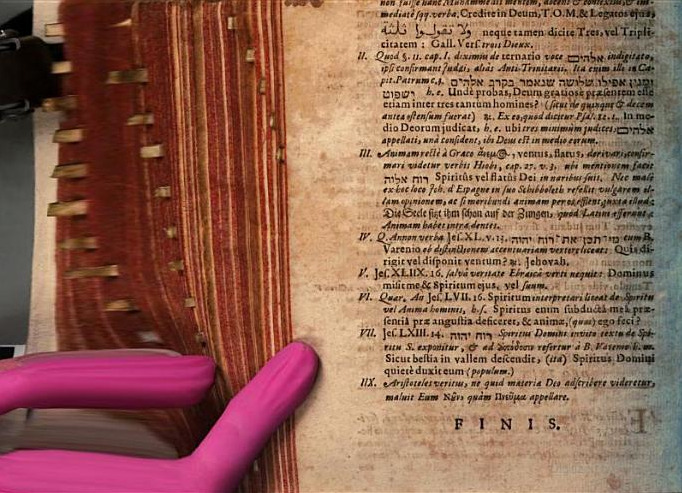
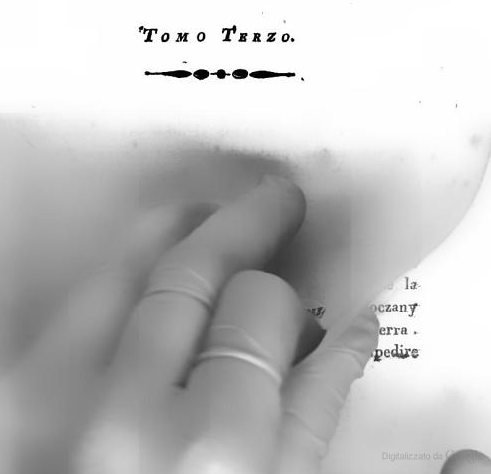
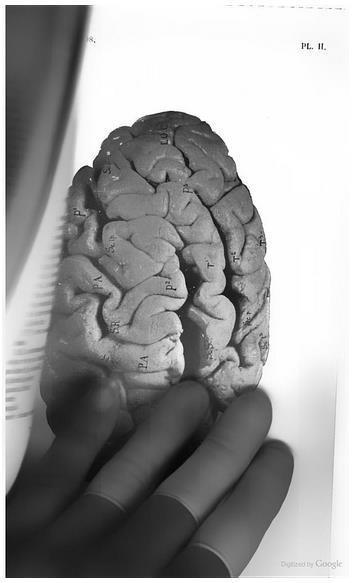
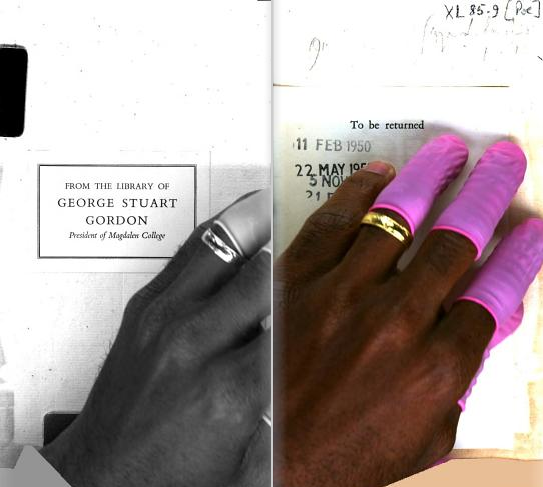
This short visual essay forms a counterpoint to the research. Where the book addresses you, this is about people addressing books. Or at lest a mistaken snapshot into the process. They are scans of books archived by google books, though they have the edition of the archivers hands in them. It provides a fun snapshot into the time and point these books were being scanned. Held by someone, moved and interacted with. Held in places while scanned, these images place the reader there directly with the book.
Further reading:
- Dear Reader: of private and public writing an essay by Mick Wilson: https://gupea.ub.gu.se/bitstream/2077/24662/1/gupea_2077_24662_1.pdf
- Video Essay: Breaking the fourth wall by Leigh Singer: http://blogs.indiewire.com/pressplay/video-essay-breaking-the-fourth-wall
- The art of google books: http://theartofgooglebooks.tumblr.com/search/hand
[George]
Further reading:
- Dear Reader: of private and public writing an essay by Mick Wilson: https://gupea.ub.gu.se/bitstream/2077/24662/1/gupea_2077_24662_1.pdf
- Video Essay: Breaking the fourth wall by Leigh Singer: http://blogs.indiewire.com/pressplay/video-essay-breaking-the-fourth-wall
- The art of google books: http://theartofgooglebooks.tumblr.com/search/hand
Labels:
Archive,
Book Arts,
Cinema,
digital books,
Film,
Forth Wall,
George,
Google Books,
Hands,
Literature,
Reader,
research,
Scans
Subscribe to:
Posts (Atom)