Showing posts with label Randi Strand. Show all posts

Wednesday, 9 December 2015

GUEST POST: SENSES CHANGES MINDS MOVES - ARABESK (Randi Strand)


ARABESK – a series of books made in relief print and hand-cut stencils on 11-12 grams Japanese paper. Each book has 4 – 7 sheets. The paper and the ink is so transparent that you always see something of each sheet. The books have black covers. Edition of 1 to 5. Year 2014- 15.
Here you see images of ’Arabesk 12’.

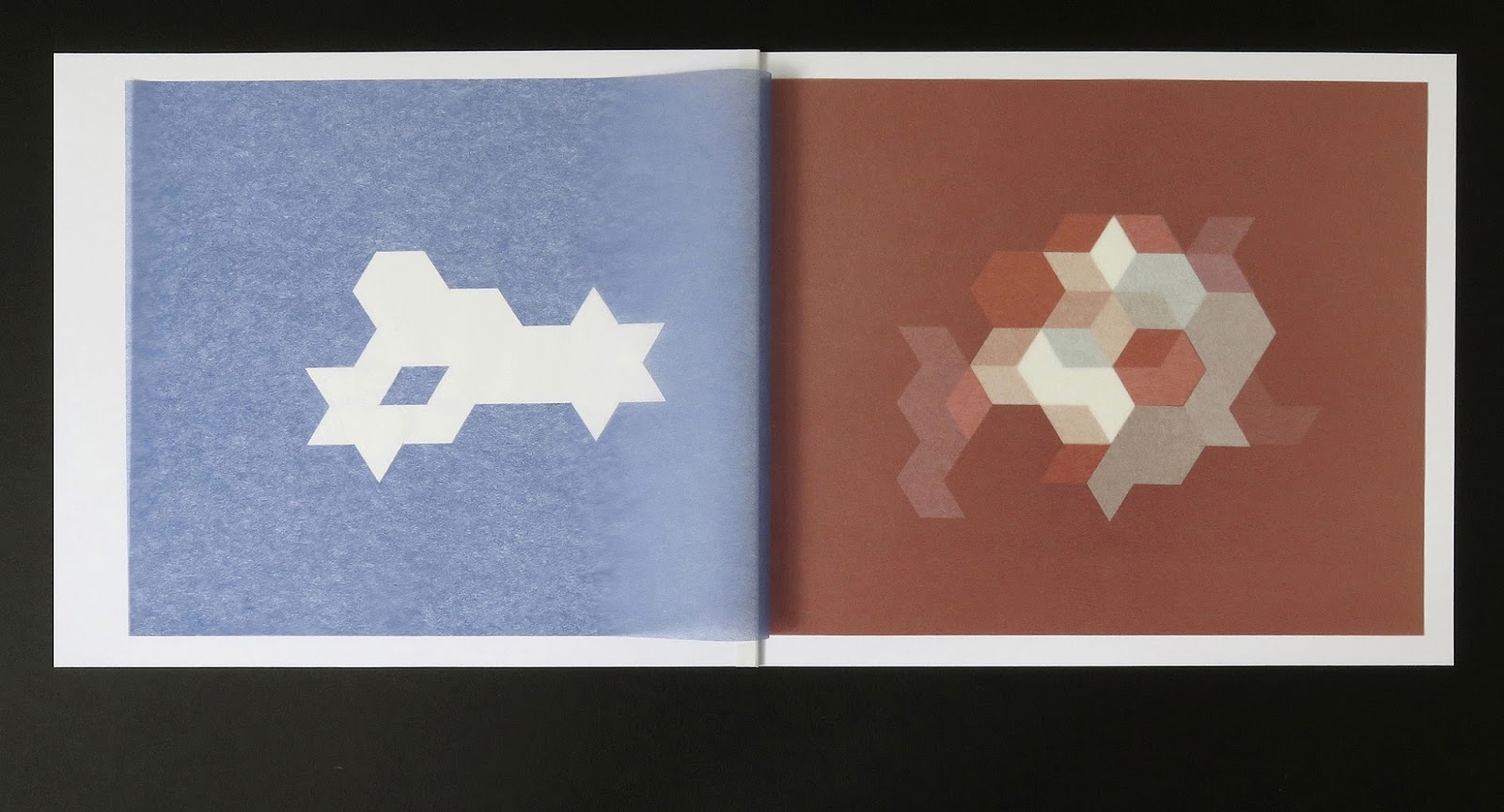


The paper is translucent, soft, airy, and completely silent. Quick movements of the papers is physically impossible. Each sheet has one visual element, a shape which is mirrored as you turn the page.


The fragile paper is printed with motives developed from Arabic ornamentation. This expression was originally created out of mathematics and geometry, to avoid imagery that might lead to idolatry. I wanted to combine the book as a system, with this geometry to see what that could bring. I find it fascinating how the images switch between flat and spatial, and that despite the strict patterns, associations may vary and go towards modernism, the oriental, and paradoxically also towards figuration.


The transparency causes overlaps between the pages that create new shapes and new colors. The sheets melt together in a way which makes it almost impossible for the reader to predict the next sheet’s exact pattern and color, or to remember precisely the last motif. It plays with the illusions of form, color, space and order. The image is transformed with each turn of a page and becomes ephemeral.


A book starts to exist the moment its pages are turned. Since the book is a media of intimacy, presence and touch, haptic communication inevitably establishes meaning in itself, a communication which invariably will be in some kind of relation to the mental content. It is an arena where perception and thinking operate together, it might also bring awareness of your own perception.


Books have been holy objects for many different reasons. The fragility of the paper and the actions necessary, may add a ritualistic element to the act of reading. I see the reader’ act as a performance, a slow motion ballet. In a materialistic culture of mass consumption and noisy, offensive expressions, I find it appropriate to react by focussing on tranquility, care, and consideration.


Like mandalas, which often are written in sand to be washed away, I have tried to create a space for a contemplative experience, displaying the ever changing character and relativeness of existence, where different elements always are colored and influenced by their surroundings.


One time based media can express another; see a slow motion page-turner, a real interactive media by clicking:


Arabesk 4: https://www.youtube.com/watch?v=Vzpw99bqKRo
Arabesk 9: https://www.youtube.com/watch?v=YnzaAkFcEIs
Arabesk 12: https://www.youtube.com/watch?v=4yYLoLW66w8


www.randistrand.no


Randi Annie Strand, visual artist, born in Norway 1962. Lives in Oslo. MA from Bergen Academy of Art and Design (92). Language, signs and sensory experiences are central elements in her works. Her ideas has been realised through different media and techniques. She has had many solo- and group exhibitions in Norway as well as abroad. Purchased by The National Museum, KODE Art Museum among others.


Wednesday, 23 September 2015

→ books & braille: reading with the fingertips

↓ 

At BABE earlier this year I met a Norwegian artist Randi Strand. Randi's work reflects on the physicality and meaning of language signs, exploring relationship between signifier and signified. Randi showed me her recent book BERØRINGSSTROFER, which runs a Norwegian text alongside a text in Braille. Norwegian words are printed in a gently raised glossy ink. A bind person would be able to read the Braille and detect the physical presence of another text without being able to read it. A sighted person, on the other hand, will be able to read the Norwegian text (subject to the knowledge of Norwegian!) and see the presence of Braille as asemic writing. This beautifully light and poetic book combines tactile and visual pleasure of reading.


↓

When we close our eyes, the object between our fingers loses visual cues - such as title, text, colophon, index, images. Books become blank books - or libri illeggibile - books devoid of traditional attributes of book in favour of acoustic and tactile experience. (Reading Book as an Object, 2015)

Indeed, some books become less blank than the others: some books are produced for tactile reading and they can only be read with the fingertips. In those books materiality of the object merges with the verbal and the visual content into one tactile experience of a very physical reading. They are the books for the blind.

↓ 

David Rumsay Map Collection holds a 1837 embossed atlas for the blind. The atlas is printed in Boston Line Type - it was not until 20th century that New England Institution for Education of the Blind adopted Braille. 

L: Back of embossed New Hampshire map page. R: Explanation of New Hampshire map. From atlas of the united states, Printed for the use of the blind, at the expense of John C. Cray; under the direction of s.g. howe. at the n.e. institution for the education of the blind. Boston 1837.(SLATE)

L: Back of page holding explanation of Vermont map. R:New Hampshire map. From atlas of the united states, Printed for the use of the blind, at the expense of John C. Cray; under the direction of s.g. howe. at the n.e. institution for the education of the blind. Boston 1837. (SLATE)

↓ 

Contemporary embossed maps are produced by Princeton Braillists. The master drawings are duplicated by the Thermoform process to make clear, sharp copies onto plastic sheets, which are bound into volumes with cardboard covers and spiral plastic binders.


from OUTLINE MAPS OF THE WORLD

from ATLAS OF NORTHERN AFRICA

from BASIC HUMAN ANATOMY


↓


A few years ago Illinois Rare Books and Manuscripts library found a 19th century Moon's "First illustrated reader": a book for blind children, published in Moon type and decorated with eight embossed illustrations.


Bellow is a beautiful contemporary Braille edition of Piccolo Principe, with embossed illustrations, including this image of a boa constrictor digesting an elephant.


↓

A very promising appliance for the blind was featured in September 2015 issue of BBC Focus Magazine. BLITAB - a tablet which will allow the 285 million of blind and visually impaired individuals to finally enter the "tablet revolution". BLITAB is the first affordable (potentially) and light tablet for the blind. It was developed by an Australian startup: it creates Braille out of tiny, liquid-filled bubbles. Up to 15 lines of Braille can be displayed, while built-in software can convert text into Braille from websites or USB sticks. BLITAB can also display graphs, pictures, maps. It is expected to go on sale in 2016.


 ↓

The final body of images come from a photographic work by the above mentioned Norwegian artist Randi Strand. Her series Memoria feature a set of seemingly insignificant images overprinted with Braille, forming a drawing of embossed writing.
The works are at the same time images of language and inaccessible language images. They conceal their message and convert communication into decoration. One language decorates another. She complicates them, takes them apart and reassembles them in new ways. She challenges us to ignore the meaning of signs and draws our attention to the signs as such, in other words, to the visuality of language – as form, movement, image. In this way the signs are emptied of their original meanings, without becoming meaningless in the process. (text by Mari Aarre)
 [post by Egidija]