Showing posts with label art: theory. Show all posts

Wednesday, 25 October 2017

art /ärt/ n hacking the human. [L ars, artis]

Some years and some wine later Robert Good's "A New Dictionary of Art" is finally out!


If Robert Good was Socrates, he would have gone to Agora in Athens - to the tables, shops, workshops, barbers -  and discussed the definition of art with the public. Instead, he went to internet - the contemporary global Agora of chatrooms, forums, institution webpages - and asked the same question. The cacophony of voices that he received back, he presented in the book A New Dictionary of Art.


As a mesmerising accumulation of over 3000 definitions compiled from internet, the book is a glorious monument to undefinability. "A New Dictionary of Art" has all the definitions of art you had ever imagined: by critics, art historians, students and casual ramblers though Constable’s landscapes. And then there are some more definitions. And then another few  and some you may totally agree with. And then a few more and another one which may sound like something Aunt Bessie would say. Two hundred and thirty pages contain neatly arranged long and short explanations, which range from goddamn serious (art is an effort to contextualise our existence, p.53) to whimsical (art is an egg’s idea of things that aren’t eggs, p.53). The volume of alphabetically sorted definitions is too vast to contain any conclusion of what art is, yet it provides a fascinating dip into a dazzling world of opinions of the English speaking world. Each voice in the dictionary is undeniably individual and unique. Each statement and different. Any effort of finding a common thread is futile.
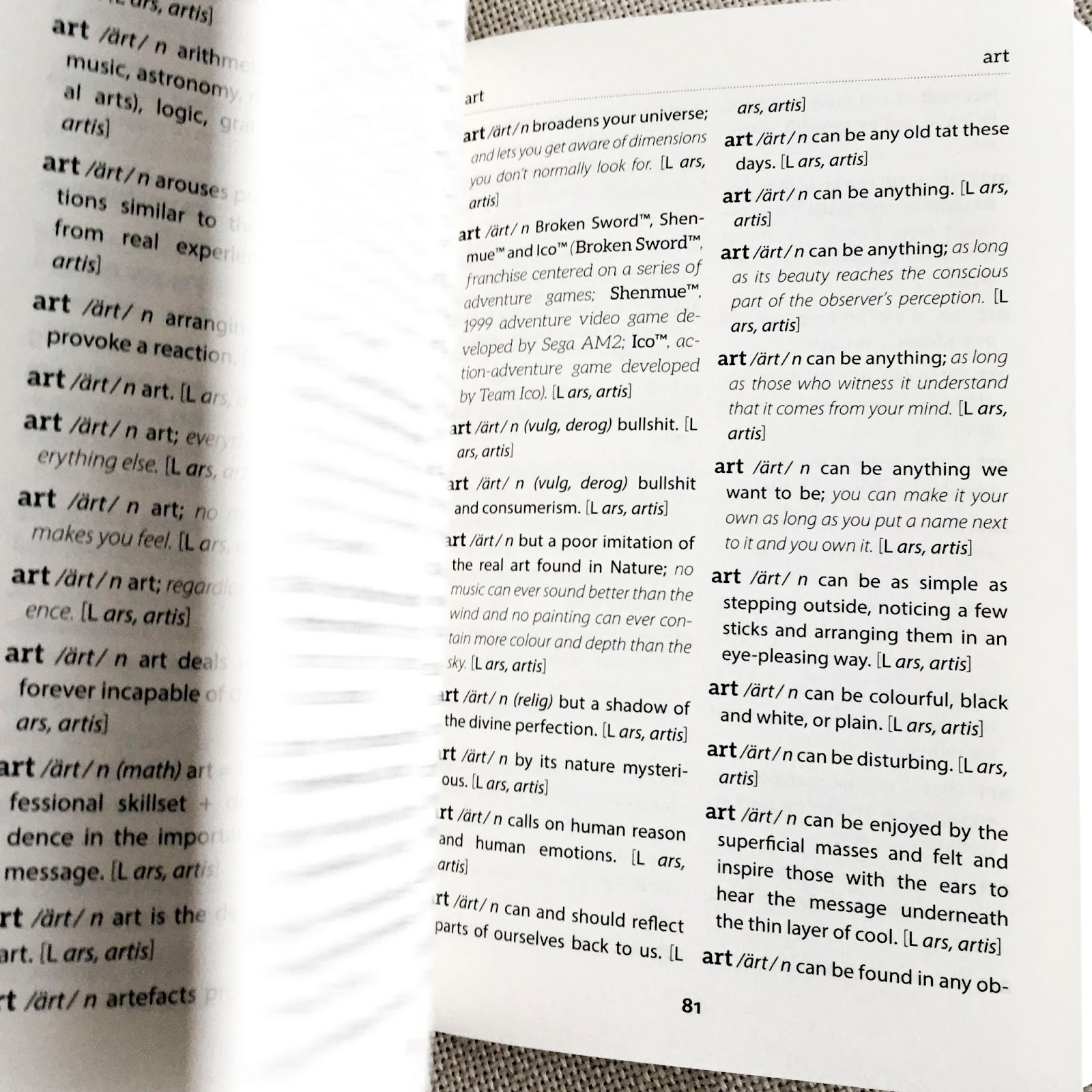


The book is a serious dictionary of art: pronunciation included (✓), part of speech included (✓), origin of the word included (✓). Two column design (✓). It feels solid (✓) . It weighs well. (✓). It has many pages (✓), chart of pronunciation (✓) and the list of abbreviations (✓). 


A New Dictionary of Art is a white flag in the search of meaning for the word “art”. Its captivating kaleidoscope of disparate opinions shows enormity of the task with which humanity has been struggling for centuries. This dictionary is spellbinding in both its madness and profoundness. Like an object of art, it “exists to inspire”. (p. 101)


[Egidija]


Wednesday, 8 July 2015

GUEST POST: open access & art books (Stuart Lawson)

Today's Guest Post is by librarian and researcher Stuart Lawson about the relevance of open access to Artists Books. Stuart will soon begin a PhD on the Politics of Open Access.
>>>

Open access is when scholarly research is made openly available online for anyone to read with no access barriers and minimal restrictions on reuse. With most of the world’s research behind paywalls and only available to those at educational institutions that can afford to access it, open access poses a radical solution to making the scholarly record available to all.


So far, the academics, librarians, and publishers who have been trying – with growing success – to make all research open access have primarily focused on journal articles rather than books. This is for multiple reasons: the science and technology focus of many advocates, who publish in disciplines where journal articles are the main unit of scholarly transmission; the fact that articles are mostly online anyway, whereas a significant proportion of books are not; and the simple fact that a book is a much more complex thing than a journal article. However there have been humanities scholars working to address the problem of open access books such as Open Book Publishers, Open Humanities Press, and Knowledge Unlatched.

Open access is relevant to artists, particularly those working with the book, not only if they work within academia; it is also an interesting space for experimentation in itself. This experimentation is partly driven by the permission-based approach to intellectual property. Open licenses such as Creative Commons licenses allow people to do a lot more with books than usual copyright law permits. Unless a non-derivative clause is attached these permissions include the ability to ‘remix, transform, and build upon the material’. So the potential for altering and combining existing work is now possible in a way it never was before, posing a challenge to notions of authorship.


There is also experimentation with the human processes involved in producing a book. Mattering Press is dedicated to ‘publishing with care’:

Mattering Press provides a platform to experiment with ways of producing academic books that encourages shared scholarship and mutual support as well as novel book formats … An aim is to begin to reshape the social and material relations surrounding the production of relational work.

In ‘The political nature of the book: on artists' books and radical open access’ Janneke Adema and Gary Hall have discussed the parallels between the role of artists’ books as a political medium and the current reimagining of long-form scholarly work. The culture of academia is in many ways very conservative and slow to change, so hopefully there will be a growing number of creative interventions in realm of open access books to catalyse the imagination of humanities scholars and publishers.


This work is licensed under a Creative Commons Attribution 4.0 International License.

Wednesday, 15 April 2015

BABE 2015 - from behind the table


Our table in BABE 2015

Firstly I would like to say how impressed I was with #BABE2015 at the Arnolfini. The amount of visitors and variety of stalls was outstanding.

I would like to talk a bit about being behind the table and the chance of interacting with the public, also more importantly for them to interact with our books. I think it ties in quite nicely to the talk that we also gave at BABE entitled: 'codex: between one hand and another. A video and talk on the relationship between the reader, the book and the hand.'


We showed a video which we have been working on, where people where asked to close their eyes and talk about how the book feels. The book as an object. A still of which is above. Listening to people talk about their experiences was fascinating, as people filled the lack of sight with memories.

What is important for me as a book artist and sitting behind the table at BABE was watching people interact with the books. Experiencing and learning about them through touch. One of my books has interleaved pages which get turned over one by one. (See the images below). Watching how people approach it, pick it up and how it reveals itself to them though movement was for me really interesting. I know it sounds a bit cliche to say it, but it made me see the work in a new way. It is so easy to get caught up in the making of it, you get lost sometimes in the simplicity of things. I often wonder if people interact with the work in a way that I intended, as often my books rely on movement to convey their meaning. If people move them differently does it still convey the same thing?

'connected space' - George Cullen


The book structure is a familiar thing but when it is presented in a slightly different way, as in my book above, or in another example in some of my colleagues Egidija's work. It is an intriguing new experience that is fun to watch and be a part of. Some of Egidija's work on the table at the weekend (see below) were beautifully fragile and light. They came as unbound, folded loose sheets. The very nature of the super thin printed Japanese papers to float and catch in the wind, transformed these pieces when picked up, into a performance. There was a lightness in them that brought out a poetic romantic quality from the book, which spoke of the femininity of the paper coupled with the strength of the book structure. Something which, only as I watched people read them did I notice. 


'those frivolous readers' -  Egidija Čiricaitė

So if you are a book artists and have never been to a fair, I strongly recommend it. Having a table at BABE was a great way to critique your own work. For me at least it has sparked some thoughts in where I would like my work to progress. We make books to be read, so let people read them!

[George]

Wednesday, 25 March 2015

the photo book


The photo book has evolved quite rapidly since the invention of the photographic process and I am going to explore a few below. From the worlds first right through to a project that we worked on together. The photo book maybe associated now with a soulless print on demand generation of book making but the photo book has an interesting past and is still can be very interesting now.


'Photographs of British Algae: Cyanotype Impressions'  - cover detail A


The worlds first photo book created between 1843-1853 was 'Photographs of British Algae: Cyanotype Impressions' by Anna Atkins. It is made up of a series of cyanotype prints where dried algae are placed directly on the cyanotype paper. Paper coated in water soluble iron salts when exposed to sunlight form a compound know as Prussian blue, hence the blue image created.


'Photographs of British Algae: Cyanotype Impressions'  - page detail A

"The difficulty of making accurate drawings of objects as minute as many of the Algae and Confera, has induced me to avail myself of Sir John Herschel's beautiful process of Cyanotype, to obtain impressions of the plants themselves," 1.


'The Pencil of Nature' - cover detail B

The first photographically illustrated book to follow this was 'The Pencil of Nature', 1844- 1846 by William Henry Fox Talbot. Set up as a commercial exploitation to encourage the widespread distribution of large editions of photographic prints. The 'Pencil of Nature' contains 24 plates with a brief text for each. 2.


'The Pencil of Nature' - page detail C

One artist that most of us will be familiar with for his photo books is Ed Ruscha. He is probably responsible for bringing the popularity photo books to the world of book arts. Rejecting the tradition of the handmade limited edition these books are mass produced simple and in large repeated editions. 3.


'Twentysix Gasoline Stations' - cover and page detail D


Heres a short video of Ed Ruscha taking about his photo books. E


Lastly I would like to mention the visual essays that we worked on together as part of 'codex: between this and that'. Here we used the idea of the photo book and combined images together that created a narrative which relied on the form of the book to convey itself. The images we chose would not work, or at least not be so successful if conveyed in any other way. The book holds the narrative of the imagery and conveys our thoughts in a visual way.

'codex: between one hand and another.' F.


[George]


Refrences

Images

Wednesday, 11 February 2015

photocopy/photocopy

I would like to start exploring books around certain printing techniques or methods of production and I am going to start with the humble photocopier. Most of us, I am sure have had contact with one and maybe some of us have also made books by using one. It is the instant and cheap nature of this early 'print on demand' process that attracts artists, zine makers and activists to use it. “The copier was pretty revolutionary in its time, It allowed artists to print an image on their own in an instant. It allowed them to publish books. The speed and ease were liberating. That was a key to a lot of these works." (Michelle Cotton talking on an exhibition of photocopied works at firstsite http://www.firstsite.uk.net/page/xerography-2)


Invented in 1938 by Chester Carlson 'Xerography'  is a dry photocopying technique that requires no chemicals and uses an electrostatic process to transfer toner to paper. (http://en.wikipedia.org/wiki/Xerography)


Chester Carlsons lab book (a history of the book in 100books)


There are many books that use photocopies but I am going to focus on three:

_____

Sigmar Polke - Daphne


The artists hand is used to manipulate the image as it is scanned giving a painterly effect to the image. The artists hand can control or manipulate the image in collaboration with the photocopier. The photocopier reproduces in a mechanical fashion, but introduce movement you can make an image that contains a human element of chance.

"Created directly by Polke himself, Daphne is a book with 23 chapters illustrated in large-format photocopies. Each "copy" of the book differs, as each has been photocopied and manipulated individually, pulled from the machine by the hand and watchful eye of the artist.  Process is revealed, over and over again. Motifs accumulate page after page, as do small graphic cycles. The printed dot, the resolution, the subject, and the speed all determine and are determined by the apparently unpredictable and often impenetrable secret of a picture whose drafts are akin to the waste products of a copying machine." (Reiner Speck, http://greg.org/archive/2010/06/19/daphne_as_photocopied_by_sigmar_polke.html)


_____

Roland Brauchli - Un coup de des...


(http://rolandbrauchli.blogspot.co.uk/2009/10/un-coup-de-des-2008.html)


This work is about chance, dice are thrown onto the photocopier and a copy is taken. It is the instant nature of photocopying that is celebrated here and also its ability to capture an event.


_____

The "xerox" Book


This book published in 1968 is a collection of photocopied work by seven artists. They were all given 25 pages and asked to respond to the format. The artists include: Carl Andre, Robert Barry, Douglas Huebler, Joseph Kosuth, Sol LeWitt, Robert Morris and Lawrence Weiner.

“This project evolved in the same way as most of my projects, in collaboration with the artists I worked with. We would sit around discussing the different ways and possibilities to show art, different contexts and environments in which art could be shown, indoors, outdoors, books, etc. The “Xerox book” — I now would prefer to call it the “Photocopy book”, so that no one gets the mistaken impression that the project has something to do with Xerox — was perhaps one of the most interesting because it was the first where I proposed a series of “requirements” for the project, concerning the use of a standard size paper and the amount of pages the “container” within which the artist was asked to work. What I was trying to do was standardize the conditions of exhibition with the idea that the resulting differences in each artist’s project or work, would be precisely what the artist’s work was about."  (Seigelaub, in discussion with Hans Obrist in 1999, http://artistsbooksandmultiples.blogspot.co.uk/2012/03/xerox-book.html)

This is an exhibition in a book where the photocopier was used as a medium. A way of exploring what may come out if different artists are using the same method of production.

The book can be downloaded as a .pdf here: http://www.primaryinformation.org/files/CARBDHJKSLRMLW.pdf


[George]

Wednesday, 28 January 2015

Artists’ Books and Appropriation

An ongoing project of mine (hidden away in the background) is making new artworks from books by Virginia Woolf (particularly Mrs Dalloway), in the hope of teasing new voices from her beautiful, intricate narratives. In this blog post I wanted to look an example of an artist whose work also does this, an artist whose work also raises questions surrounding copyright.

In 2010 Simon Morris published the book Getting Inside Jack Kerouac's Head through his own imprint informationas material in 2010.  His book started life as a blog in which Morris copied a page a day of Jack Kerouac’s novel On the Road as an exercise in better understanding the book and the author’s writing process.  As blogs are displayed showing the latest entry first, those wishing to read On the Road through Morris’s blog will be faced with the book in reverse order.


The printed book retains the reversed page order and uncorrected text of the blog and the cover is designed to resemble the 2007 Penguin Modern Classics edition (compare image 1 and 2).  Although the text in the book is ostensibly Kerouac’s these minor differences distance Kerouac’s work from Morris’ in a dramatic way; if a reader were to pick up On the Road, they would find a linear story about a road trip; if a reader were to pick up Morris’ book, they would find a disjointed story, a story that prompts the reader to question the nature of the book they were holding.  The difference here is a conceptual one.


I heard Morris speak at the Whitechapel Gallery in 2011 about his own approach to using the material of others as a starting point. He said that ‘If there is no danger of being original it can be very liberating.’ Morris’ view implies that it is Kerouac’s On the Road, which carries the burden of originality and not Getting Inside Jack Kerouac's Head.  It is this weight however that makes copyright such a fiercely contested terrain. I think this sense of freedom is apparent in the work, as the book comes across as a game in a way, one that one that Morris has played with commitment and determination.

Copyright and reproduction are important topics in the book world, particularly with the threat of Google’s mass book-digitization programme, which has dramatic implications for the global publishing industry (according to Robert Darnton, in The Case for Books).  Google’s quest to scan and make available millions of books has triggered legal action from publishers and re-raised questions of intellectual property and ownership. Morris’ book can’t help but touch on that as it is almost (but not quite) a word-for-word copy of Kerouac’s.

Questions of copyright and ownership first came about in the 18th century when it was created to break monopolies in book publishing, ensuring authors were protected and other publishers were able to distribute works (Lessig, Free Culture, 2006).  Two hundred years later copyright now appears to protect the interest of corporations, ensuring that intellectual property can be controlled long after the death of the original creator.

Several publishers (and notably the author J. K. Rowling – who released the digital versions of Harry Potter) are moving away from such strong digital encryption, allowing books to be shared more easily. And perhaps these gestures, along with the works of artists such as Morris, are pushing the boundaries and encouraging others to play with content and give it a new or alternative life. 

{Chris}

Wednesday, 21 January 2015

intimate // public


Through my own practice I have become fascinated with the place in which text or language sits. This might be within the intimate confines of a book or in an open ‘public’ space such as a gallery. 

In terms of the intimate book Holland Cotter sums up nicely the intimacy shared with the object. ‘…books are created for one-on-one interactions. They are, by nature zones, of privacy. There is no way, short of censorship, for an outside observer to or control the intimate encounters they offer…’ (Cotter, 1994)

There is a certain quality in reading that absents us from the world around us. A certain skill in the author perhaps that takes you beyond the world in which we are. None more is this escape apparent than in the work of André Kertész. ‘Thriving on the paradox that even in the most crowded, public space one can enjoy such a solitary, private activity’ (Smart, 2009)

Figure 1: André Kertész, Long Island University, New York, 1963

‘Blissfully unaware they are being snapped, Kertész's subjects appear transported, fleetingly removed from life as we know it, into their realm of reading.’ (Smart, 2009) 

I find that intimate engagement with a space fascinating. All your attention given over to an object. Or rather language/text within an object. It is a direct connection with language.


Figure 2: Carey Young, Consideration 2004


In a public space however this may change. Carey young an artist who works within the realm of officialdom, legal contracts and bureaucracy become the method of communication., The control is often subtle but can be brash. The language and place are key elements to her practice. Place that is dictated by language and language that is dictated by place. Often working with legal teams, the work is about the boundaries we share everyday between rules that govern our place and that place we move around in.  ‘In this work, a legally-impossible contract is established between artist, art gallery and viewer, questioning the notion of information, independence and control in liguistic and special terms.’ (Young, 2005)

The language subverts the space in which people move around. This is the space at large taking control of movement and understanding. It is a shared connection with language. 


The language/text will always reference the place it is put in, as it relies on this space for existence. Words sit on walls and on pages. The joy language has in space is that it is in that space; on paper, on screen, in the ear, always held by the physical. As much control language can have over a space with regard to the words, the space is always there as a constant reminder of the words fragility. Language will always be about space if it conjures up a world or describes an environment, even floating though a concert hall and connected though the internet. But language is not solid and it can change states through this space. Language can so easily transform from the intimate space to the public and vice-versa. As much as it relies on this place as a carrier it can so quickly take control. Words read aloud are transformed from an intimate space to a public one. Spoken language written down goes from the public to intimate. It is not so much the control these spaces and the language has it is the fluidity of language to bridge these spaces. Space whether intimate or public will always hold language. It is only in languages power to make us realise this space where its control lies.


[George]


References:

Cotter, C (1994) Drucker, J. The Century of Artists' Books . New York: Granary Books 

Smart, A. (2009) André Kertész: On Reading, at The Photographers' Gallery. The Sunday Telegraph. 17 July. Seven Magazine

Young, C. (2005) Consideration. [internet]. Available from < http://www.careyyoung.com/past/consideration.html> 


Young, C. (2009) Speech acts. [internet]. Available from < http://www.careyyoung.com/past/speechacts.html> 


Illustrations:

Figure 1: André Kertész, Long Island University, New York, 1963 [online image] Available at: <http://www.guardian.co.uk/artanddesign/gallery/2009/jul/23/andre-kertesz-on-reading-exhibition?picture=350678872> 

Figure 2: Carey Young, Consideration 2004 Available at: <http://www.careyyoung.com/past/consideration.html>


Wednesday, 10 December 2014

Wednesday, 26 November 2014

Issues of Classification

Over the past few weeks I have been 'librarian in residence' as part of an art exhibition at Cafe Gallery Projects and aside from engaging visitors with the art on display,  I've answering questions about my own practice.

Librarian in Residence as part of Folles de leur corps / Crazy About Their Bodies
Despite the fact that my artwork hasn't changed much in style over the past ten years or so (compare The Weimar Years (2005) with In Explanation of the Book ( 2011)), I still find it difficult to describe. Although this must be a common experience for many contemporary artists,  I think it is compounded when it comes to art that involves books.


Still from The Weimar Years

Still from In Explanation of the Book
I think there are two reasons for that:

The first reason is that more and more people I speak to have heard the term Book Art. A shortcut like this can be useful when speaking about someone's art practice, however the term Book Art can incorporate vastly different types of art. Just looking at the art that Egidija,  George and I produce - we can see that each work can be structurally and conceptually diverse (From Egidija's Damnatio Memoriae to George's The Mind Follows and my Book Becomes Book).

Damnatio Memoriae
The Mind Follows
Book Becomes Book
The second reason is that each of us has a whole personally history with books and therefore a lifetime of associations.  Depending on our reading habits and preferences, we can all have a slightly different relationship to the same everyday object.

Seen from a different perspective these preconceptions and these differing understandings make for a rich in-depth discussion and add layers of meaning to the artwork, making the creation and the viewing, a much more rewarding experience.

{Chris}

Wednesday, 19 November 2014

words to be read aloud

Often we talk about what goes into a book but not the potential the book has to broadcast outside of itself. There is a performance element to the book that leads it to be read.  I am going to be exploring an artist whose main concern is text as it is read and also exploring the book as a performance space to be read from. 


Liliane Lijn works with text as it should be read. Though not within a book, the way she explores reading is fascinating. I think the way that reading is controlled and paced through her sculptures has a lot in common with the book.  Poem cones with words printed on rotate, so that words near the top where the cone is narrower move slower and words near the bottom where the cone is wider move faster. This affects your ability to read and controlling your experience of language, in a very similar way that a book may pace your experience of the text. But they challenge the nature of reading and what is able to be read. Words still exist but they blur then come into focus, forcing you as a viewer to distinguish between reading and seeing.


Another peice of work I would like to look at is: 'An Exhibition to Hear Read'. Where the book is used to be read from and broadcast out. Where reading is used to fil the space.
'An exhibition to hear read proposes the notion of speech as material gesture, in which both the texture of the word and its spoken quality are inscribed in space and time through the act of reading.  The vocal interpretation of these artworks constructs an abstract and ephemeral reality that can be said to sculpt the spaces in which it occurs. This ongoing investigation into the materiality of artwork as a question of word and speech is crystallized through a series of publications that act as both score and memory.' (Matieu Copeland)


The book here is one of the most important parts. It facilitates reading and in reading it opens itself up to a much larger space than it contained before. 

I think that I am now going to start thinking about my work in terms of how it might be read. At least in terms of how it can be read aloud. How can this change the work and can it be to its advantage. It takes the personal experience of the book and relays it as a communal one. In a way the reader claims the text that they are reading and reveals it as a performative act. Almost as if they are actors performing a script. 

I will leave you with a performance piece by Matteo Fargion called songbook which consists of a songbook that the dancers use to direct themselves.  The performance is both about the songbook as direction and the performers who act. As a result you are reading the songbook though interpreting the performance:


[George]

__________

Links:

http://www.ica.org.uk/whats-on/poor-old-tired-horse

http://www.lilianelijn.com/

http://www.mathieucopeland.net/

http://annesylviehenchoz.prosite.com/119822/643405/projects/an-exhibition-to-hear-read

http://www.siobhandaviesreplay.com/record.php?id=3105