Showing posts with label book: theory. Show all posts

Wednesday, 8 June 2016

GUEST POST: The Book as Utopian Object (Sally-Shakti Willow)


For my practice-based PhD in utopian poetics and experimental writing at the University of Westminster, I’m researching the utopian philosophy of Ernst Bloch and the artist books of Theresa Hak Kyung Cha.  I’m coming towards the end of my first year, and the first fruit of creative practice is the project called The Unfinished Dream, a collaborative work with illustrator and animator Joe Evans.

The Unfinished Dream began as an experiment in applying Ernst Bloch’s utopian theory to creative writing practice, inspired by the text works of Theresa Hak Kyung Cha.  Both Bloch and Cha explore the relationship between subject and object (self and other).  Bloch suggests that the experience of non-alienation, where the subject (the individual) experiences itself as not-separate from the object (the world/the other) is the essence of the utopian.  Cha embodied this desire to create an experience of non-alienation between the subject and the object in all of her major text, film, and performance works.  The Unfinished Dream experiments with these ideas and has developed into a collaborative project that keeps growing and shifting – an unfinished and unfolding creative process.

For Bloch, the utopian function of art and literature is to facilitate the ‘self-encounter’ (100), the recognition of oneself in and through an encounter with the other.  For Cha, as for Bloch, the art object becomes a space of encounter between the artist and the audience where each fulfils the roles of both subject and object in their interrelationship with one another through the work.  One of the forms used by Cha for realising this connection was the artist book.  The book is an object of intimacy, a space in which the reader and writer are drawn together through the page.  The book, as an object, is designed to be held and engaged with in a one-to-one relationship between the writer/maker and the reader.  Cha uses scriptovisual techniques to create a relationship between text and space, words and silence, self and other in her artist books.

I’m interested in exploring this strange relational space between artist and audience, writer and reader, self and other as an experiment in the kind of non-alienation that Bloch ascribes to the utopian function of art and literature.  I’m interested in the ways that the book form can facilitate this kind of an encounter between subject and object, self and other.  What kinds of spaces need to be opened up within the text for the reader to project herself into?  How might the relationships between text and space / word and silence / text and image / image and space engender a performative experience of non-alienation for a reader encountering the book object? 

To experience something, we often need to encounter it physically, via our sense organs.  In this sense, and in others, the physical relationship between the book and the body is integral to the project.  I’m also deeply interested in the physicality of the book form, its materiality and its function.  Below, I describe some of the processes and ideas behind the creation of The Unfinished Dream, the first part of my creative practice for this three-year PhD.

The Unfinished Dream illustration details

 ‘May I write words more naked than flesh, stronger than bone, more resilient than sinew, sensitive than nerve’. Theresa Hak Kyung Cha, Dictee
  
The Artist Book:
The physical object of the book is a central concern of The Unfinished Dream.  The experimental writing collection explores the ways that the materiality of the book is often ignored and made invisible at the expense of the words and ideas it contains, in a similar way perhaps to the relationship between the physical human body and the concepts and ideas that are generated by the mind.  The Unfinished Dream explores writing, drawing and creative practice as embodied, physical processes – processes that take place in, of and through the body, and which may be experienced physically, viscerally and emotionally by those who come into contact with them.

Similarly, the general invisibility of the book form means that culturally we take for granted the codex structure which has become synonymous with what a ‘book’ is.  Historically though, and across geographical and cultural spaces, different forms such as scrolls, wrapped papers, and now digital platforms have provided alternative ‘book’ forms with different relationships to structure, linearity and temporality.  The codex form developed with Coptic Christianity and encodes the linear, teleological (end-focused) structure of the biblical narrative.  What happens when we question these invisible assumptions that structure the stories we tell ourselves, and the stories we tell of ourselves, so implicitly?  The Unfinished Dream explores the human relationship to the codex form and the teleological narrative it encodes and embodies.

Ernst Bloch describes utopia as ‘in the process of being’ (15).  For Bloch, utopia is a process rather than a destination and as such it is non-teleological.  Cha’s major artist book Dictee embodies a non-teleological structure in that there is no temporal narrative development throughout the book, and her use of repetition to return to key thematic images and ideas gives the book a cyclical or circular structure, despite its codex binding.  The Unfinished Dream embodies a similar structural rhythm in an attempt to disrupt the teleological structure of the codex form via its content. 
The book also explores the relationship between words and silence as represented by the spaces between words and phrases on the page; the relationship between words and images; and the relationship between parts of words through the non-standard use of the square bracket.  Each of these relationships has the potential to generate multiple possibilities through the gaps in between two elements and/or the dissonance generated between two or more contradictory parts placed together.  This is intended to have a twofold utopian function in that it disrupts teleological structural development by offering a profusion of possible pathways through the book as well as situating the reader as a co-creator of meaning, as each person encounters and experiences the book differently.  In this way the boundaries between writer and reader become more permeable.  The  co-creative relationship between the reader and the writer/artist is at the heart of The Unfinished Dream, as the reader must complete and interpret the work of the writer and illustrator from the multiple possibilities that are offered both within and beyond the text.

When making The Unfinished Dream we also wanted to question some of the invisible assumptions which suggest that artist books must be artisan products, requiring specialist skills, materials and equipment to produce and displaying the skills of fine craftsmanship.  We love those kinds of artist books of course.  But we were interested in a kind of democratic creative process that didn’t fetishize the book as an object, that embraced real life physical processes and that aesthetically embodied the ideas contained within the book.

 
 A4 school exercise books, hand illustrated, cut and pasted
Binding with Sally’s hair
The Unfinished Dream – artist book
The Unfinished Dream – interior pages
The final poem is left unfinished, with space for the reader to complete the work


In addition to the artist book, The Unfinished Dream is also a short film and a performance.  Click here to watch the film (90 seconds; contains nudity).
To find out more about the project, including the film and the performance, please click here.
A still from the film, projected as part of the performance


The Unfinished Dream is a project by [Sub]Atomic Books: Sally-Shakti Willow & Joe Evans


Bibliography:
Bloch, Ernst (1988). The Utopian Function of Art and Literature: Selected essays, trans. Jack Zipes and Frank Mecklenberg.  Cambridge Massachusetts and London: The MIT Press
Cha, Theresa Hak Kyung (2001 [1982]).  Dictee.  Berkeley, California: University of California Press

Wednesday, 27 April 2016

→ intimate and cathartic is the constellation of cancer


Speaking in Tongues: Speaking Digitally / Digitally Speaking (2015) by David Paton


"Intimate and cathartic" refers to both: the process of making a book and the process of reading. Book as an object encourages intimate interaction between the maker and the object, the object and the reader. Art as an activity veers towards the cathartic experiences between the artist and the object; the object and the viewer. Adding to that a medical context, results in Medical Humanities and an approach to art, which considers artist’s books as a tool to aid healing and facilitate communication between doctors and patients.


Test Day II (1999) by Martha A. Hall


I was honoured to co-organise with Dr Stella Bolaki Prescriptions exhibition, which is now open until August 14 at The Beaney House of Art and Knowledge, Canterbury. The exhibition is part of Artists’ Books and the Medical Humanities project by the University of Kent’s School of English. It was originally structured around a set of Martha A Hall’s books, which she created from 1998 until her death in 2003 to document her experiences with breast cancer and interactions with the medical community. To extend Prescriptions further, I initiated an open-call, which resulted in over 200 artists worldwide submitting nearly 250 works, of which 88 bookworks were selected as a curated Medical Humanities artist's books collection, reflecting on the themes of illness, grieving, disability, mental health, surgery, birth, aging, recovery, history of medicine, treatments and wellbeing. Once the exhibition is over, the collection will be housed at University of Kent’s Library's Special Collection.


View of Prescriptions at The Beaney, Canterbury.


Illness, healing, grief are intimate processes. Like Martha A Hall, a number of Prescriptions artists have responded to their conditions by making books: some dealt with  their own diagnosis, others dealt with the grief at the illness of a friend. Like Martha A Hall, 25 of the participants have cancers, of which 11 are breast cancer patients and further 4 are friends or family of a breast cancer patient. 


→ 


Cancer is one of the twelve constellations of the zodiac. Its name is Latin for crab and it is commonly represented as one. Its astrological symbol is ♋. Cancer is a medium-size constellation with an area of 506 square degrees and its stars are rather faint. Cancer is the dimmest of the zodiacal constellations, having only two stars above the fourth magnitude.


Cancer is frequently represented as a combination of five stars. 


1. Lizzie Brewer
The first star in my Cancer constellation is Lizzie Brewer. Lizzie's work Prescriptions is a set of embossed prints, which reflect on the amount of pills taken during the five years of her breast cancer treatment. Each tablet is one little step towards healing: her work shows a long journey. Repetition is what stands out in Lizzie’s work: tablets look the same, pages look the same. There is meditative quality to an ongoing expanse of sheet after sheet after sheet. Other then details of her surgical report there are no other texts and there are no images. The person behind this data is very much absent - repetition hides her like a smokescreen.


 2. Carole Cluer
Carol Cluer was diagnosed with breast cancer in 2004. Unknown is another seemingly detached work, which hides individual well behind volume, number and data. Carole considers the number of people diagnosed with breast cancer in the same year as her. Based on the measurement grids and tattoos used when you have radiotherapy, she had drawn a grid by dragging a fine gold wire across paper, so each dot represents one person - anonymous person - like herself. The books consist of pages and pages and pages of identical looking hand drawn grids: simple to look at, but exquisitely executed. If Lizzie’s work zooms into individual’s experience, Carol’s work zooms out to globalize it, by re-contextualising herself into the worldwide stream of data. 


3. Carol Pairaudeau
 
If individual is hiding behind the data in two previous two works, Carole Pairaudeau puts herself right into the center of her book. Not only is the work presented in a hospital sample bag with Carole's name printed on it, her book is a concertina, showing her scar and bruising on one side and words (about healing of the scar) on the other. The photo images of bruised skin are otherworldly in their blues, greens and purples. Their beautiful and painterly quality contrasts with their painful origin. The text complements images: it transports reader through stitch to fade of the scar in three concertina folds, producing six steps. Like in Lizzie’s work, Carol’s work is about time and healing. The steps might be bigger and may take more time of complete, but the work feels cathartic and emotionally true.

4. Ruchika Wason Singh
 
Ruchika Wason Singh builds her book as a journey of acceptance at the loss of her breast. Physical and emotional healing is replicated in her creative process. Ruchika paints breasts and tears them into pieces, which she then restores by painting onto them. She resurrects the breast visually as she completes her inner transformation into an honest acknowledgment of her situation. Ruchika then pastes images onto sheets of paper to form a book, which further contributes to the idea of archiving the experience. Her set of collages is loosely held together by fabric, resembling bandages. The cover image is a stitched scar. The book is wholesome, bold and honest. Ruchika’s work elicits anguish and grief that feel resolved as the book is closed.


5. Mara Acoma
A photo book by Mara Acoma documents her own experience of having her mother diagnosed with breast cancer. The work, Mara says, allowed her to demystify her own emotional journey. She is using the visual language of near death experiences and folklore surrounding ghosts. The images are dark, produced to the backdrop of gothic sets of crumbling castles, gloomy forests, abandoned hospitals and misted up windows. A lone ghost of a heroine is moving from one location to the next across sprawling spreads of large size monochromatic photographs. Those imaginary locations represent her mental states, which - like Lizzie’s tablet’s or Carole’s bruises - are steps towards emotional healing. 


→
 

Intimate and cathartic is a diary for the writer, as it is for the reader. The books above are diaries in the most generic sense of the word. They are non-verbal diaries. Their authors reach beyond language to say the unsayable. The (almost) lack of language evokes universal readability of the artwork, which in turn, resonates with universal concerns of understanding illness and understanding healing as a process.


[Egidija]


Wednesday, 20 January 2016

TV on the BOOK

Recently I have become very interested in the representation of the tv screen in the book. Not only because one of our projects had led us there but I have had a couple of books pop up which have explored this. One I have read and one that I have seen, they are both very beautiful in terms of design and aesthetic. In exploring structure, time and space the book functions much the same as video does although it has a slightly random and non linear one based on the choice of the reader. 

The fist book I am going to look at is a project that we have been working on. 

reading the book as an object - collective investigations

This book originated as a film as a book. Where the film takes the structure of the book. The screen divided into two ‘pages’ recreates a visual similarity with the open spread. With this framework the film slipped nicely back into the book form. It was interesting to see the volume the film took up when this was done. A screen capture was taken every second of a three minute film. The physical weight of the film is represented in the book  

Alice’s Adventures in Wonderland - and Through the Looking Glass

This book I came across quite recently and is quite a fun example of how you can portray a film within a book. The book being one that already exists in a literature sense has been adapted for film. Like our project this film adaption finds itself back in the book. Though this time it is a frame by frame analysis done in line drawings with text. These are interspersed with photos of the cast. Whats on screen is interpreted for a printed book and layered with the bookish elements of text.


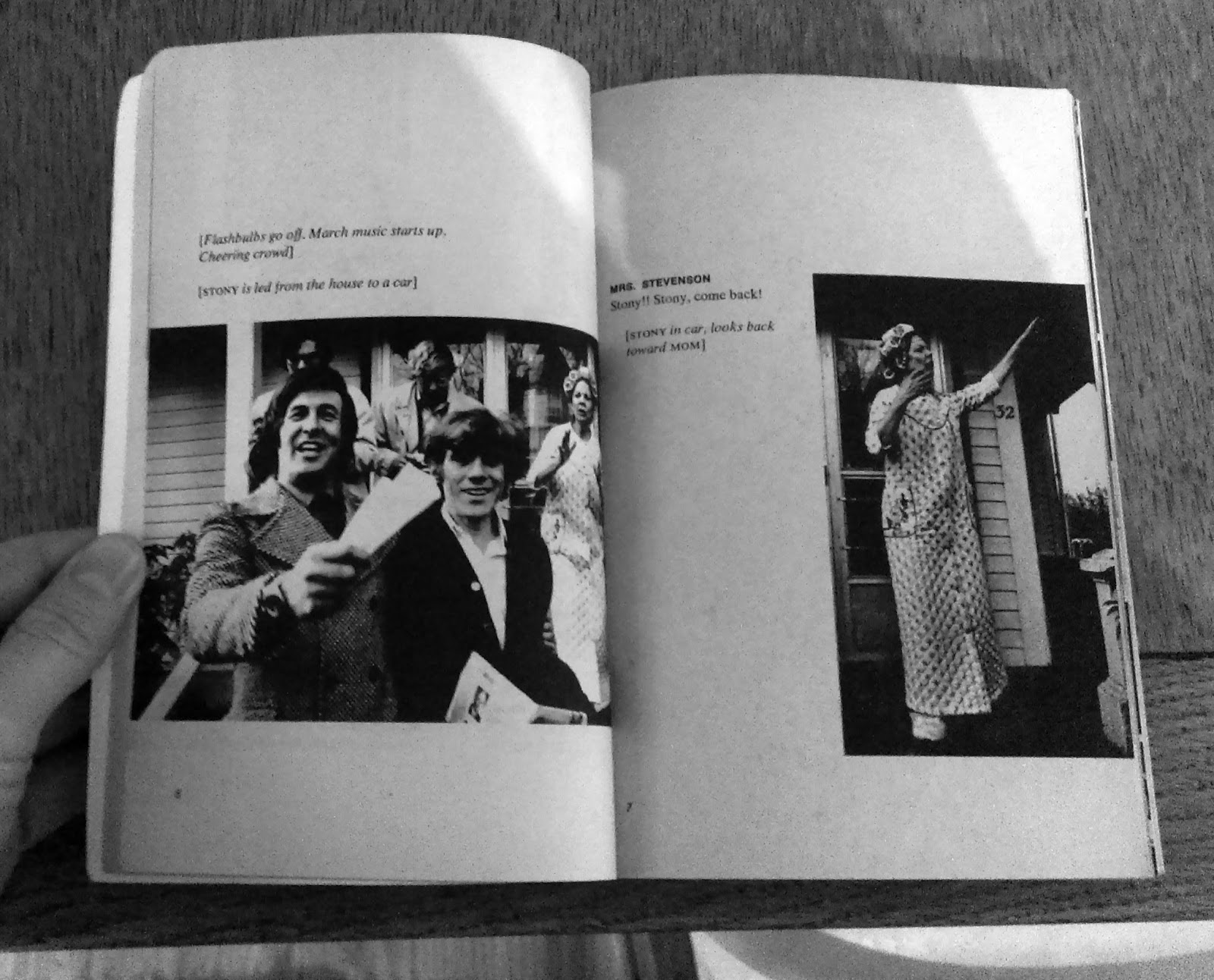
Between Time and Timbuktu - Kurt Vonnegut

One of my favourite authors Kurt Vonnegut wrote a television film in 1972. The film was published as a book in the same year. The script is published along with stills and photos from the film. When I discovered this book I had a sense of pure delight. Not only because I enjoy his work but the simplicity and clarity of the design gives it a graphic novel feel. It is a great study in how image and text can work together. It is not a pure representation of what happened on the screen in the way that reading the book as an object is. It supplements the TV with the quality of the book. That of the story. Presented as a script, you can read it as a novel but it retains that immediacy of TV. It is TV slowed down, TV that goes at your own pace.


Wednesday, 16 December 2015

→ EDITION SIZE UNKNOWN (making sense of editioning artists' books)

ABOUT STONES, an unnumbered edition of 51


This blog post is a private contemplation, as I try to make sense of editioning. 
Remarks and comments on the subject are very welcome.


Everyone producing artists' books seems to have their own process and rules of editioning. Most of the time, I mark and sign edition on the back, and then - discreetly in the gutter - I keep the information on the print run, the paper, the printer and the ink and any other speciffication which I may find important. Like most of us, I try to print all of the edition at once. It is not always practical, however - frequently, I do not have the facility to store large amount of books. If I do not print the edition in one run, can it still be considered the same edition? Can it be numbered as the same edition if it was printed in three runs six months apart using the same printer? The same bed of type? A different printer or different bed of type in a different location? How do you mark those differences? Is it important to mark them?

The business of editioning artist's books sits between producing and numbering books as fine art multiples and producing artist's books as publications. Each of those areas is governed by the absence of formal rules(1), which leave all of us to our own devices of how and when we number our works.


FINE ART (prints)

In printmaking, as Wikipedia says,  "an edition is a number of prints struck from one plate, usually at the same time. This may be a limited edition, with a fixed number of impressions produced on the understanding that no further impressions (copies) will be produced later, or an open edition limited only by the number that can be sold or produced before the plate wears."

In digital printing, "dating digital images is particularly important. Since a digital file prints out exactly the same way every time you print it, no matter when you print it, the quickest and simplest way to differentiate one image from the next is by the date it was printed. Even though a print may be one of a larger edition, a date individualizes it, and makes it just a little bit more unique. And buyers like that. In fact, buyers generally like dated art, especially when their dates precede other buyers' dates." (Giclee Printing and Pricing for Artist Limited Editions)

Fine art prints also allow for an artists' proof to exist (marked as AP) outside the edition. Classically, 10% of a limited edition size is considered an appropriate amount of artists proofs (Editioned Prints and Photographs).


(Then there is fine art ephemera, which is a different kettle of fish - see further below.)
 

Fine art (printmaking) environment has the figure of buyer-collector in the picture. Art buyers like to know the size of the edition. Art buyers like low numbers. Art buyers like signatures. Also, as it turns out, art buyers like digital images to be dated.


PUBLISHING

Bibliographical definition of an edition was given by Fredson Bowers in Principles of Bibliographical Description (1949). Bowers wrote that an edition is “the whole number of copies printed at any time or times from substantially the same setting of type-pages,” including “all issues and variant states existing within its basic type-setting, as well as all impressions.”  Collectors, however, would only consider the first print run as the first edition, while publishers each have their own rules.

A wonderful book First Editions of To-day and how to Tell Them (1929)(2) by H.S.Boutell gives some fascinating insight into the issues of editioning and terminology used, some of which, is still very relevant today.

        Generally speaking, the collector of first editions is really a collector of first impressions, a first impression being a book from the first lot struck off the presses, and a first edition comprising all books which remain the same in content and in format as the first impression. A second impression is a second printing, A second edition postulates some alteration of text or format. But these terms are, unfortunately, not strictly adhered to. (Introductory Note by Boutell)   

In the Publisher's Note Boutell further points to Arrowsmith entry on page 12, where they note that "the correct term not First Edition but First Impression or Issue." Boutell regrets that the error of terminology is almost universal.


(Can a digital print run be still called an impression?)
 
The rest of 62 page book is filled with publishers' responses to how they mark their first and subsequent editions and impressions. The book shows how varied the practice can be! For example, I used the book trying to track down the edition number for my The Poetical Works of John Milton (1898) published by Frederic Warne and Co., only to find out that they did at one time mark first editions with a private mark, but they had discontinued the habit and they had even lost trace of private marks (p38).
 

Bibliographical/book-collector context brings forward the importance of differentiating between the edition and the print run. 


Editioning information of Alice in the Wonderland (1929) published by George G. Harrap & Co., LTD.
Editioning information of Tractatus Logico-Philisophicus (2009) published by Routledge Classics.


EDITION SIZE UNKNOWN?

Artists' books include not just bound books, but also a wide range of ephemera in the form of posters, postcards, leaflets, pamphlets, periodicals, zines, fanzines, bookmarks, maps, graphs, tickets, invitations, etc., which may come as multiples, but may not always be numbered. Some will be produced on site to serve as an evidence or a continuation of another event. Others will be regularly published. Among the more fascinating cases of ephemera are Fluxus score sheets.
"Produced throughout the 1960s and 70s, they take on a variety of forms from small event cards with text prompting the viewer to perform everyday actions to larger graphic scores with abstract compositions for indeterminate musical and dance performances." (Exhibiting Fluxus: Keeping Score in Tokyo 1955–1970: A New Avant-Garde) Many of those scores were published and disseminated by Maciunas as Fluxus editions, multiples stamped “© Fluxus”. They could be purchased at low costs. Here are three catalogue entries for three Fluxus publications:


CONCLUSIONS
 

The concept of editioning is tied down to the place and time of production and it benefits the collector/buyer to make judgement on the value of the artists' publication.
 

Is it important to keep editioning consistent? In the tradition of artists' book as an editioned work of print, the publication benefits from showing all of the information mentioned above as an honest statement about the scale of production. However, the artists' intention might be that the publication is infinite and ephemeral. In that case, it is up to the collector and cataloguer to make sense of it's editioning data.


NOTES:

(1)  New York and California consumer protection laws require a certificate of authenticity when selling artist multiples.
http://artlawjournal.com/art-dealers-full-disclosures-selling-multiples/
https://news.artnet.com/market/buying-and-selling-art-in-multiples-323824


(2) First Editions of To-day and how to Tell Them (1929) by H.S.Boutell was purchased from Barter Books in Alnwick. If in Northumberland, it is always worth a trip to this  
Ghibli-esque emporium of second hand books.

[Egidija]


Wednesday, 8 July 2015

GUEST POST: open access & art books (Stuart Lawson)

Today's Guest Post is by librarian and researcher Stuart Lawson about the relevance of open access to Artists Books. Stuart will soon begin a PhD on the Politics of Open Access.
>>>

Open access is when scholarly research is made openly available online for anyone to read with no access barriers and minimal restrictions on reuse. With most of the world’s research behind paywalls and only available to those at educational institutions that can afford to access it, open access poses a radical solution to making the scholarly record available to all.


So far, the academics, librarians, and publishers who have been trying – with growing success – to make all research open access have primarily focused on journal articles rather than books. This is for multiple reasons: the science and technology focus of many advocates, who publish in disciplines where journal articles are the main unit of scholarly transmission; the fact that articles are mostly online anyway, whereas a significant proportion of books are not; and the simple fact that a book is a much more complex thing than a journal article. However there have been humanities scholars working to address the problem of open access books such as Open Book Publishers, Open Humanities Press, and Knowledge Unlatched.

Open access is relevant to artists, particularly those working with the book, not only if they work within academia; it is also an interesting space for experimentation in itself. This experimentation is partly driven by the permission-based approach to intellectual property. Open licenses such as Creative Commons licenses allow people to do a lot more with books than usual copyright law permits. Unless a non-derivative clause is attached these permissions include the ability to ‘remix, transform, and build upon the material’. So the potential for altering and combining existing work is now possible in a way it never was before, posing a challenge to notions of authorship.


There is also experimentation with the human processes involved in producing a book. Mattering Press is dedicated to ‘publishing with care’:

Mattering Press provides a platform to experiment with ways of producing academic books that encourages shared scholarship and mutual support as well as novel book formats … An aim is to begin to reshape the social and material relations surrounding the production of relational work.

In ‘The political nature of the book: on artists' books and radical open access’ Janneke Adema and Gary Hall have discussed the parallels between the role of artists’ books as a political medium and the current reimagining of long-form scholarly work. The culture of academia is in many ways very conservative and slow to change, so hopefully there will be a growing number of creative interventions in realm of open access books to catalyse the imagination of humanities scholars and publishers.


This work is licensed under a Creative Commons Attribution 4.0 International License.

Wednesday, 10 June 2015

GUEST POST: Annotated treasures at the Library of Amgueddfa Cymru – National Museum Wales

This months guest post is from Jennifer Evans the Assistant Librarian at the Amgueddfa Cymru – National Museum Wales. She also keeps a beautiful blog of gems from their collection which is definitely worth looking at: http://www.museumwales.ac.uk/blog/?cat=1784


The Library at Amgueddfa Cymru - National Museum Wales


The Library at Amgueddfa Cymru – National Museum Wales primarily holds collections that reflect the museum’s curatorial departments; Art, Archaeology & Numismatics, Industry and the Natural Sciences. However, over the years we have been the welcome recipient of several generous loans and donations and have built up a collection of some very unusual and eclectic early books.  

Special Collections in the Library at Amgueddfa Cymru - National Museum Wales


However, today I’d like to share a selection of items we hold that are absolutely unique. These are annotated books, and whereas normally this would fill any decent Librarian with dread, these items were annotated long ago and one always hopes, by the owner. 


Instructions for collecting and preserving insects; particularly moths and butterflies by William Curtis [1771]

This 1771 edition of Instructions for collecting and preserving insects; particularly moths and butterflies by William Curtis [1771] has been annotated with the most exquisite watercolour insects. We do not know who added these drawings but we think we know why; another edition we hold, has a plate of illustrations but this one does not and therefore someone has copied the illustrations [plus many others] into the margins. 

We have a strong collection of early natural history books greatly enhanced by the Willoughby Gardner Donation bequeathed to the museum in 1953. Included in this collection are our only two incunabula [pre-1501 books], as well as writings by Conrad Gesner and other 16th and 17th century writers. Gardner’s interests were varied, but he had a most particular penchant for bees, wasps and butterflies, evident in the exceptional insect and Aurelian works by, among others, Moses Harris, Benjamin Wilkes and Thomas Moffet. 


Cambria Depicta by William Pugh [1816] is an observant and amusing account of a walking tour of North Wales


We also have a strong collection of Welsh topographical books; these late 18th and early 19th century tours of Wales are mostly accounts written by well-to-do early tourists, mainly from England, and together with some very interesting illustrations, they provide an invaluable picture of the country at this time. And within this collection is a copy of Cambria Depicta [1816] by Edward Pugh.

This is an observant and amusing account of a walking tour of North Wales; the book contains 68 various engravings, and gives very detailed descriptions of a journey that took the author almost 10 years to complete. It offers a unique insight to the history and poetry of the time, and is therefore considered to be a true representation of North Wales two hundred years ago.

Before this book ever came to us, someone had written extensive notes and sketched exquisite drawings in the margins. These are no random doodles, all drawings and written notes relate specifically to the text itself.


This two volumed work, Memoirs of Lord Bolingbroke  by George Wingrove Cooke [1836]  is an example of fore-edge painting


This last example of annotated books concerns fore-edge paintings; images painted onto either of the three fore-edges of a book.

This two volume work, Memoirs of Lord Bolingbroke, by George Wingrove Cooke, [1836] is an example of “single disappearing fore-edge painting”. Single, because the painting appears only on one edge of the book. Disappearing, because the painting was done when the pages of the books were slightly bent over, thereby allowing the image to be painted along the very edge of the pages. When the image dries the book is allowed back into its original state and the image effectively disappears.

Memoirs of Lord Bolingbroke  by George Wingrove Cooke [1836] Volume I showing fore-edge painting of Caernarfon Castle

Memoirs of Lord Bolingbroke  by George Wingrove Cooke [1836] Volume II showing fore-edge painting of Conwy Castle


The earliest fore-edge paintings date as far back as the 10th century and were mostly symbolic designs. Early English examples, believed to date from the 14th century, presented heraldic designs in gold and other colors. The first known example of a disappearing fore-edge painting like these, where the painting is not visible when the book is closed, dates from around 1649. The earliest signed and dated example is from 1653. These books were purchased specifically because of their fore-edge paintings, the two volumes have watercolour images depicting Caernarfon Castle and Conwy Castle. 

To conclude, and still on the subject of unique books, the following photographs show some surprising items we have found nestled between the pages: 

Hayward's Botanist's pocket book by W.R. Hayward [this edition 1930]

Insectorum sive minimorum animalium theatrum [Theatre of Insects] by Thomas Moffet [this edition 1634]

The Fern Paradise by Francis George Heath [1876]


We are resigned to the fact that we will probably never know who painted the marginalia and fore-edge images and most certainly will never know who placed the butterfly wings, scorpion sketch and ferns between the pages of these books. But, this very fact makes these mysterious and wonderful additions to our special collections.


We love to Blog and Tweet about our Library Collections! 
Please follow us here:

Jennifer Evans
Assitant Librarian
Amgueddfa Cymru – National Museum Wales

All photographs taken by the author
Copyright Amgueddfa Cymru – National Museum Wales