Showing posts with label art: contemporary. Show all posts

Wednesday, 25 October 2017

art /ärt/ n hacking the human. [L ars, artis]

Some years and some wine later Robert Good's "A New Dictionary of Art" is finally out!


If Robert Good was Socrates, he would have gone to Agora in Athens - to the tables, shops, workshops, barbers -  and discussed the definition of art with the public. Instead, he went to internet - the contemporary global Agora of chatrooms, forums, institution webpages - and asked the same question. The cacophony of voices that he received back, he presented in the book A New Dictionary of Art.


As a mesmerising accumulation of over 3000 definitions compiled from internet, the book is a glorious monument to undefinability. "A New Dictionary of Art" has all the definitions of art you had ever imagined: by critics, art historians, students and casual ramblers though Constable’s landscapes. And then there are some more definitions. And then another few  and some you may totally agree with. And then a few more and another one which may sound like something Aunt Bessie would say. Two hundred and thirty pages contain neatly arranged long and short explanations, which range from goddamn serious (art is an effort to contextualise our existence, p.53) to whimsical (art is an egg’s idea of things that aren’t eggs, p.53). The volume of alphabetically sorted definitions is too vast to contain any conclusion of what art is, yet it provides a fascinating dip into a dazzling world of opinions of the English speaking world. Each voice in the dictionary is undeniably individual and unique. Each statement and different. Any effort of finding a common thread is futile.
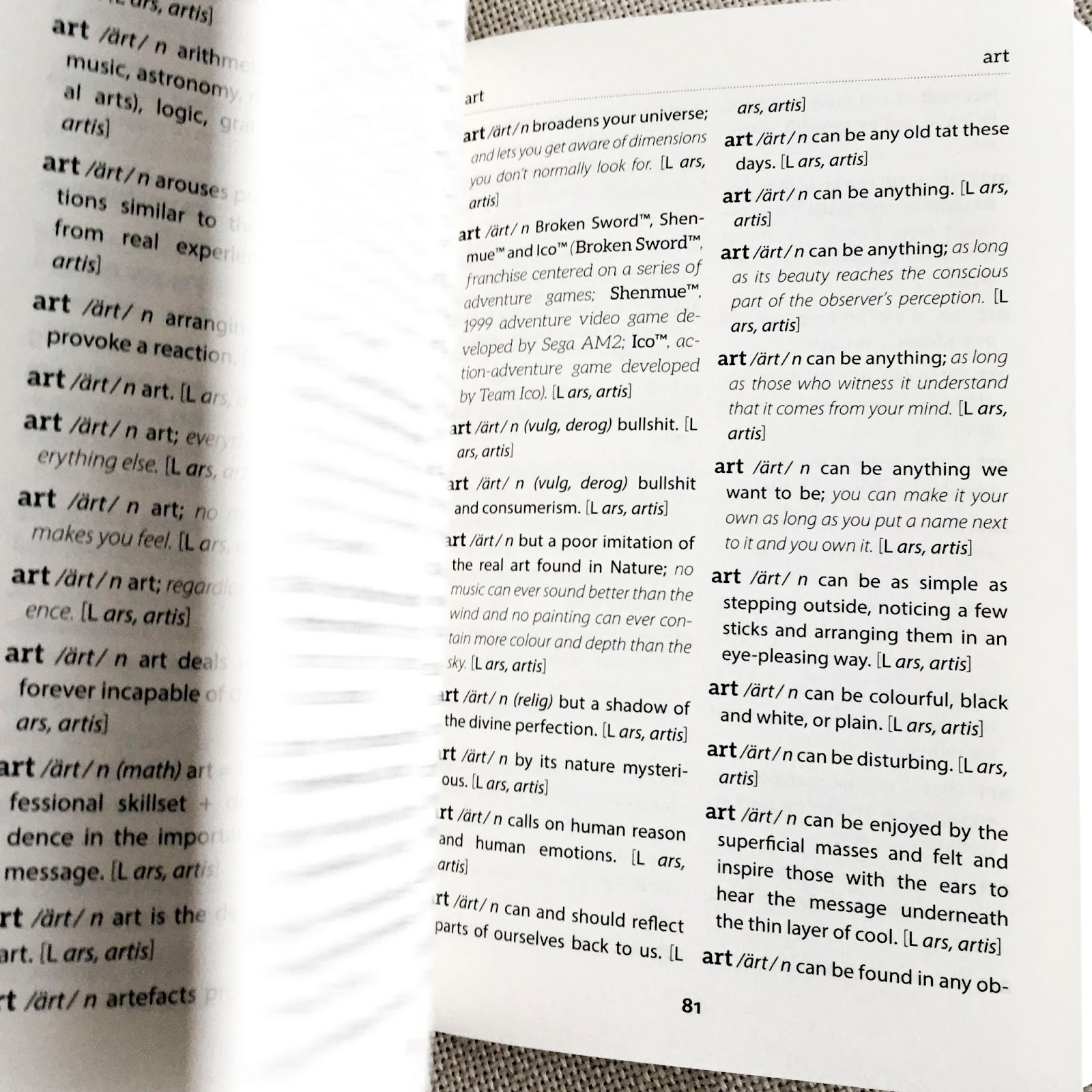


The book is a serious dictionary of art: pronunciation included (✓), part of speech included (✓), origin of the word included (✓). Two column design (✓). It feels solid (✓) . It weighs well. (✓). It has many pages (✓), chart of pronunciation (✓) and the list of abbreviations (✓). 


A New Dictionary of Art is a white flag in the search of meaning for the word “art”. Its captivating kaleidoscope of disparate opinions shows enormity of the task with which humanity has been struggling for centuries. This dictionary is spellbinding in both its madness and profoundness. Like an object of art, it “exists to inspire”. (p. 101)


[Egidija]


Wednesday, 6 July 2016

Three Unconventional Narrative Structures

Narrative takes a central role in most, if not all of my artworks. I am often to keen to tell a story, something that develops over time. When it comes to site-specific works that I have made, the narrative might even be driven by details from a place.

Recently, my artwork has been becoming more stand-alone and often a narrative will be confined to just one book (as opposed to a series) and because of this I have been keen to think how I might escape the linearity of the form. Instead of looking out there at other book-objects, I will look at three works in different media to see whether ideas from those could translate across.

Journey Into Fear, Stan Douglas
The first is a video installation called Journey Into Fear by Stan Douglas (2001), which I saw at the Serpentine Gallery many years ago. The work is a single screen projection which at first glance appears to be a feature film; some kind of drama set on a ship. The film is mostly made up of exchanges between characters inside the boat - these scenes are interspersed with exterior shots or views of the ship at sea. Except for the exchanges appearing a little cryptic and the dialogue jarring slightly, as if it has been dubbed, the film seems like any other thriller of the genre. Things begin to change however once the viewer sees the same scene repeated, but with the characters saying different dialogue. It turns out that the scenes loop randomly and have several possible dialogue tracks for each, changing the nature of the interaction and subsequently the flow of the story itself. A viewer would have to watch the film for 157 minutes to witness all the possible permutations - this in itself means that each gallery visitor is likely to have a slightly different experience of the artwork, as they are unlikely to see the entire work.

Her Story, Main Screen.

The second example I would like to talk about is Her Story; a video game (Android and Apple) where players must assume the role of a detective, watching interview footage from a case in order to work out the details and solve it. On the surface the game sounds straightforward, but compared to others, it is pretty unique. When you first open the app you are presented with the desktop search terminal from a police computer (circa 1994) and apart from viewing the 'Read Me' files on the desktop, all you can do is enter key words into the search bar and view the footage that is returned.

Her Story, Interview Footage
Each interview clip is short, only giving you a partial scene, so you are forced to think up different key words (terms that you think might appear in a dialogue) in order to piece the scenario together. This technique makes the game mysterious, but compelling, as the player has to listen and look out for clues that might suggest a key word or phrase that might broaden the search. As clips are sorted by key words and not date, the player might be hearing interview footage from any part of the enquiry. Playing the game makes you feel like you are creating a huge jigsaw, but without knowing how many pieces you have left. This narrative device is fascinating and hugely compulsive.

Still from Imitation of Life.
Imitation of Life is an imaginative music video for the group R.E.M., which features a crowded scene at what appears to be a party. The camera zooms in and out and the footage plays backwards and forwards throughout the video, highlighting snippets of action at the party. The thread that ties the video is that characters in the midst of actions at the party appear to be lip-syncing the words to the song. The technical devices used make us unaware of the real duration of the events we are seeing, and the constant refocusing of the frame tease out new narratives, making us think of the endless possibility in each moment.


Still from Imitation of Life.


Is there scope for this type of story telling in the book form? Could the author replay scenes but with different elements as Stan Douglas does, or could a reader be guided through a book in different ways in order to discover different events first as in Her Story? Or maybe the reader could pick a new narrative out of an existing one like Imitation of Life? 

[Chris]

Wednesday, 18 May 2016

Making Books as a Ritual

I was recently reminded of Donald Parsnips Daily Journal: a publication made and distributed daily by the artist Adam Dant in the Spitalfields over a five year period. The artist printed 100 copies each day and handed them out on his way to work.

Donald Parsnips Daily Journal - 8th July 1998. Image Source: Artnet.

When I first came across the artwork, during my BA in Fine Art I was inspired by it (and by a similar, and more intimate artwork by a friend Rose Clout), particularly for the artist's focus and persistence; the fact that day in and day out they kept creating. Collectively the body of resulting work had impact, in much the same way as a retrospective of On Karawa's date paintings might have; the artworks are tangible results of a quest for perfection. Some of the glow from these works may come from the realisation that the artist has sacrificed some part of their life to this cause. To a young artist as I was, there was something heroic in this and perhaps romantic; the struggling artist personified.

On Kawara's Today series. Image Source: Art Bouillon.

Ten years later when I embarked on my MA in Book Arts, I dabbled in this ritualistic process myself over the course of the works:

Your Day is My Day was a publication I created daily, produced and printed on the same day and left in a location related to the content. The intention was that someone would find the 'book' and realise it relates to the place they were standing and perhaps make them conscious of where they were at that moment and what they were doing; a prompt for self-reflection.

This idea morphed into another work of art a year later. For a group show called Overdue I placed a book wrapped in paper in a vitrine in Camberwell College's library. The book contained a QR code on the front, which linked to an ebook created by me that could be downloaded each day. The book changed each day, implying the fluidity of books within the digital realm.

Wrapped book in vitrine
Detail of artwork in one of the ebooks.


The next time I worked in a similar way was for an exhibition at bookartbookshop as part of Collective Investigations. I created four stacks of book pages, each with a brief story on each (relating to the place in the shop where they were left) and embedded with a QR code. When scanned the the viewer would be taken to a page online, where the text would be redrafted day by day until it became unrecognisable.

One of the stacks of paper in situ.
None of these projects were carried out on the scale of Adam Dant's or On Kawara's, but each was difficult and rewarding in their own way. On the positive side the projects pushed me to work to a deadline each day and the time constraints meant I couldn't be too precious about the end result. The time-pressure and the ongoing nature of the works pushed me to be inventive and think of something new each day and these ideas, although not groundbreaking themselves, did germinate other ideas for later artworks. The only real negative of this way of working was that the rushed nature of some of the works meant that individual details were not completed with the standard of quality I would usually work to.

[Chris]


Wednesday, 16 March 2016

the typewriter


As part of our Gutter project we used a typewriter. The reason for us, was that it is the most transportable way of printing on site without having to have a computer and a printer.  It doesn't need electricity or take up a lot of room, so fits into our project quite nicely, allowing us to print a publication during the duration of the fair.


Photo: Pauline Lamont-Fisher


So I'm going to explore a few creative uses of the typewriter in various forms. 


Firstly this manual for the use of an Olivetti typewriter from the 50's. Though not intended as a piece of art it is beautifully designed and reads like a piece of concrete poetry. It sums up the modern differences in keyboard design which enthralled so many people at the fair. The 'experience' of the typewriter, the noise, the extra pressure you put on the keys added an interesting layer to the event. Also what I liked was that the backspace key pointed in the direction the carriage moved and not in the direction it now points on a modern keyboard. I wonder when this change in direction appeared?


I couldn't look at the typewriter without looking at concrete poetry which seems to form a big part of its creative use, like these typewriter drawings and poems by Carl Andre. It did strike me while using the typewriter the other weekend, that there is something quite freeing about an analogue way of working. If you don't mind not having perfectly straight lines of text, the typewriter works more like a drawing with a slightly less than precise form of mark making. 


While doing this typewriter research I came across this fun book by Ed Ruscha that I wasn't aware of. Some might be repulsed by it but it fits into this post on the creative use of a typewriter quite nicely. 

This artists' book documents the destruction of a Royal (Model 'X') typewriter that was thrown from a car travelling at 90 m.p.h. The book being an interpretation of Jack Kerouac’s 1959 novel, On the Road. Various parts of the typewriter that were scattered far and wide were documented along with the remaining body of the typewriter itself and the artist inspecting it. 


I'll leave you with this: 'The Typewriter' a piece of classical music from the 50's written by Leroy Anderson. Reminding us that the typewriter can not only be used to draw with, record text and be thrown out of a speeding car, but can also be used to make music. Enjoy!


Wednesday, 24 February 2016

Books Between Art and Science or Science and Art

Book exterior. Image source: Folia Water

A friend introduced me to this excellent project which aims to provide clean and safe drinking water to parts of the world that don't have access; the product is a book which contains advice and whose pages can be torn out to use as filters.

Book interior. Image source: Folia Water


According to the makers one page can filter water for up to a month and the entire book can filter water for a year.

Book as filter. Image source: Folia Water

I love the aesthetic of the book - the bound and embossed cover, the orange perforated pages with silver text. As this is a prototype, I wonder if the finished product would look dramatically different?

It is interesting that this book started as a scientific project, when it could have so easily been an art project - it's great to see how the two fields converge.

An example of the opposite - an artist whose work becomes scientific - could be Jamie Sholvin in his excellent project 'Various Arrangements' who used a mathematical formula to design covers for unreleased volumes of the iconic Fontana Modern Masters Book series.

Exhibition detail. Image source: Wire Frame

The project started when the artist noticed that ten forthcoming books were advertised but never released, so he created a loose formula to determine how the finished covers might look. 

Formula detail. Image source: Fontana Redux 

His 2012 exhibition at the Haunch of Venison exhibited his playful experiment and the book covers he has designed.

[Chris]

Wednesday, 13 May 2015

GUEST POST → Text in the City (Robert Good)


 Robert Good (Art Language Location organiser) reflects on how other artists have relocated texts away from the printed page.


in the reflected sky was a three-part installation by Collective Investigations for Art Language Location (ALL), installed in Cambridge during October 2014. 


Whisper it, but books are boring.

Not the content - there are plenty of interesting texts to be found, sampled and enjoyed - but the context in which that text has been placed and offered to us for consumption is, too often, dull. The paperback, in particular, tends towards mere utility, with its frequently mealy paper, single digit font sizes and abhorrence of white space. But even a book which is without doubt an object of great beauty and desirability is like a mono recording in a stereo world.


For books are designed for the private, solitary consumption of words. We curl up with a good book, adopting the foetal position on the womb of the sofa. We become lost in a book, adrift from the anchors of the everyday. Turning inwards, there is no externality, nothing beyond. A book is the wafer of communion between reader and text: miraculous maybe, but nevertheless a functional go-between in a private exchange.
Artists who present text in other formats and in other places are therefore performing an act of liberation. The words are rescued from the confines of the printer's galley and set loose to breathe amidst the joyous possibilities of The Real World. Here, text can truly flourish: it becomes social.


In Art Language Location we see this transformation of text in a magnificent array of guises. Text on the wall, text on the floor, text on the river, text at the bus stop. Text to be sat on, text to be walked over, text to be eaten. Text inhabits the world.


This relationship between text and place can work in several ways.


Lilian Cooper, 24 hours in Cambridge, 2012


First, it is an interruption: an unexpected encounter and a confrontation. The consumption of words is no longer on the reader's own terms, for the reader has chosen neither the content of the text nor the time and place of the encounter. It is a violation of the quotidian routine. This provides the text with a force that it does not possess on the printed page.
In Lilian Cooper's work these interruptions are gentle yet insistent, beautifully realised reminders of the world around us that we so often forget to see.


Susie Olczak, Perception, 2014


Second, there is an enriched visual hit. The superimposition of text onto the everyday creates an additional layer. Our observed landscape is at once both aesthetically modified and also made to serve as a substrate, on top of which the text can lie.
So with Susie Olczak's work: its punchy playfulness creates a set of buzy new sense-data. Our retinas respond; then our brains set to work on the process of assimilation and interpretation.


Guy Bigland All the four-letter words I could find on the Casimir Lewy Library webpages 2015


But then there is a third relationship: the way in which the content of the text interacts with the borrowed landscape of its location. The words themselves, which on the sofa trigger private thoughts and private responses, now cannot avoid referencing public objects and the world beyond, conversing with the surrounding visual array.
In Guy Bigland's intervention for the Casimir Lewy Philosophy Library, the content of the text, its placement and its mode of display all echo and comment upon the library itself. Placed right outside the entrance to the library, it becomes a mirror with which the institution can view itself.


Adding of context to text is like adding sound to movies, or colour to photos. There is new vitality, a richness and an added dimension. A synaesthesia between text and context. Text becomes social, experiential. Of course the nature of the intervention between text and place is almost limitless in possibilities. But a successful intervention always seems to create a dynamic between the two, a buzz of interactivity where the visual and the verbal meet and spar. Context enhances text like switching on the surround sound and feeling the boom of the subwoofer.


[Robert Good]


Wednesday, 25 March 2015

the photo book


The photo book has evolved quite rapidly since the invention of the photographic process and I am going to explore a few below. From the worlds first right through to a project that we worked on together. The photo book maybe associated now with a soulless print on demand generation of book making but the photo book has an interesting past and is still can be very interesting now.


'Photographs of British Algae: Cyanotype Impressions'  - cover detail A


The worlds first photo book created between 1843-1853 was 'Photographs of British Algae: Cyanotype Impressions' by Anna Atkins. It is made up of a series of cyanotype prints where dried algae are placed directly on the cyanotype paper. Paper coated in water soluble iron salts when exposed to sunlight form a compound know as Prussian blue, hence the blue image created.


'Photographs of British Algae: Cyanotype Impressions'  - page detail A

"The difficulty of making accurate drawings of objects as minute as many of the Algae and Confera, has induced me to avail myself of Sir John Herschel's beautiful process of Cyanotype, to obtain impressions of the plants themselves," 1.


'The Pencil of Nature' - cover detail B

The first photographically illustrated book to follow this was 'The Pencil of Nature', 1844- 1846 by William Henry Fox Talbot. Set up as a commercial exploitation to encourage the widespread distribution of large editions of photographic prints. The 'Pencil of Nature' contains 24 plates with a brief text for each. 2.


'The Pencil of Nature' - page detail C

One artist that most of us will be familiar with for his photo books is Ed Ruscha. He is probably responsible for bringing the popularity photo books to the world of book arts. Rejecting the tradition of the handmade limited edition these books are mass produced simple and in large repeated editions. 3.


'Twentysix Gasoline Stations' - cover and page detail D


Heres a short video of Ed Ruscha taking about his photo books. E


Lastly I would like to mention the visual essays that we worked on together as part of 'codex: between this and that'. Here we used the idea of the photo book and combined images together that created a narrative which relied on the form of the book to convey itself. The images we chose would not work, or at least not be so successful if conveyed in any other way. The book holds the narrative of the imagery and conveys our thoughts in a visual way.

'codex: between one hand and another.' F.


[George]


Refrences

Images

Wednesday, 25 February 2015

→ between the reader and the world is the lens

An instrument of natural magic may reappear as a philosophical instrument, as an instrument of entertainment, or as a practical "invention" in a new guise" (Hankins and Silverman, 1995)


I. 


and all we are left with is the world
window vinyls and a set of three artists’ books, including viewing devices


On Wednesday, February 25th, 2015 In a Bookshell opens at Milton Gallery @
St Paul's School, SW13 9JT, London. Among many wonderful, innovative, surprising and creepy pieces of bookworks Collective Investigations will also have two pieces on display: 1. between one hand and another (a video installation) and 2. and all we are left with is the world (book installation). This blogpost refers to the first one.

and all we are left with is the world is an installation about perception. It consists of three artist's books and three viewing lenses on the window sill. The books contain scholarly quotes on optics, solipsism, and sensory experience. The lenses guide viewer’s attention to the book and then through it and into the warped space beyond, inviting us to consider the systems of perception as part of our relationship with the surrounding environment.


II.

Books and spectacles go together like horse and carriage, strawberries and cream, oysters and champagne (not quite, but always worth mentioning). Stereotypical geeks carry books and wear glasses. Bill Gates does, for example. Apparently, 53% of university graduates are nearsighted and require reading aids, as compared with 24% of those, who did not even complete secondary education.

Glasses, like books, feature often in portraiture of academically accomplished individuals and those would would wish to be considered as such. For ages men have used spectacles as props to embellish the aura of their professionalism in painting and photographs, says William Rosenthal, a collector of visual aids (Rosenthal, 1996).

and all we are left with is the world (see above ↑ ) deals with the metaphysics of looking through a lense and the sensory-perceptual experience of it. Below, ↓ I will mention a few fun, curious and wonderful devices that are part of the history of spectacles.


Apparently, there is no such thing as concise history of spectacles, because there is no agreement as for who and where invented them. Marco Polo observed elderly Chinese use spectacles in 1270. Chinese claim, that spectacles originated in the 11th century Arabia. (1)  In the meantime, in Europe Vikings were already able to grind lenses out of rock crystal. However, "proper" first spectacles are often attributed to the Italians of the Veneto region. (2)

With the invention of mechanical printing and subsequent rapid growth of publishing industries, the need for reading devices increased and inexpensive spectacles became widely available from peddlers. Finally, in the 1600s the spectacles as we recognise them now were born: the two lenses were finally fixed to a rigid bridge allowing them to stay in place on top on the nose. (1)

Here are a few fun, curious and wonderful devices from the history of spectacles:

a.)
  ↓


From 17th century spectacles were were sold by instrument makers, who also traded in compasses, zograscopes, telescopes and other fantastical "scientific toys", that coexisted together with a range of other more or less useful instruments. Among them, were faceted lenses - multiplying glasses - which were used for entertainment and were treated as a luxury commodity: they were produced in expensive materials and were generously decorated (Stafford and Terpak, 2001).


b.)
 ↓

Another use for faceted lenses came in the form of perspective glass, or vue d'optique, which produced a convincing sense of perspective. The trick was, to have the faceted side of the lens facing the viewer, so the concave produced a slight warping effect to the image beyond it.


 c.)
   ↓

Personally, I find optical fans most fascinating! Some fans had tiny telescopes set into the centers, others had lorgnette frames folding away into the guardsticks. However, the most exciting were spyhole fans. 
For short sight a single concave lens could be mounted in one of the spyholes, effectively forming a Quizzer or Quizzing Glass. This was then further developed into a Galilean telescope by mounting a convex lens in the outer guardstick and a concave lens in the inner guardstick. Lining up the holes in the intervening sticks, when the fan was closed and the blades rested upon one another, produced a simple tube with a lens at each end. The resulting spyglass could even be adjusted for focus by varying the separation of the closed sticks. (3)


III. 

Lens devices used in art, including book art, are varied, but not abundant. Here are a couple of the works that I found most interesting. I have chosen one work of each (kind of) category.


a.) installation lens/vision
  ↓

Haruka Kojin explores the distortion of reality through her piece "Contact Lens". Two types of lenses are used, one completely flat and clear and the other with a warped surface to create interconnected circles of varying sizes. As the light travels through the acrylic, the images on the other side are flipped and contorted, changing the experience of the space. since the elements are clear with no frames or distinct features of its own, the physical material merges into the environment, only visible through the transformation it causes. 
 
b.) installation lens/light
  ↓

IPOcle by Candas Sisman is a light installation produced with lenses, light, mirror, sound, container, and fog. It simulates the way we perceive the physical reality and the various layers, variables, cycles that are present in this process of perceiving. These perceptions draw our perceptual schemas and these schemas in turn shape the reality we perceive. Our perceptions and what we perceive, therefore, constantly reshape call each other into being, as in a vicious cycle. At this point, how can we define what reality really is, what constant can we refer to, and aren’t we supposed to look at this issue in a more holistic and intertwined manner?

c.) book lens/vision
  ↓ 

Strictly speaking, this is not a work that uses lens in the optical sense of it. Artist's book READ by Jackie Batey is about the act of reading. The book was inspired by Our Mutual Friend and takes the first 20 pages of this novel but hides within them a Dickens' quote on reading. The quote describes reading as being like a code, whereby the initiated can open the world of books. The quote is hidden word by word on each page in pale turquoise that can only be seen clearly when viewed through the red lens on of the magnifying glass.

c.) artefacts lens/surprise
  ↓ 


A Glimpse of Heaven by Keith Lo Bue is an optical device made of industrial shop ruler, clockspring, brass, brass hardware, steel, engraving, book end paper, glass bead, lenses, paper, text, soil. Keith Lo Bue's works connect disparate phenomena: reality and surreality; preservation and decay; memory and forgetting.


.

An instrument of natural magic may reappear as a philosophical instrument, as an instrument of entertainment, or as a practical "invention" in a new guise" (Hankins and Silverman, 1995)


 Sources:

(1) Ophthalmic Heritage & Museum of Vision
(2) The College of Optometrisists
(3) Online Museum and Encyclopaedia of Vision Aids 


Hankins, Thomas L. and Robert J. Silverman. 1995. Instruments and the Imagination. Princeton: Princeton Univ. Press. p. 221.
Rosenthal, William J. 1996. Spectacles and Other Vision Aids. San Francisco, CA: Norman Publishing. p. 358.
Strafford, Barbara Maria and Frances Terak (eds.) 2001. Devices of Wonder: from the World in a Box to Image on a Screen. Los Angeles: Getty Publications. p185.

[Egidija]