Showing posts with label archives/museums/collections. Show all posts

Wednesday, 22 June 2016

→ John Dee, Aby Warburg, library as a portrait and a bit about tomorrow.


With tomorrow approaching fast, I was intending to write something suitably pro-European. Unfortunately, I am not a very politically eloquent person. Even yesterday's BBC debate failed to inspire me with their power of speech on the subject.

↓

As result, I was flicking though the notes from the events I had attended recently. (It is that time of the year, when there is a lot happening!). I was lucky to be part of two exceptional events in the past two weeks: a Book History Research Network study day Collections within Collections at UCL organized by Anne Welsh (trully the happiest librarian I have ever met!) and Aby Warburg 150: Work, Legacy, Promise conference at the Warburg Institute. The common thread that ran though those days was that of a collection, a unique curated group of objects and ways of approaching it, organizing it, working with it.


Aby M. Warburg, «Mnemosyne-Atlas», 1924 – 1929
Mnemosyne-Atlas, Boards of the Rembrandt-Exhibition, 1926 | Photography | ©

Book History Research Network is run by ever-amazingly organised Catherine Armstrong from Loughborough University. The study day Collections within Collections was attended by a small but enthusiastic international group of researchers from various libraries across Europe, speaking about book collections: some being as big as Hospitaller Order's Library in Malta, others being as small as a parochial English library with six books. I was interested in the collection as an identity, in particular. The common denominator in each private library is the collector, after all. Kate Birkwood (Royal College of Physicians) spoke about John Dee’s library and Alison Walker (British Library) spoke about reconstructing Sir Hans Sloane’s library. Each of them mentioned collection as a sense of self. There is currently an excellent exhibition at the Royal College of Physicians  Scholar, courtier, magician: the lost library of John Dee, which illustrates the idea very well: carefully selected and very heavily annotated books draw Dee’s life paths and interests. The exhibition is supplemented by three very informative films, which are certainly worth watching. 

Dee built, and lost, one of the greatest private libraries of 16th century England. He claimed to own over 3,000 books and 1,000 manuscripts, which he kept at his home in Mortlake near London, on the River Thames.
The authors and subjects of Dee’s books are wide-ranging, and reflect his extraordinary breadth of knowledge and expertise. They include diverse topics such as mathematics, natural history, music, astronomy, military history, cryptography, ancient history and alchemy.
These books give us an extraordinary insight into Dee’s interests and beliefs – often in his own words – through his hand-written illustrations and annotations.


Predictions of solar and lunar eclipses to 1606. Eclipsium omnium ab anno Domini 1554 usque in annum Domini 1606 accurata descriptio et pictura | Cyprian von Leowitz, published Augusburg, 1556 | Royal College of Physicians

Aby Warburg 150: Work, Legacy, Promise conference started a Tuesday later with screening of a wonderful documentary by Judith Wechsler  Aby Warburg: Metamotphosis and Memory. Aby Warburg was a book collector and his greatest legacy is his library now housed at Warburg Institute. The library represents Warburg's distinctive interdisciplinary vision not only though the type of works it contains, but also though the unique system of classification he envisioned:
The categories of Image, Word, Orientation and Action constitute the main divisions of the Warburg Institute Library and encapsulate its aim: to study the tenacity of symbols and images in European art and architecture (Image, 1st floor); the persistence of motifs and forms in Western languages and literatures (Word, 2nd floor); the gradual transition, in Western thought, from magical beliefs to religion, science and philosophy (Orientation, 3rd & 4th floor) and the survival and transformation of ancient patterns in social customs and political institutions (Action, 4th floor).
In other words the Library was to lead from the visual image, as the first stage in human's awareness (Image), to language (Word) and then to religion, science and philosophy, all of them products of humanity's search for Orientation which influences patterns of behaviour and actions, the subject matter of history (Action).

Warburg Library plan


The library is a joy to visit! Fluid intuitive system of filing images (for example) creates unexpected parallels, not unlike those in his Bilderatlas Mnemosyne. The idea of juxtaposition and layering seems to play an important role here. A small but curious exhibition on display illustrates Warburg’s interconnected way of working, when each of his projects was conceived as part of a greater totality.

Systems of Warburg Library.


Library recreates the collector behind it. Private or public, it is a representation of the mind, the individual, the society which curated it and found importance in certain titles, orders, systems, but not the others. Warburg’s or Dee’s collections are their portraits, in a certain way. What portrait does my library paint?


PS.

And the referendum?

"I am not an Athenian or a Greek, but a citizen of the world." (Socrates)

"When life ends up breathtakingly fucked, you can generally trace it back to one big, bad decision. The one that sent you down the road to Shitsburg.” (Deadpool)

Fingers crossed for tomorrow. 


[Egidija]

Wednesday, 4 February 2015

→ reading imagining picturing procrastinating


New Focus arrived today. While Bible might be delivering good news for some parts of population, in our house - it's Focus. Today's issue alone is going to take a few bubble-baths of reading. So what's the good news of today? 


↓  reading

First of all, Einstein's collected papers are available online through Princeton university - a very clearly structured interface for accessing some of the most extraordinary pieces of writing of the 20th century. For example, one can now dip into a delightfully lyrical world of Einsteinian letter-writing, such as this one he sent to Mrs Curie in 1913.


http://einsteinpapers.press.princeton.edu/vol5-trans/354


"A few days have passed since the wonderful profusion of things rushed past me. The fibrils of my brain must still be in terrible disarray from all of that...." 
If science can be poetic - Einstein has certainly nailed it - of course, among a few other facts that he had nailed rather well too. Such a pleasure to read! I only wish the texts were complemented by the scans of the originals.


↓  imagining

The second bit of great news is that...  everything is in the head. Apparently, carrying out five sessions of imaginary exercise per week had positive effects on developing grip-strength in volunteers at Ohio University. No sweaty armpits, no chlorine soaked hair, no shin splints - only five imaginary sessions which, I could perform from a hammock under linden trees.


↓  picturing

Third - not entirely everything is in the head, as page 81 suggests. Why do we get a mental picture when reading? Or - why don't we? 
Visual and auditory areas of your brain are at work when you read, as you subvocalise the words when one of the characters is speaking... All of this contributes to what we think of as pictures in our head - yet in reality our brains probably contain no such thing. Indeed, recent theories treat vision more like an activity or interaction with the world rather than a picture-making process. Oddly enough, more detailed written descriptions may not result in richer or more satisfying mental imagery. Sometimes, the simplest descriptions allow you to create your own imagined world with far more detail and emotional involvement. 
 Less is more, they suggest. It is more emotionally satisfying to be involved in creating a personalised mental imagery. This satisfaction is probably what explains the allure of haiku poems and artists such as Hiroshi Sugimoto and Indrė Šerpytytė. 

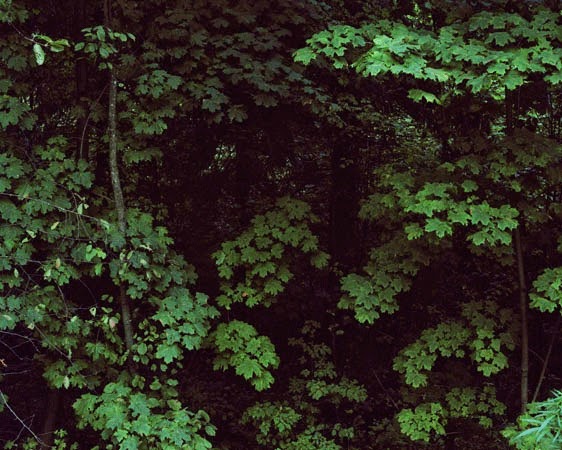
Indrė Šerpytytė is one of the artists currently showing as part of Conflict Time Photography exhibition at Tate Modern. In one of the rooms (towards the end) she is showing wooden carvings of KGB interrogation houses and their studio "portraits". Refreshingly, her take on Lithuanian history is a non-judgemental, non-sentimental commentary with plenty of gaps and empty spaces for the viewer to fill in. My favorite works, however, are those from Forest Brothers series: dense treescapes, suspended between the world of Hansel-and-Gretel-fairy-tale fear of the dark forest and an honest link with factual landscape of the post-war Lithuanian resistance fighters. Less is more.


↓  procrastinating

The final good news is called WIKIGALAXY. Computer science MA(!) student Owen Cornec put together this galaxy-style visualisation of tens of thousands of Wikipaedia pages to help you get lost down even more rabbit holes of useless but fascinating information. While drifting aimlessly among his 3D paths linking various concepts, I did wonder if this could be called a binding. If the metaphor of book can extend into the digital reading media, could we not extend the notion of binding too, to denote the ways that keep separate pages of digital information together? 


[Egidija]


Wednesday, 3 December 2014

scrolling gadgets {moving panoramas}

http://www.frieze.com/issue/review/tomas_saraceno/
Tomas Saraceno, Cumulus at Barbican


↓↓↓

Some time ago I wrote a post digitised scrolls: from the Pond at Deuchar to the Trip to London, at the bottom of which I mentioned a charming Georgian device Trip to London that had been digitised by Princeton University. Trip to London is a box containing a twelve plate scroll that displays a humorous story of a honeymoon trip. It is a close development of the very popular moving panoramas, which came to Europe in late 17th century and by early 19th century they were so common, that there were even ladies' fans with miniature scrolled pictures incorporated into the designs. 


Trip to London

↓↓↓


Moving panorama - to put it simply - is a long panorama in a scroll, which has ends of it attached to two rods. The handles on the rods are then turned to allow the panorama to move across the screen, very much like a basic animation film. Moving panoramas were available in handheld scrolling devices as well as a form of large screen/stage entertainment. They were hugely popular: successful shows drew crowds and boasted years of performances. For example, Albert Smith's Ascent of Mont Blanc was performed for seven years at the Egyptian Hall in London, while Hugo d'Alesi's Mareorama allowed seven hundred spectators per viewing of this show, that offered a multisensory sea voyage illusion, complete with thunder, wind and local dancers.


a card promoting Hugo d'Alesi's Mareorama


Moving panoramas were extraordinary pieces of engineering. They often featured special enhanced sets and effects, merging of medias and mediums into one immersive spectacle. For example, touring panoramas of the late nineteen century England frequently included such novelties as mechanical puppets and slide projections. The most impressive ones, of course, were present at Exposition Universelle in Paris, 1900. The above mentioned Hugo d'Alesi's Mareorama incorporated two screens, each 2,500 feet long and forty feet in height, which were scrolled for the viewers present on board of the full size boat. The boat required hydraulic piston engines and pumps driven by electric motors to stimulate motion. 


Hugo d'Alesi's Mareorama


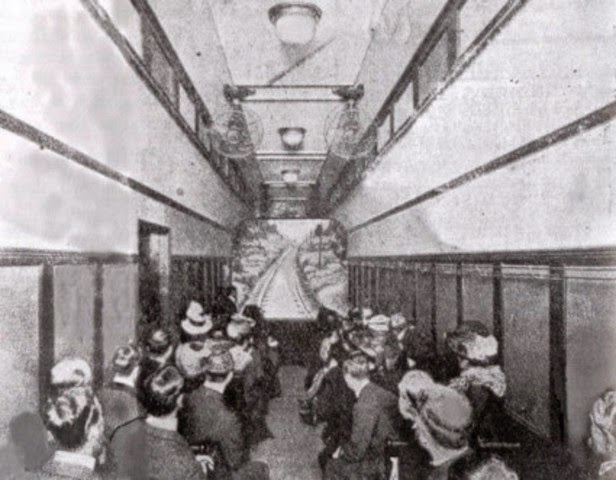
Another immersive panorama at Exposition Universelle in Paris was Pavel Yakovlevich Pyasetsky's Great Siberian Railway Panorama in the Russian pavilion. It offered a 45 minute experience of Trans Siberian rail journey complete with stuffed polar bears on papier-mache icebergs, a dinner of caviar and sturgeon in a luxury imitation train with a library, gymnasium, marble bath, smoking and music salons.


This 45-minute experience was an essay in detail. It offered a chance to experience the 14-day journey by rail from Moscow to Peking, a 6300-mile journey over tracks not yet completed at the time of the Paris Fair of 1900.
There were three realistic railway cars, each 70 feet long, with saloons, dining rooms, bars, bedrooms, and other elements of a luxury train. Totally detailed and lavishly equipped, the cars were elevated a little above a place for spectators in conventional rows of seats. The gallery faced a stage-like arena where the simulated views along the train trip were presented by an inventive contraption.
The immediate reality of a vehicular trip is that nearby objects seem to pass by more rapidly than distant ones. So, nearest to the participants was a horizontal belt covered with sand, rocks, and boulders, driven at a speed of 1000 feet per minute! Behind that was a low vertical screen painted with shrubs and brush, travelling at 400 feet per minute. A second, slightly higher screen, painted to show more distant scenery, scrolled along at 130 feet per minute. The most distant one, 25 feet tall and 350 feet long painted with mountains, forests, clouds and cities, moved at 16 feet per minute.
Real geographical features along the way were depicted on this screen: Moscow, Omsk, Irkutsk, the shores of great lakes and rivers, the Great Wall of China, and Peking. The screens, moving in one direction only, were implemented as a belt system. Due to the inexact speeds of the scenery,the 'journey' never repeated itself exactly, providing an ever-changing combination of scenes and a reason to pay to see the attraction again.  (from The Past Was No Illusion  by Walt Bransford)


Pavel Yakovlevich Pyasetsky's Great Siberian Railway Panorama

↓↓↓


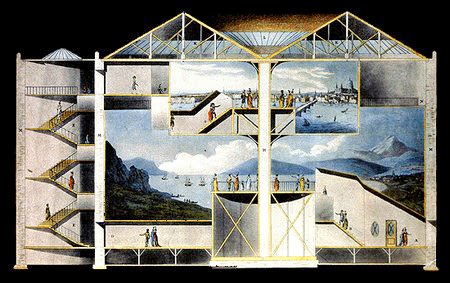
Apart from the great spectacles at Exposition Universelle, 1900, there was a range of other - more common and more humble - weird and wonderful panorama devices. There existed pleoramas, dioramas, padoramas, myrioramas, phantom rides for public viewing as well as personal hand panorama reels, magic lanterns and peep-shows.


http://dip9.aaschool.ac.uk/references/
The Kaiserpanorama, 1900
http://motherboard.vice.com/en_uk/blog/remembering-the-human-gopros-that-gave-the-world
Phantom Ride
https://ore.exeter.ac.uk/repository/handle/10472/2843
Rotunda, Leicester Square
https://ore.exeter.ac.uk/repository/handle/10472/212
Coronation Procession of King George IV
https://ore.exeter.ac.uk/repository/handle/10472/4717
Tableau of the procession at the Queen's coronation June 28, 1838
http://writhingsociety.blogspot.co.uk/2010/02/myriorama.html
Myriorama or tableau polyoptique by Jean-Pierre Brès
(a set of cards that can be arranged in any order)


↓↓↓


Here are a few of the contemporary moving panoramas that range between overwhelming digital installations of Tomas Saraceno to painted paper scrolls of Adam Cvijanovic.

http://helendouglas.onlineculture.co.uk/ttp/ttp.html
Helen Douglas, The Pond at Deuchar
http://www.frieze.com/issue/review/tomas_saraceno/
Tomas Saraceno, Cumulus at Barbican
https://erindziedzic.files.wordpress.com/2013/09/rolling-panaorama-1_cvijanovic.jpg
Adam Cvijanovic, Rolling Panorama Number 1
http://upload.wikimedia.org/wikipedia/commons/8/8d/Panoramic_View_of_Old_City_lane_%28Pole%29_Ahmedabad.jpg
Panorama of Achmedabad


 ↓↓↓


The Trip to London scroll box is a story telling gadget that bridged book and upcoming cinema. It's situation is not dissimilar to the hybrid publishing projects emerging today as a result of media arts niche-ing themselves into the book market, such as FakePress and HybridBook. Moving panoramas were defeated by the cinema, of course. Which of the contemporary story telling gadgets are going to stay?


↓↓↓


Printed book sources:
- Schwartz, Vanessa. Spectacular Realities: Early Mass Culture in Fin-de-siecle Paris . Berkeley: University of California Press, 1998.


[Egidija]


Wednesday, 19 November 2014

words to be read aloud

Often we talk about what goes into a book but not the potential the book has to broadcast outside of itself. There is a performance element to the book that leads it to be read.  I am going to be exploring an artist whose main concern is text as it is read and also exploring the book as a performance space to be read from. 


Liliane Lijn works with text as it should be read. Though not within a book, the way she explores reading is fascinating. I think the way that reading is controlled and paced through her sculptures has a lot in common with the book.  Poem cones with words printed on rotate, so that words near the top where the cone is narrower move slower and words near the bottom where the cone is wider move faster. This affects your ability to read and controlling your experience of language, in a very similar way that a book may pace your experience of the text. But they challenge the nature of reading and what is able to be read. Words still exist but they blur then come into focus, forcing you as a viewer to distinguish between reading and seeing.


Another peice of work I would like to look at is: 'An Exhibition to Hear Read'. Where the book is used to be read from and broadcast out. Where reading is used to fil the space.
'An exhibition to hear read proposes the notion of speech as material gesture, in which both the texture of the word and its spoken quality are inscribed in space and time through the act of reading.  The vocal interpretation of these artworks constructs an abstract and ephemeral reality that can be said to sculpt the spaces in which it occurs. This ongoing investigation into the materiality of artwork as a question of word and speech is crystallized through a series of publications that act as both score and memory.' (Matieu Copeland)


The book here is one of the most important parts. It facilitates reading and in reading it opens itself up to a much larger space than it contained before. 

I think that I am now going to start thinking about my work in terms of how it might be read. At least in terms of how it can be read aloud. How can this change the work and can it be to its advantage. It takes the personal experience of the book and relays it as a communal one. In a way the reader claims the text that they are reading and reveals it as a performative act. Almost as if they are actors performing a script. 

I will leave you with a performance piece by Matteo Fargion called songbook which consists of a songbook that the dancers use to direct themselves.  The performance is both about the songbook as direction and the performers who act. As a result you are reading the songbook though interpreting the performance:


[George]

__________

Links:

http://www.ica.org.uk/whats-on/poor-old-tired-horse

http://www.lilianelijn.com/

http://www.mathieucopeland.net/

http://annesylviehenchoz.prosite.com/119822/643405/projects/an-exhibition-to-hear-read

http://www.siobhandaviesreplay.com/record.php?id=3105


Wednesday, 12 November 2014

#metadata #narrative #archive


↓↓↓


The images on this page are generated by "visually similar" Google image search for brass pull cord bayonet type lightbulb lamp holder traditional earthed.  An algorithm pulled them out from the vast archive of Google images for me. 

Somebody said that digital database defines the 21st century.


↓↓↓


A couple of weeks ago Books in Browsers 2014 took place in San Francisco. Most of their talks are now available on YouTube, including the one from Johanna Drucker Database Narratives in Book and Online. She gives a neat introduction into what she believes to count as a book*. She then admits homicidal feelings towards those who think otherwise, and continues with her fascinating talk on the structuring of a narrative as an online database and a consecutive print output.

At the core of Johanna Drucker’s talk is her personal project, where she attempts to reign in the archive of her unpublished works, the records of which span about 40 years of writing. In the process of this experiment she scans her unpublished works to create an online representation of the library and to explore it’s relationship to the potential printed book as well as the original manuscript. She works in xml format and her archive is heavy with metadata. Metadata fields, she says, allow to structure multiple kinds of chronological and temporal organisational filters: they allow to redistribute literal temporality built into most of the narratives.
Johanna Drucker talks about the relationship between the networked resource and a printed output. What would the role of the printed book be in relation to the database? Is it a catalogue of the archive? Is it a guidebook? Is it an interface providing an augmented experience of the web environment?

Those questions, of course, can be asked about any book published from a database. Wolfgang Ernst in his essay The Archive as Metaphor** observes that archive as such does not contain narratives: it is a purely technical practice of data storage.
The archive does not tell stories; only secondary narratives give meaningful coherence to its discontinuous elements. In its very discreteness the archive mirrors the operative level of the present, calculating rather than telling. In the archive, nothing and nobody ‘speaks’ to us – neither the dead not anything else. The archive is a storage agency in spatial architecture. Let us not confuse public discourse (which turns data into narratives) with the silence of discrete archival files.
When traditional paper archives migrate into digital forms, their contents get reduced to a binary code. As a result, computer stops separating stored file information and processing rules (as in traditional archives).
When both data and procedures are located in one and the same operative field, the classical documentary difference between data and meta-data (as in libraries, where books and signatures are considered as two different data sets) implodes.
Digitalised memory undoes the traditional supremacy of letters in paper-based archives; instead, sound and images enter as well which can be addressed in their own medium: melodies can be retrieved by similar melodies, images by images, patterns by patterns.
Metadata allows to break the syntagmatic relationship between the items in the traditional database, in favour of highlighting paradigmatic links. While a collection of data in its own right has no narrative, it is how we travel through the archive: how we connect its fragments and how we fill in the gaps, that gives linearity to the experience. 
Is clever manipulation of metadata enough to function as a guide for the reader? Or would database benefit from a printed interface providing an augmented experience of the web environment?


↓↓↓


An expansive volume of writing and artwork is available on the subject of archives, database generated narratives, collaborative authorship, etc. Below I have chosen a couple of works and texts that I had found fascinating:

art:  
Listening Post by Mark Hansen and Ben Rubin  
Pockets Full of Memories by George Legrad
Postcards From Google Earth by Clement Valla
I’m Google  by Dina Kelberman. (I did not get to the end of it. If you do, can you let us know what’s there at the bottom?)
Girls on White by Rebecca Lieberman

articles/(almost)books:
Lev Manovich : Database as a Genre of New Media
Wolfgang Ernst : Digital Memory and the Archive
Wolfgang Ernst : The archive as metaphor ** 
Brooke Belisle : Total Archive: Picturing History from the Stereographic Library to the Digital Database
 D|N|A: Seven Interactive Essays on Nonlinear Storytelling

Other almost relevant links: 
The Internet Archive
UK Web Archive
-
oScope visual search
TinEye multicolour search
retrievr search by sketch 
Musipedia melody search


* Book is a a structured sequence of intertextual components that have a structural relationship to each other, each of which is coded in order to participate in the semantic field of the book as a whole.


↓↓↓


Wednesday, 29 October 2014

considering the spine


''The spines of books on our shelves form a visual database. Continuing the cover image over the spine should remind us of the cover - and the contents of the book.' Derek Birdsall - Notes on Book Design
I have recently become very interested in the spine of a book. Both from a design point of view and an artistic one. I think it has something to do with spending the whole day in the Philosophy Library in Cambridge for the 'in the reflected sky' project. We had a list of the books we were interested in, with thier dewey decimal number and spent the day wandering along the shelves finding the books. The fist contact you would have with a book is when you grabbed its spine and pulled it out. The whole experience of the book, at least in this setting is hinged on the spine and as I sit here looking at my own bookshelves, it is a mass of coloured lines with the concentrated contents of the books all facing out. It is interesting to think of the 'face' of the book not being the cover which is rarely seen from day to day but the spine. 

I have come across an artist called Buzz Spector, who has made a body of work that is about the familiarity and relationship to your own personal library. Looking at the archive of books that you surround yourselves with. Why I thought he was interesting for this post is that his work seems to me, to be about the book spine. The spine being the point of contact.

'My work is abstract: it derives from things in nature or things in culture, but it's meant to be understood in terms of the excavation or displacement of its objects from their situations.'


In this image Spector has stacked a reconfigured books from his own library. In a way that removes all connection with content the book, it is just about its form. The way the pages fall and lie flat. The only constant being the spine, which becomes a repeated hollow linking them all together. 


In this installation 'Unpacking my library' Spector has arranged his books in order of the height of the spine, from tallest to shortest, on a single shelf in a room large enough to hold them. For me this has focused in on the spine being the centre of the book. Seeing the mass of books arranged in this way you are made aware of how important the spine is. Though this work is a personal collection of books the books themselves are presented as objects. It is the personal connection with the object itself on the shelf that is important, this point of contact. 


I want to also take a look at some design considerations when looking at the spine. The design of the spine changing the colour and look of our bookshelves. Having an interest in design it is always interesting to see what considerations the deigner has had. 


Two book projects by the deigner Derek Birdsall I find particulary interesting. For a collection of Penguin Education books Birdsall was given the task of dsigning the covers. Here he has used the width of the books to determine the size of the type on the spine. Seen together the literal weight of the book is represented by the weight of the type. Giving the spine a prominece in the whole design of the book. 'The titles were the thing, and I decided to exploit the varying spine widths typographically'


Here the spine of the book is central to the design. With the image making reference to the structure of the book and vice versa. 'I carefully placed the groom's hand to rest on the spine of the horse and the book'. It is a playful game with the anatomy driven precision of Stubs' paintings and the formal tradition of bokbinding. 


So now when you are next in a library or just gazing at your bookshelves take some time to consider the spine. Not just as a carrier of the books infomation but as that first contact you have with the book. The spines facing out on the world waiting for you to grab them. 

[George]

Refrences / Further Reading

- notes on book design, Derek Birdsal, 2004