Showing posts with label imagining. Show all posts

Wednesday, 27 May 2015

against veneration: faux books


Maitland-Smith Aged Regency Finished Mahogany And Lacquer Occasional Table, Leather Faux Book Drawers


***


at Marché aux Puces de Saint-Ouen, Paris

On Monday, in Marché aux Puces de Saint-Ouen I noticed a piece of furniture in a row of decomposing wardrobes: a disintegrating drinks cabinet with a decaying faux books panel. €1200. Needs some restoration.
The faux books were not blank. Even though the titles were generally illegible, three of them read MUSEE DE VERSAILLES(?) 18XX-18XX and one of them read XXXXX DE MAISON. The cabinet was probably made at the turn of the century, possibly commissioned by a middle class Parisian who wished to be seen as the sort of person who might have offered you a glass of fashionable absinthe from the cabinet to complement an erudite conversation in a backdrop of books. After all, in iconographical tradition, book is a symbol of power and knowledge.

Faux books are a 19th-century phenomenon, unsurprisingly: born in the century of emerging optical spectacles, curiosity cabinets and all things magical.


Faux books are an Edwardian novelty. Often made of fine jewel-toned leathers with Moroccan leather binding and gold tooling, they usually filled library or study shelves in the homes of the well-to-do. When financial difficulties arose, the faux books were sold to help recoup losses. Cabinetmakers and designers quickly realized the potential in recycling these books-by-the-yard for their decorative and prestige value. Maitland-Smith, the first to incorporate the book motif into modern-day furniture, adheres to many of the norms of library binding in this coffee table and its other book-related items. (Architectural Digest, Volume 61, p 212.)
Maitland-Smith Stacked books coffee table with drawers.
Then there are faux libraries. Many faux libraries might be pointless (library interior in a restaurant?) and/or vain, however British Museum has something different - an entire The Kings Library, Age of Enlightenment exhibition room is composed of replica book spines, produced by FAUX BOOKS: they created exact replica book spines so that genuine books could be placed in environmentally controlled storage.


The newest addition to fake books are, of course, the reading tablet covers, which copy the aesthetics of codex books - sometimes even graphics and library stickers -  to imitate the real covers.


The British Library e-book covers.


Run For Cover PVC e-book covers.

Like that 19th century Parisian, 21st century faux book e-reader-cover owners wish to be seen as the sort of people who own and read books. 

 *** 

A portrait of a man with an iPad may imply a modern man with a knowledge of technology, but it does not hold the same symbolism as a portrait of a man with a book. Even if it is a fake one.


[Egidija]


References:
FAUX BOOKS: http://www.fauxbooks.co.uk/faux-books/
Architectural Digest, Volume 61, p 212. 


Wednesday, 4 February 2015

→ reading imagining picturing procrastinating


New Focus arrived today. While Bible might be delivering good news for some parts of population, in our house - it's Focus. Today's issue alone is going to take a few bubble-baths of reading. So what's the good news of today? 


↓  reading

First of all, Einstein's collected papers are available online through Princeton university - a very clearly structured interface for accessing some of the most extraordinary pieces of writing of the 20th century. For example, one can now dip into a delightfully lyrical world of Einsteinian letter-writing, such as this one he sent to Mrs Curie in 1913.


http://einsteinpapers.press.princeton.edu/vol5-trans/354


"A few days have passed since the wonderful profusion of things rushed past me. The fibrils of my brain must still be in terrible disarray from all of that...." 
If science can be poetic - Einstein has certainly nailed it - of course, among a few other facts that he had nailed rather well too. Such a pleasure to read! I only wish the texts were complemented by the scans of the originals.


↓  imagining

The second bit of great news is that...  everything is in the head. Apparently, carrying out five sessions of imaginary exercise per week had positive effects on developing grip-strength in volunteers at Ohio University. No sweaty armpits, no chlorine soaked hair, no shin splints - only five imaginary sessions which, I could perform from a hammock under linden trees.


↓  picturing

Third - not entirely everything is in the head, as page 81 suggests. Why do we get a mental picture when reading? Or - why don't we? 
Visual and auditory areas of your brain are at work when you read, as you subvocalise the words when one of the characters is speaking... All of this contributes to what we think of as pictures in our head - yet in reality our brains probably contain no such thing. Indeed, recent theories treat vision more like an activity or interaction with the world rather than a picture-making process. Oddly enough, more detailed written descriptions may not result in richer or more satisfying mental imagery. Sometimes, the simplest descriptions allow you to create your own imagined world with far more detail and emotional involvement. 
 Less is more, they suggest. It is more emotionally satisfying to be involved in creating a personalised mental imagery. This satisfaction is probably what explains the allure of haiku poems and artists such as Hiroshi Sugimoto and Indrė Šerpytytė. 

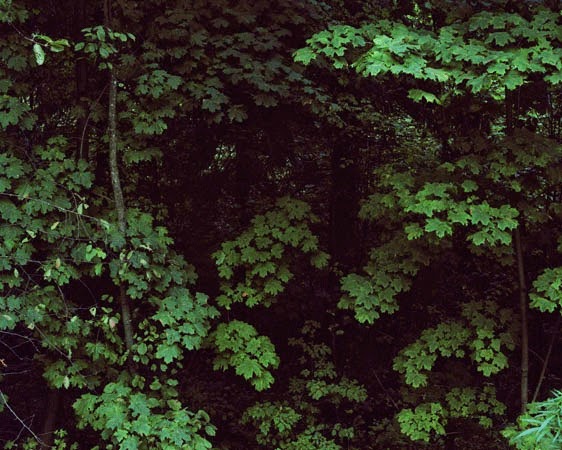
Indrė Šerpytytė is one of the artists currently showing as part of Conflict Time Photography exhibition at Tate Modern. In one of the rooms (towards the end) she is showing wooden carvings of KGB interrogation houses and their studio "portraits". Refreshingly, her take on Lithuanian history is a non-judgemental, non-sentimental commentary with plenty of gaps and empty spaces for the viewer to fill in. My favorite works, however, are those from Forest Brothers series: dense treescapes, suspended between the world of Hansel-and-Gretel-fairy-tale fear of the dark forest and an honest link with factual landscape of the post-war Lithuanian resistance fighters. Less is more.


↓  procrastinating

The final good news is called WIKIGALAXY. Computer science MA(!) student Owen Cornec put together this galaxy-style visualisation of tens of thousands of Wikipaedia pages to help you get lost down even more rabbit holes of useless but fascinating information. While drifting aimlessly among his 3D paths linking various concepts, I did wonder if this could be called a binding. If the metaphor of book can extend into the digital reading media, could we not extend the notion of binding too, to denote the ways that keep separate pages of digital information together? 


[Egidija]